

A new research report on Provaris Energy Ltd (ASX:PV1, OTC:GBBLF, FRA:WS90) has highlighted the company’s expanding exposure to carbon capture and storage (CSS) infrastructure, arguing the opportunity could provide an earlier commercial pathway alongside its established hydrogen shipping strategy.
In a note released on Thursday, Longspur Research said the market had not fully appreciated the value of Provaris’ move into liquid CO2 storage and transport infrastructure, particularly as Europe accelerates development of carbon sequestration projects.
Longspur assigned Provaris a revised central case valuation of A$0.11 per share, including A$0.04 attributed specifically to initial CO2 projects, compared with the company’s recent trading price of about A$0.01 per share.
Longspur said the CO2 opportunity could also generate earlier commercial revenues than Provaris’ hydrogen projects, helping validate the company’s proprietary tank technology and broader infrastructure model.
“With countries such as Norway moving ahead with the development of carbon sequestration, the need for solutions such as that provided by Provaris becomes immediate,” the report stated.
“With committed partner funding development, we see the CO2 opportunity as providing near term monetisation for the Provaris IP and complementing the large-scale hydrogen tank opportunity.”
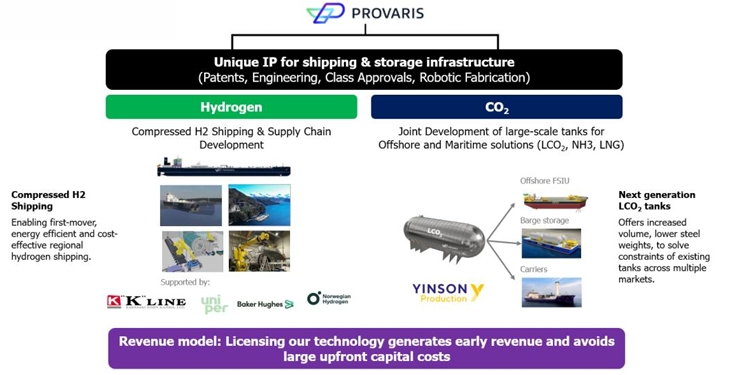
Hydrogen and CO2 Working Together at Provaris.
Carbon capture partnership moves into FEED stage
A major focus of the report was Provaris’ partnership with offshore energy infrastructure group Yinson Production, which is developing CCS infrastructure linked to projects in Norway.
The companies originally signed a joint development agreement in 2024 to adapt Provaris’ compressed hydrogen tank designs for liquid CO2 storage and transport. The work is centred on developing a 25,000-cubic-metre (cbm) low-pressure tank for use in floating storage and injection units (FSIUs), carriers and offshore terminals.
Longspur said the project had now advanced into front-end engineering and design (FEED), with Yinson funding development costs through to commercialisation.
The report highlighted Yinson’s acquisition of Norwegian CCS developer Stella Maris earlier this year, giving the partnership direct exposure to the Havstjerne sequestration project on the Norwegian Continental Shelf. The project is targeting operations by 2030 and is expected to have CO2 storage capacity of around 10 million tonnes per annum.
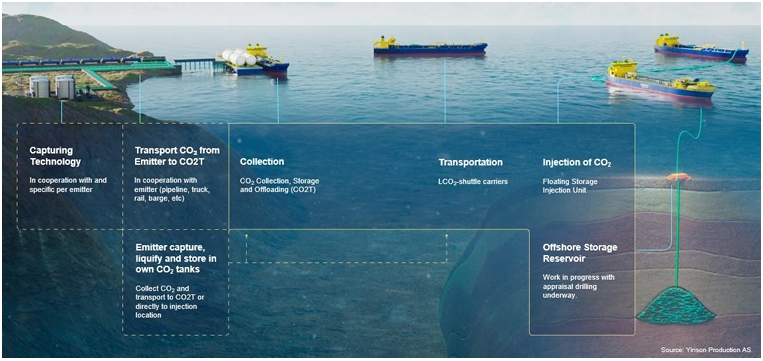
Infrastructure planned for the Havstjerne CCS project.
Longspur argued that involvement in a real-world CCS project materially strengthened Provaris’ commercial positioning.
“Concept selection has now been made for the FSIU, carriers and terminal storage using based on the Provaris low-pressure 25,000 cbm capacity tank,” the report noted.
Larger-scale CO2 shipping seen as competitive advantage
The report also suggested Provaris could hold a technical advantage over existing CO2 shipping concepts being developed in Asia.
Longspur said most currently available low-pressure liquid CO2 shipping designs rely on multiple smaller Type C tanks with capacities of roughly 6,000–7,000 cubic metres. By contrast, Provaris is targeting much larger tank configurations designed for 30,000–50,000 cubic metre carriers.
According to preliminary designs referenced in the report, a 50,000-cubic-metre Provaris carrier could operate using just two tanks, compared with six or seven tanks in competing concepts, potentially improving cargo capacity, vessel efficiency and capital costs.
The broker also pointed to growing interest from Asian shipowners following a regional roadshow completed with shipping adviser Clarksons in 2025.
Europe and Asia driving CCS growth
Longspur’s report argued broader policy momentum around CCS was creating a potentially large long-term addressable market for Provaris.
Norway remains one of the key focal points, with the country estimated to hold Europe’s largest CO2 storage capacity at roughly 29 gigatonnes. The report also highlighted growing CCS support in Germany, the UK, Denmark and the Netherlands.
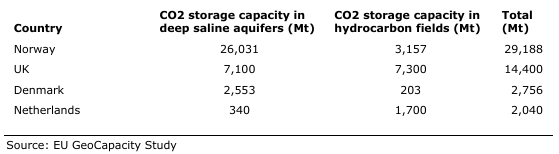
Estimated Storage Capacities of largest European countries.
In Asia, Japan and South Korea have both introduced new CCS legislation and storage targets, while Australia and New Zealand are updating regulatory frameworks to support carbon import and storage projects.
Longspur said those developments were occurring alongside broader growth in carbon dioxide removal markets and increasing support for carbon credit mechanisms internationally.
Hydrogen story remains central
Despite the growing emphasis on CO2 infrastructure, Longspur said hydrogen transport remained central to the broader Provaris investment thesis.
The company continues developing proprietary compressed hydrogen shipping and storage systems designed for regional export markets, particularly in Europe. Longspur described Provaris’ approach as one of the more efficient solutions for hydrogen transport over shorter marine distances.
The report acknowledged several risks, including project financing, development timelines, vessel approvals and broader uncertainty around the pace of hydrogen market adoption.
But Longspur ultimately argues that the addition of carbon capture infrastructure significantly broadens Provaris’ commercial opportunity — and could provide an earlier pathway towards revenue generation as global CCS investment accelerates.
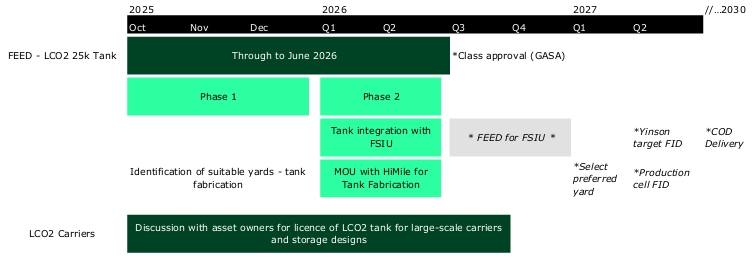
Provaris CO2 development timeline.


