

Maritime transport carries more than 80 percent of global merchandise trade by volume, making it the backbone of global supply chains.[1] At the same time, international shipping accounts for around 3 percent of global greenhouse gas emissions, making it one of the most difficult sectors to decarbonise.[2] The International Maritime Organization’s (IMO) 2023 Revised Greenhouse Gas Strategy established a pathway towards net-zero emissions from international shipping by or around 2050, while regional measures such as the European Union Emissions Trading System (EU-ETS) and FuelEU Maritime are accelerating demand for cleaner fuels and lower-emission shipping operations. These policy shifts are reshaping competition across the maritime sector by linking shipping emissions to production of clean fuels and the availability of lowcarbon port infrastructure.
India and South Korea also face a growing domestic imperative to decarbonise their maritime sectors.
According to their respective submissions to the United Nations Framework Convention on Climate Change (UNFCCC), India’s maritime activities, including international fleet bunkering, emitted over 6.4 million tonnes of CO₂e,[3] while South Korea’s domestic and international navigation emitted approximately 38.4 million tonnes of CO₂e in 2022.[4]
These developments indicate that maritime decarbonisation is no longer a question of improving vessel efficiency but increasingly depends on two interdependent energy value chains: the first centres on the production, storage and supply of low-carbon marine fuels, including green hydrogen, ammonia, and methanol; while the second focuses on transforming ports into energy hubs capable of electrifying port operations, supplying shore power, and supporting alternative fuel bunkering.
Alternative Maritime Fuels
Heavy fuel oil has powered global shipping for decades because of its high energy density and suitability for long-distance ocean transport.[7]
However, the IMO’s decarbonisation pathway and emerging fuel regulations are accelerating interest in green ammonia and green methanol, both of which are increasingly viewed as leading candidates for deep-sea shipping.
Green ammonia has emerged as a leading long-term option for deep-sea shipping because it contains no carbon and offers notably higher volumetric energy density than hydrogen while avoiding the need for cryogenic or high-pressure storage systems.[8] Green methanol, by contrast, is easier to handle using existing fuel infrastructure but requires a sustainable carbon feedstock, which can be derived from captured CO₂ (e-methanol) or from biomass-derived carbon (bio-methanol), making large-scale production more complex despite its operational advantages.[9]
For ports, these fuels represent more than a decarbonisation pathway. Green hydrogen and its derivatives—like green ammonia and green methanol—can reduce emissions from port operations while creating entirely new revenue streams through fuel bunkering and exports.10 Realising this opportunity, however, will require new storage and transmission infrastructure, dedicated safety standards, large-scale in[10]vestment, and coordinated regulatory frameworks to enable ports to become integral nodes within the emerging green hydrogen economy and contribute to a broader energy transition.[11]
India’s comparative advantage lies upstream in producing these future maritime fuels. The National Green Hydrogen Mission identified Deendayal Port (Kandla), Paradip and V.O. Chidambaranar (Tuticorin) as Green Hydrogen Hubs to integrate renewable energy, hydrogen production, and maritime applications.[12] India’s competitive renewable energy costs have already translated into some of the world’s lowest discovered prices for green hydrogen and green ammonia, strengthening its prospects as a future exporter of zero-carbon maritime fuels.[13] This ambition is reinforced by the Harit Sagar-Green Port Guidelines, which require all major ports to establish green ammonia bunkering and refuelling facilities by 2035.[14]
There have been many noteworthy developments at the Deendayal Port Authority: in 2025, a 1-megawatt (MW) electrolyser-based green hydrogen plant was commissioned, while India’s first shore-to-ship methanol bunkering demonstration was completed in April 2026, and the port aims to supply around 500 kilo tonnes per annum (KTPA) of Renewable Fuels of Non-Biological Origin (RFNBO)-compliant e-methanol by 2028–29, with plans to scale hydrogen production to 10 MW.[15]
India has begun embedding this transition within its maritime strategy. With nearly 95 percent of the country’s trade by volume moving through sea routes, ports are strategic gateways for economic growth and international trade.5 The Maritime Amrit Kaal Vision 2047 thus positions green fuels, carbon-neutral ports, and maritime decarbonisation as strategic priorities aligned with the IMO’s net-zero agenda.
Similarly, South Korea has embedded maritime decarbonisation within its national policy framework. In 2026, the National Assembly passed the Green Shipping Corridor Support Act to accelerate low-emission shipping routes and support port infrastructure.6 Together with Korea’s leadership in shipbuilding, this legislation positions the country at the forefront of next-generation maritime technologies. It is home to three of the world’s largest shipbuilders—HD Hyundai, Hanwha Ocean, and Samsung Heavy Industries— and remains a global leader in the construction of Liquefied Natural Gas (LNG)-, methanol-, and ammonia-capable vessels.
Against this backdrop, India and South Korea possess complementary capabilities across the emerging maritime energy ecosystem. India’s strengths lie in renewable energy deployment, emerging green fuel production capabilities, and expanding port infrastructure, whereas South Korea leads in advanced shipbuilding, alternative-fuel vessels, and smart port technologies. This article examines how India and South Korea can jointly build the infrastructure needed for maritime decarbonisation through two interconnected energy value chains: alternative maritime fuels and ports as integrated energy systems; to advance both bilateral cooperation and the broader transition towards resilient, low-carbon maritime networks across the Indo-Pacific.
The V.O. Chidambaranar (VOC) Port has emerged as India’s leading green maritime fuel hub, becoming the country’s first port to produce and utilise green hydrogen onsite while simultaneously developing green methanol and green ammonia bunkering infrastructure.[16] In 2026, AM Green and VOC Port signed an agreement to establish up to 200 KTPA of green ammonia bunkering capacity by 2029–30, positioning it as one of India’s first dedicated green ammonia bunkering hubs.[17]
Paradip Port, meanwhile, is developing a dedicated jetty and allied facilities capable of handling up to 4 million tonnes per annum (MTPA) of green hydrogen and green ammonia and other liquid cargo following approval by the Ministry of Ports, Shipping and Waterways (MoPSW) in February 2026, establishing India’s eastern coast as an export gateway for future maritime fuels.[18]
Figure 1: Major Seaports of India and South Korea
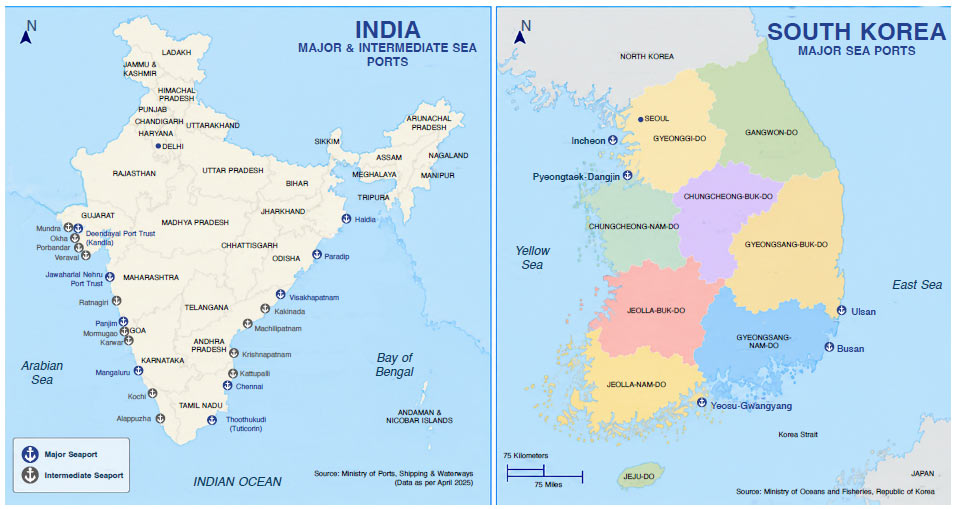
Source: Maps of India and Ministry of Oceans and Fishers, Republic of Korea[19]
South Korea, in contrast, occupies the downstream end of the value chain. It has become a global leader in technologies compatible for utilising low-carbon maritime fuels. Korean shipbuilders are leading the development of ammonia-ready vessels, methanol-powered ships and dual-fuel propulsion systems, while ports such as Busan and Ulsan are developing commercial methanol and ammonia bunkering capabilities.
Busan has completed LNG and methanol ship-to-ship bunkering demonstrations and is preparing for commercial-scale deployment as demand for alternative marine fuels expands.[20]
Under South Korea’s Eco-friendly Fuel Supply Chain Development Strategy, Ulsan has been designated the national hub for LNG, methanol, and ammonia bunkering.[21] In April 2026, Ulsan Port completed the commercial pipe-to-ship (PTS) green ammonia bunkering operation, supplying 600 tonnes of green ammonia to an ammonia-fuelled vessel built by HD Hyundai Heavy Industries. This marked the world’s first commercial application of ammonia as a marine fuel and the first fully established integrated commercial green ammonia value chain from production to end use.[22] Ulsan was also the world’s first port to implement a green methanol bunkering system, and has begun supplying green methanol to ships.[23]
Driven by its 2050 carbon neutrality goals, South Korea is seeking alternative fuels such as hydrogen and ammonia to cut emissions from industry and power generation. As a result, in 2025, South Korea imported US$518 million of ammonia from Indonesia, Saudi Arabia, China, Australia, and Malaysia.[24]
Figure 2: Net Trade Balances in Hydrogen-Based Fuels and Commodities (2025)
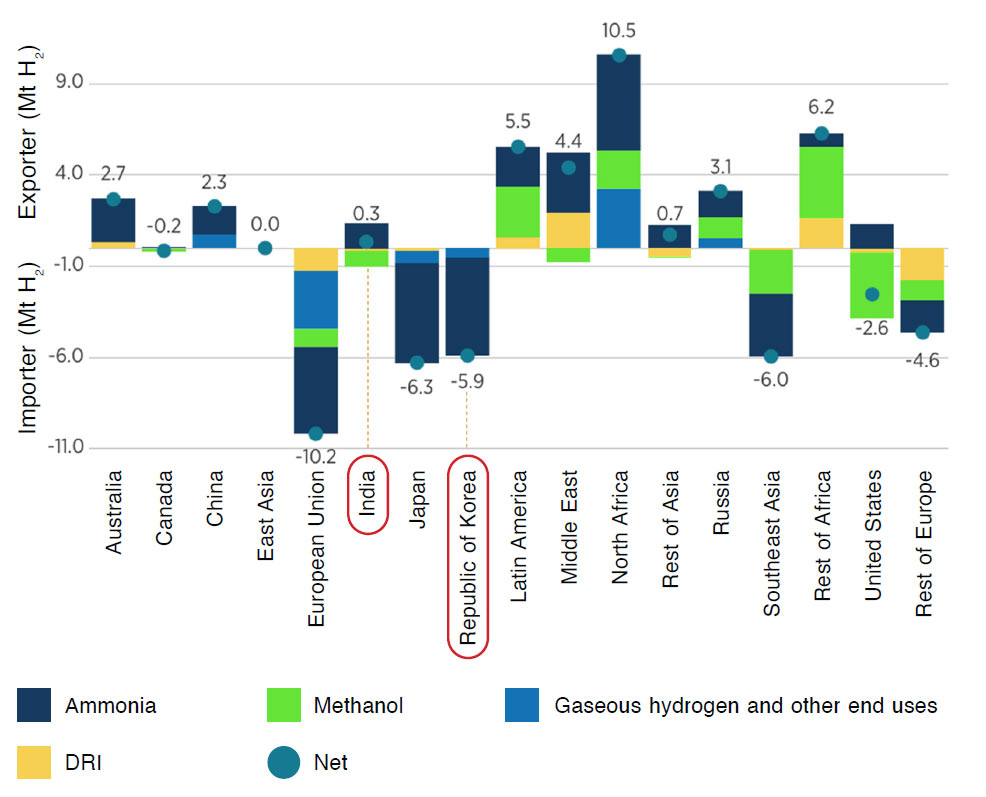
Source: International Renewable Energy Agency[25]
Industrial collaboration between India and South Korea is also emerging in the green hydrogen and ammonia ecosystem. In 2025, South Korea’s KP Group partnered with AHES and India’s GH2 Solar to establish a 100,000 MTPA green ammonia project in India, combining Korean electrolyser technology with Indian renewable energy and manufacturing capabilities.[26]
Further, in March 2026, Reliance Industries and Samsung Construction and Trading (C&T) signed a 15-year agreement worth more than US$3 billion for the long-term supply of Indian green ammonia to South Korea. This creates one of the first largescale commercial linkages between India’s emerging green fuel production base and Korea’s industrial demand.[27] It builds on earlier investments, including the 2024 US$3 billion cooperation agreement between India’s ACME Group and Korea’s LTech UVC to develop green hydrogen and ammonia projects in India.[28]
Taken together, these developments point to a complementary bilateral value chain rather than parallel national transitions. India possesses the renewable resources, production potential, and port infrastructure to become a competitive supplier of green maritime fuels, while South Korea offers globally competitive capabilities in fuel-consuming vessels, bunkering technologies, and maritime engineering. Scaling cooperation across this production-to-consumption chain could form the foundation of an integrated India-Korea alternative maritime fuel ecosystem.
Green Ports as Integrated Energy Systems
Alternative fuels alone will not decarbonise maritime transport unless ports evolve alongside them. As shipping transitions away from conventional bunker fuels, ports are no longer simply logistics gateways but increasingly function as integrated energy systems that generate renewable electricity, electrify port operations, store and bunker low-carbon fuels, and digitally manage increasingly complex energy flows. The transition, therefore, extends well beyond vessel technology to the development of ports capable of simultaneously serving as renewable energy consumers, fuel production hubs, and clean energy distribution centres.
India has begun embedding this systems approach within its broader maritime decarbonisation strategy. The Harit Sagar Green Port Guidelines require major ports to progressively increase renewable energy use to more than 60 percent by 2030 and over 90 percent by 2047. It also mandates the simultaneous expansion of shore-toship power, electrifying cargo-handling equipment, deploying Electric Vehicle (EV) charging infrastructure, and establishing green hydrogen, ammonia and methanol bunkering facilities.[29] They also identify ports as future offshore wind support bases and require infrastructure development for green hydrogen storage and refuelling under the National Green Hydrogen Mission.
Implementation has already begun across several major ports. The VOC, Deendayal and Jawaharlal Nehru Ports are already operating predominantly on renewable electricity, while the Deendayal Port has begun generating surplus renewable power that can support future hydrogen production and port electrification.[30] The New Mangalore Port has achieved 100 percent solar power integration, while the Cochin Port plans to meet around 60 percent of its electricity demand through solar generation by 2030.[31]
Operational electrification is also progressing. At the VOC Port, ABB—a Swedish-Swiss technology company—has commissioned India’s first shore-to-ship power solution, enabling berthed vessels to switch off onboard diesel generators and draw electricity directly from the grid, massively reducing emissions and local air pollution during port stays.[32] The Mumbai Port is also introducing shore-to-ship power infrastructure, while Deendayal Port has deployed electric cargo-handling equipment in line with the Harit Sagar Guidelines.[33]
Under the Green Tug Transition Programme (GTTP), four major ports (Jawaharlal Nehru, Deendayal, Paradip, and VOC) will introduce battery-electric harbour tugs during the first implementation phase (2024–2027), before progressively adopting hydrogen, methanol, and ammonia-based propulsion technologies.[34]
At the same time, the Maritime Development Fund, with an allocation of approximately US$3 billion, is intended to support shipbuilding, green vessels, port infrastructure, and energy-efficiency investments, providing an important financing mechanism for India’s wider maritime energy transition with key timeline targets in 2030 and 2047.[35]
South Korea’s policy increasingly frames ports as integrated energy hubs where renewable power generation, energy storage, alternative fuel infrastructure, and digital optimisation operate as a single system. This approach is reflected in the International Shipping Decarbonization Promotion Strategy (2023), the Hydrogen Port Master Plan, and the Carbon Neutral Port Master Plan, which together promote renewable-powered port operations, expanded onshore power supply (OPS), alternative fuel infrastructure, and intelligent energy management.[36]
The electrification of port equipment without the decarbonisation of electricity supply merely shifts emissions from ports to the power sector, constituting what experts call “emissions externalization”.[37] This leads to a stronger emphasis on coupling port electrification with renewable energy deployment, distributed generation, and microgrids.
The Busan Port’s Global Hub Port strategy accordingly targets renewable electricity generation equivalent to 25 percent of port demand by 2032 and 100 percent by 2050, alongside expanded solar generation, offshore wind integration, fuel cells, and alternative marine power infrastructure.[38] In 2025, the Busan Port Authority launched the country’s first state-owned all-electric ferry−powered by ABB’s end-to-end electric propulsion system−as part of a national programme to replace 140 state-owned vessels with cleaner alternatives by 2030.[39]
Meanwhile, Incheon Port has established Korea’s first charging infrastructure for electrified cargo-handling equipment and is progressively electrifying yard tractors, forklifts, and other terminal machinery, while Busan Port Authority is integrating electricity demand forecasting, renewable energy planning, and digital energy management into future port expansion.[40]
Korea’s experience also reveals that the limitations of the wider energy system is a key factor that hinders port electrification. Although renewables accounted for 11.4 percent of national power generation by the end of 2025,[41] ports remain heavily dependent on the Korea Electric Power Corporation (KEPCO) grid. Transmission bottlenecks and limited renewable energy access constrain deeper decarbonisation.[42] These challenges have reinforced policy attention towards renewable energy procurement, microgrids, distributed power systems and intelligent energy management. This positions ports not only as major electricity consumers but also as strategic renewable energy off-takers within the broader energy transition.
India’s comparative advantage lies in renewable electricity generation, land availability, and the expansion of new port infrastructure, while South Korea offers world-leading capabilities in port engineering, electrification technologies, digital energy management, and smart port operations. These capabilities, when integrated, suggest that future India-Korea cooperation should extend beyond individual technologies towards the joint development of integrated green port ecosystems capable of supporting both maritime decarbonisation and wider regional energy transitions.
From Complementarity to Partnership
Rather than viewing shipping, ports, and fuels as separate domains, both countries have an opportunity to jointly develop an integrated maritime energy ecosystem spanning fuel production, vessel technologies, port infrastructure, and regulatory frameworks. Existing institutional arrangements, including the India-ROK Comprehensive Framework for Partnership in Shipbuilding, Shipping and Maritime Logistics and the recent Memorandum of Understanding (MoU) between India’s MoPSW and Korea’s Ministry of Oceans and Fisheries, provide an institutional foundation for such cooperation.[43]
• Enhanced Cooperation on Joint Value-chain Development
Rather than pursuing isolated investments, both governments could work towards an India-Korea Green Maritime Energy Partnership centred on alternative maritime fuels and green port infrastructure. Existing commercial agreements, including the long-term Reliance Industries-Samsung C&T green ammonia supply agreement and emerging India-Korea hydrogen investments, demonstrate that industrial demand and commercial interest already exist.[44]
• Jointly Demonstrate Integrated Maritime Energy Systems
Beyond piloting hydrogen projects or bunkering facilities, India and Korea could jointly develop a demonstration green shipping corridor linking a major Indian port such as Deendayal or VOC with Busan or Ulsan around a common alternative fuel such as green ammonia or green methanol. Demonstration projects integrating renewable fuel production, bunkering infrastructure, alternative-fuel vessels, and port electrification would provide commercially valuable operational experience while helping reduce technology and investment risks. Such projects would also build on the growing emphasis on Green Shipping Corridors within both countries’ maritime strategies.[45]
• Scale Coordinated Finance, Standards, and Innovation
Financing remains one of the principal constraints to the large-scale deployment of maritime energy infrastructure. India’s Maritime Development Fund, together with financing from the Export-Import Bank of Korea (KEXIM), risk mitigation instruments from the Korea Trade Insurance Corporation (K-SURE), exportlinked financing from EXIM Bank India, investments from the National Investment and Infrastructure Fund (NIIF), and multilateral institutions, such as the Asian Development Bank, Asian Infrastructure Investment Bank and−where appropriate−the Green Climate Fund, could massively reduce investment risks for green port infrastructure, bunkering facilities, and alternative-fuel supply chains.
At the same time, cooperation should extend beyond financing to the alignment of fuel certification systems, bunkering protocols, and safety standards, while institutionalising collaboration through a bilateral Maritime Energy Innovation Platform bringing together ports, shipbuilders, fuel producers, equipment manufacturers, regulators, and research institutions. Existing industry linkages, including Korea Marine Equipment Association’s (KOMEA) Mumbai office and cooperation with Korea Marine Equipment Research Institute (KOMERI), provide an initial foundation on which such a platform could be built.[46]
Maritime decarbonisation is increasingly becoming an energy transition challenge rather than simply a shipping challenge, simultaneously requiring the development of renewable electricity, alternative fuels, green ports, and digitally integrated maritime infrastructure.
India and South Korea enter this transition from complementary positions: India offers scale in renewable energy, alternative maritime fuel production, and port expansion, while South Korea contributes technological leadership in shipbuilding, port engineering, and maritime digitalisation. If these complementary strengths are combined through coordinated industrial partnerships, demonstration projects, and aligned regulatory frameworks, the partnership could extend beyond bilateral cooperation to strengthen emerging green shipping corridors and resilient clean-energy supply chains across the Indo-Pacific. In doing so, India and South Korea would not only advance their own maritime decarbonisation objectives but also help shape the region’s transition towards a low-carbon maritime economy.
Parul Bakshi is Fellow, Energy and Climate, ORF Middle East.
The author used Claude Sonnet 4.6 as an editorial support tool during the preparation of this article. ChatGPT 5.5 was used to create Figure 1 by synthesising and coordinating images from the sources cited. The originality, intellectual contribution, analysis, and conclusions of the article remain the author’s own.
Endnotes
[1] “Decarbonisation as a Trade Imperative for India’s Maritime Future,” Global Trade Magazine, April 21, 2026, https://www.globaltrademag.com/decarbonisation-as-a-trade-imperative-forindias- maritime-future/.
[2] “2023 IMO Strategy on Reduction of GHG Emissions from Ships,” International Maritime Organization, https://www.imo.org/en/ourwork/environment/pages/2023-imo-strategy-on-reduction-of-ghgemissions- from-ships.aspx.
[3] Ministry of Environment, Forest and Climate Change, India National Inventory Document, United Nations Framework Convention on Climate Change, 2024, https://unfccc.int/sites/default/files/ resource/NID_BTR1_INDIA.pdf.
[4] Government of the Republic of Korea, National Inventory Document, United Nations Framework Convention on Climate Change, 2024, https://unfccc.int/sites/default/files/resource/2024%20 National%20Inventory%20Document%20Republic%20of%20Korea_corr.pdf.
[5] “Decarbonisation as a Trade Imperative for India’s Maritime Future.”
[6] “South Korea Passes Bill to Accelerate Green Shipping Corridors,” Ship & Bunker, March 16, 2026, https://shipandbunker.com/news/apac/503521-south-korea-passes-bill-to-accelerategreen- shipping-corridors.
[7] Eliseo Curcio, “INSIGHT: A Comparative Analysis of Alternative Fuels for Sustainable Maritime Shipping,” Ship and Bunker, January 2025, https://shipandbunker.com/news/world/527976- insight-a-comparative-analysis-of-alternative-fuels-for-sustainable-maritime-shipping.
[8] Prashanth Gururaja and Serkan Ünalan, “Can ammonia propel the shipping industry toward a zero-carbon future?” ClimateWorks Foundation, 2025, https://www.climateworks.org/blog/canammonia- propel-the-shipping-industry-toward-a-zero-carbon-future/.
[9] Akshima Ghate et al., Gateway to Green: Assessing port readiness for green hydrogen transition in India, Rocky Mountain Institute, June 2025, https://rmi.org/app/uploads/dlm_uploads/2025/06/ Gateway-to-Green.pdf.
[10] “Gateway to Green: Assessing port readiness for green hydrogen transition in India.”
[11] “Gateway to Green: Assessing port readiness for green hydrogen transition in India.”
[12] “India’s Green Maritime Odyssey: India’s Maritime Agenda for a Sustainable Ocean Economy,” Press Information Bureau, Government of India, December 2025, https://static.pib.gov.in/ WriteReadData/specificdocs/documents/2025/dec/doc20251215731201.pdf.
[13] Isabelle Chan, Opportunities ahead: Insights on maritime decarbonisation in India, Global Maritime Forum, 2026, https://globalmaritimeforum.org/insight/insights-on-maritime-decarbonisation-in-india/
[14] Ministry of Ports, Shipping and Waterways, “Harit Sagar Green Port Guidelines,” 2023.
[15] Ministry of Ports, Shipping and Waterways, Government of India, https://www.pib.gov.in/ PressReleasePage.aspx?PRID=2250569®=3&lang=1, 2026; Anita Khuller, “Fuelling Innovation: Indian ports emerge as green hydrogen hubs,” Indian Infrastructure, May 2026, https://indianinfrastructure.com/2026/05/07/fuelling-innovation-indian-ports-emerge-as-greenhydrogen- hubs/.
[16] Anita Khuller, “Fuelling Innovation: Indian ports emerge as green hydrogen hubs,” Indian Infrastructure, May 2026, https://indianinfrastructure.com/2026/05/07/fuelling-innovation-indianports- emerge-as-green-hydrogen-hubs/.
[17] “AM Green & VOC Port Ink MoU for Green Ammonia Bunkering Hub at Thoothukudi,” Maritime Gateway, June 2026, https://www.maritimegateway.com/green-ammonia-bunkering-hub/.
[18] Khuller, “Fuelling Innovation: Indian ports emerge as green hydrogen hubs.”
[19] “Sea Ports in India,” Maps of India, https://www.mapsofindia.com/maps/sea-ports/; “S. Korea implements 0.10% sulphur limit on vessels at anchorage or mooring in its five major ports,” Ministry of Oceans and Fisheries, Republic of Korea, https://www.mof.go.kr/doc/en/selectDoc. do?bbsSeq=90&docSeq=49766&menuSeq=485&.
[20] Jo Hyunjin and Kang Hyunju, Renewable Energy-Based Port Electrification in Republic of Korea, 2026, https://www.pacificenvironment.org/renewable-energy-based-port-electrification-inrepublic- of-korea/.
[21] “Renewable Energy-Based Port Electrification in Republic of Korea.”
[22] “South Korea: Ulsan Port achieves ammonia PTS bunkering milestone,” Manifold Times, April 2026, https://www.manifoldtimes.com/news/south-korea-ulsan-port-achieves-ammonia-ptsbunkering- milestone/.
[23] Arnel Murga, “Ulsan Port Authority Joins DNV Korea’s Decarbonization Network to Advance Low-GHG Fuel Adoption,” Vessel Performance Info, August 2025, https://vesselperformance. info/2025/08/12/ulsan-port-authority-joins-dnv-koreas-decarbonization-network-to-advance-lowghg- fuel-adoption/.
[24] Torunika Roy, “Green Ammonia Cooperation Between India and South Korea: Opportunity or Increasing Dependence?,” Council for Strategic and Defense Research, April 2026, https:// csdronline.com/blind-spot/green-ammonia-cooperation-between-india-and-south-koreaopportunity- or-increasing-dependence/.
[25] Analysis of the potential for green hydrogen and related commodities trade, International Renewable Energy Agency, 2025, https://www.irena.org/-/media/Files/IRENA/Agency/Publication/2025/Jun/ IRENA_TEC_GH2_and_commodities_trade_2025.pdf.
[26] “KP Group to build 100,000 TPA green ammonia plant in India,” AlchemPro, September 2025, https://www.alchempro.com/news/chemicals-news/kp-group-to-build-100-000-tpa-greenammonia- plant-in-india-305108-newsdetails.htm.
[27] Roy, “Green Ammonia Cooperation Between India and South Korea: Opportunity or Increasing Dependence?”
[28] Rahul Raj, “Korea-India Hydrogen Partnership Could Accelerate the Green Century,” Seoul Economic Daily, June 2026, https://en.sedaily.com/opinion/2026/06/12/korea-india-hydrogenpartnership- could-accelerate-the-green.
[29] Ministry of Ports, Shipping and Waterways, “Harit Sagar Green Port Guidelines,” 2023.
[30] “Gateway to Green: Assessing port readiness for green hydrogen transition in India.”
[31] “Gateway to Green: Assessing port readiness for green hydrogen transition in India;”
Government of India, https://static.pib.gov.in/WriteReadData/specificdocs/documents/2025/dec/ doc20251215731201.pdf, 2025.
[32] “ABB India’s first shore-to-ship power supply for Tuticorin port to significantly reduce carbon footprint,” ABB, https://library.e.abb.com/public/0505f3e71e6647199162e5de4337d431/2UCD401229-P%20 Indias%20first%20shore-to-ship.pdf?x-sign=UvcHTU2e3ULsxDJ77cANbPohehYnylJtM/ AmCLRS4swd23PSVZbDVK0MNXg87lE3.
[33] Government of India, https://static.pib.gov.in/WriteReadData/specificdocs/documents/2025/dec/ doc20251215731201.pdf, 2025; Ministry of Ports, Shipping and Waterways, “Harit Sagar Green Port Guidelines,” 2023.
[34] Ministry of Ports, Shipping and Waterways, Government of India, https://www.pib.gov.in/ PressReleasePage.aspx?PRID=2045946®=48&lang=2.
[35] “Opportunities ahead: Insights on maritime decarbonisation in India.”
[36] “Renewable Energy-Based Port Electrification in Republic of Korea.”
[37] “Renewable Energy-Based Port Electrification in Republic of Korea.”
[38] “Renewable Energy-Based Port Electrification in Republic of Korea.”
[39] “South Korea’s first state-owned all-electric ferry powered by ABB,” ABB, December 2025, https://new.abb.com/news/detail/131804/south-koreas-first-state-owned-all-electric-ferrypowered- by-abb.
[40] “Renewable Energy-Based Port Electrification in Republic of Korea.”
[41১] “South Korea targets 20% of power mix from renewable sources by 2030,” Enerdata, April 2026, https://www.enerdata.net/publications/daily-energy-news/south-korea-targets-20-power-mixrenewable- sources-2030.html.
[42] “Renewable Energy-Based Port Electrification in Republic of Korea.”
[43] Ministry of External Affairs, Government of India, https://www.mea.gov.in/bilateral-documents?dtl/41065/IndiaROK_Comprehensive_Framework_ for_Partnership_in_Shipbuilding_Shipping_and_Maritime_Logistics, 2026.
[44] Torunika Roy, “Green Ammonia Cooperation Between India and South Korea: Opportunity or Increasing Dependence?”; Rahul Raj, “Korea-India Hydrogen Partnership Could Accelerate the Green Century.”
[45] Ministry of External Affairs, Government of India, https://www.mea.gov.in/bilateraldocuments? dtl/41065/IndiaROK_Comprehensive_Framework_for_Partnership_in_Shipbuilding_ Shipping_and_Maritime_Logistics.
[46] Ministry of External Affairs, https://www.mea.gov.in/bilateral-documents?dtl/41065/IndiaROK_ Comprehensive_Framework_for_Partnership_in_Shipbuilding_Shipping_and_Maritime_ Logistics.


