

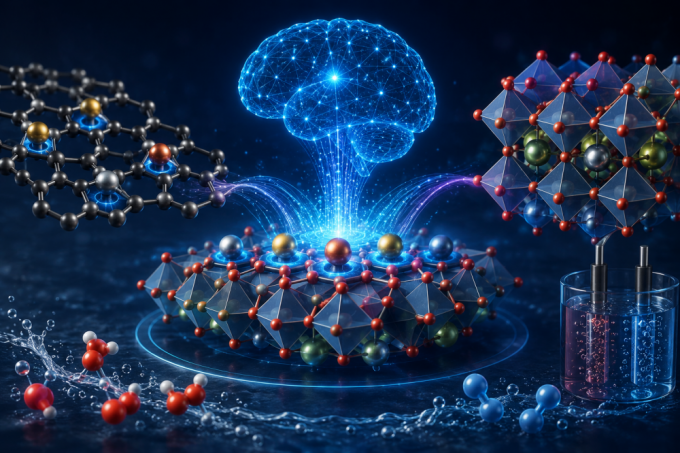
AI combined catalyst data with different properties to discover catalyst structures that did not exist before. Image generated by ChatGPT.
A Korean research team has developed an artificial intelligence (AI) system that combines data from different classes of catalyst materials to identify optimal catalysts that have never existed before.
The Institute for Basic Science (IBS) announced on the 28th that the research team led by Hyeon Taek-Hwan, director of the Center for Nanoparticle Research, has developed a Crossbreeding Neural Network (CBNN). This AI model is trained on data from two different catalyst material families, analyzes catalyst performance, and even predicts and experimentally validates entirely new catalyst structures that it has never seen during training. The results were published in the international journal “Nature Materials” on the 28th.
Catalyst performance varies greatly depending on factors such as elemental composition, atomic arrangement, and surface structure, which makes it difficult to identify the optimal catalyst material.
In particular, water electrolysis, an eco-friendly technology that produces hydrogen by splitting water, requires high-performance green hydrogen catalysts because some steps proceed slowly and demand a large amount of energy. Although researchers have begun to use AI, most AI-based catalyst studies so far have searched for optimal candidates within a single material family, such as single-atom catalysts or metal catalysts.
The team developed a Crossbreeding Neural Network (CBNN) that discovers candidate materials by combining data from two different catalyst material families.
CBNN simultaneously learns surface information from single-atom catalysts and internal structural information from perovskite oxides. In single-atom catalysts, individual metal atoms are immobilized on the catalyst surface, delivering high efficiency with a small amount of metal. Perovskite oxides are catalysts whose properties can be tuned by changing the combination of multiple metal elements inside the structure.
The researchers fed the atomic arrangement on catalyst surfaces into the AI in image form and the internal structure of oxides in graph form, enabling the model to learn the shared features of the two material families.
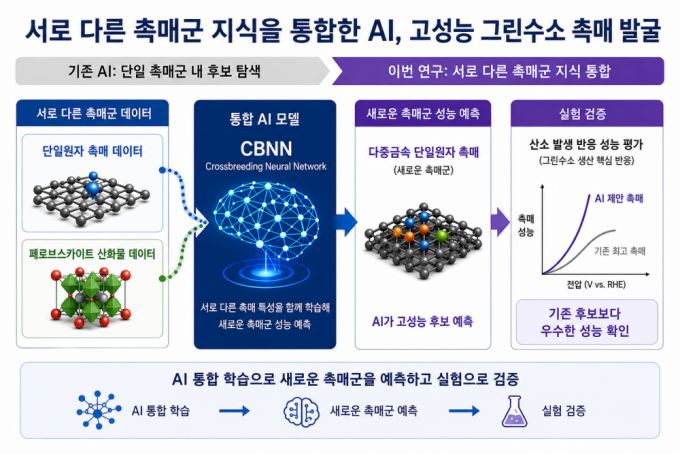
The AI combines data from single-atom catalysts and perovskite oxide catalysts to predict new structures. Courtesy of IBS.
The team then had the AI predict the performance of a new catalyst family that it had never been trained on. They set as the prediction target catalysts with a structure that combines the characteristics of single-atom catalysts and perovskite oxide catalysts: metal single atoms immobilized on the surface of perovskite oxides.
As a result, the performance ranking of 12 catalysts predicted by the AI matched exactly with the ranking verified by the research team through actual synthesis and electrochemical measurements.
In particular, based on the AI results, the researchers designed a new “multi-metal” catalyst structure that anchors several different metal single atoms simultaneously. This catalyst outperformed not only existing single-atom catalysts and perovskite oxide catalysts, but also all newly synthesized catalysts in the study.
The team also designed the AI so that it does not merely output results but also explains the reasons why it judges a particular catalyst to be superior.
Director Hyeon Taek-Hwan said, “We have shown that we can discover top-performance catalysts by combining knowledge from different catalyst families,” adding, “This approach could be extended to a wide range of fields that require exploration of complex materials, such as batteries, energy materials, and drug discovery.”
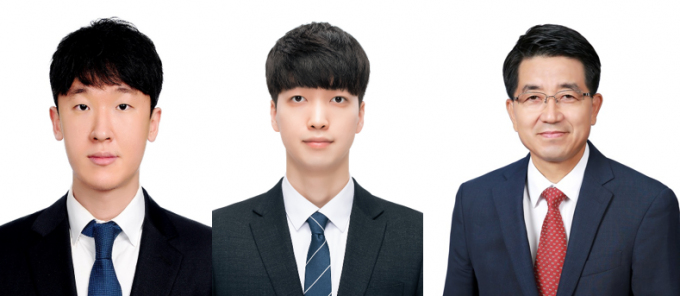
From left: integrated M.S.-Ph.D. candidate Yoo Seung-Woo, integrated M.S.-Ph.D. candidate Moon Joon-Seok, and Director Hyeon Taek-Hwan. Courtesy of IBS.
Copyright ⓒ DongA Science. All rights reserved.


