

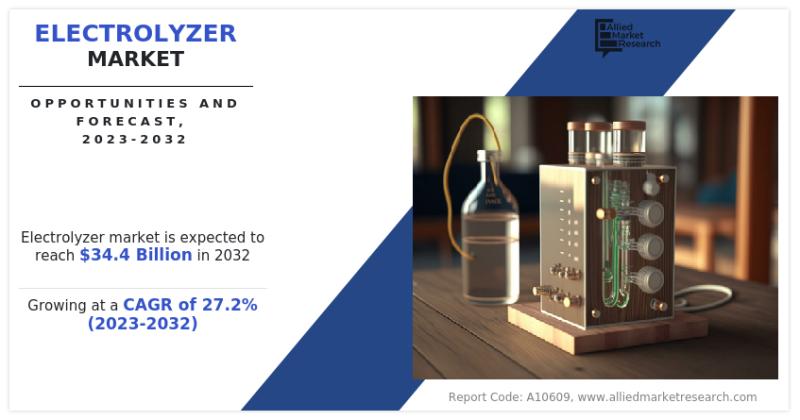
According to a new report published by Allied Market Research, the electrolyzer market size was valued at $3 billion in 2022 and is projected to reach $34.4 billion by 2032, growing at a CAGR of 27.2% from 2023 to 2032. The increasing focus on green hydrogen production, rapid expansion of renewable energy infrastructure, and supportive government policies for decarbonization are significantly driving the growth of the electrolyzer market across the globe.
Download PDF Brochure: https://www.alliedmarketresearch.com/request-sample/A10609
Introduction to Electrolyzer Market
The electrolyzer market revolves around technologies used for water electrolysis, a process that separates water into hydrogen and oxygen using electricity. Electrolyzers play a vital role in producing clean hydrogen, which is increasingly used across industrial, transportation, power generation, and energy storage applications.
Electrolyzers are considered one of the most important technologies supporting the global transition toward a low-carbon economy. Hydrogen generated through electrolysis using renewable electricity is commonly referred to as green hydrogen, which helps reduce carbon emissions and dependence on fossil fuels.
The electrolyzer market includes various technologies such as alkaline electrolyzers, proton exchange membrane (PEM) electrolyzers, solid oxide electrolyzers, and anion exchange membrane electrolyzers. Among these, alkaline electrolyzers remain the most widely used due to their cost-effectiveness and long operational history.
The growing adoption of hydrogen as a clean fuel alternative is expected to create significant growth opportunities for the electrolyzer market during the forecast period.
Rising Demand for Green Hydrogen Driving Electrolyzer Market Growth
One of the primary factors fueling the electrolyzer market growth is the increasing demand for green hydrogen across multiple industries. Governments and businesses worldwide are focusing on reducing carbon emissions and achieving net-zero targets, which has accelerated investments in hydrogen infrastructure.
Hydrogen produced through electrolysis using renewable energy sources such as solar and wind is considered environmentally sustainable. This has increased the deployment of electrolyzers in industrial facilities, transportation systems, and power generation plants.
The electrolyzer market is benefiting from supportive regulatory frameworks promoting clean energy technologies and hydrogen adoption. Governments across Europe, Asia-Pacific, and North America are introducing subsidies, tax incentives, and funding programs to support hydrogen production projects.
In addition, industries such as chemicals, refining, steel manufacturing, and fertilizer production are increasingly adopting hydrogen as an alternative feedstock to reduce environmental impact. This rising industrial demand is expected to boost the electrolyzer market significantly over the coming years.
Expansion of Renewable Energy Infrastructure Supporting Market Growth
The rapid expansion of renewable energy projects worldwide is another key factor driving the electrolyzer market. Renewable energy sources such as solar and wind often produce surplus electricity during peak generation periods. Electrolyzers help convert this excess electricity into hydrogen, which can be stored and utilized later.
This ability to store renewable energy efficiently makes electrolyzers an essential component of future energy systems. Integration of electrolyzers with renewable energy plants improves grid stability and supports long-term energy storage solutions.
As countries continue to increase investments in clean energy infrastructure, the electrolyzer market is expected to witness substantial growth. Renewable energy developers are increasingly incorporating hydrogen production systems into their projects to maximize operational efficiency and sustainability.
Furthermore, the declining cost of renewable electricity generation is making green hydrogen production more economically viable, further strengthening the electrolyzer market outlook.
Technological Advancements Enhancing Electrolyzer Efficiency
Continuous technological advancements are playing a major role in shaping the electrolyzer market trends. Manufacturers are focusing on improving efficiency, durability, and operational stability of electrolyzer systems to meet growing industrial demand.
Modern electrolyzers offer improved hydrogen production efficiency, reduced energy consumption, and enhanced scalability compared to earlier technologies. Advanced materials and manufacturing processes are also helping reduce production costs and improve system performance.
Solid oxide electrolyzers are gaining significant attention in the electrolyzer market due to their higher efficiency and operational stability. These systems operate at elevated temperatures and can achieve superior energy conversion efficiency compared to conventional technologies.
Proton exchange membrane electrolyzers are also witnessing increased adoption because of their compact design, rapid response time, and compatibility with renewable energy systems.
Innovation in electrolyzer technologies is expected to accelerate market growth and improve the commercial viability of large-scale hydrogen production projects.
Increasing Manufacturing Capacity Supporting Electrolyzer Market Expansion
The electrolyzer market is witnessing substantial expansion in manufacturing capacity due to rising global demand for hydrogen production technologies. In 2022, global electrolyzer manufacturing capacity increased by more than 25%, reaching approximately 11 GW annually.
Europe and China currently account for nearly two-thirds of global electrolyzer production capacity. Several manufacturers are investing heavily in expanding their production facilities to meet anticipated future demand.
Companies are establishing large-scale manufacturing plants and adopting automated production processes to improve efficiency and reduce costs. The increasing number of announced hydrogen projects worldwide is encouraging manufacturers to scale up electrolyzer production capacity.
According to industry estimates, global electrolyzer manufacturing capacity could exceed 130 GW annually by 2030. This rapid capacity expansion highlights the growing importance of the electrolyzer market in supporting global decarbonization goals.
However, uncertainties related to investment decisions, project approvals, and policy implementation may influence future deployment rates across different regions.
Buy This Report (350 Pages PDF with Insights, Charts, Tables, and Figures): https://www.alliedmarketresearch.com/electrolyzer-market/purchase-options
Segment Analysis of Electrolyzer Market
The electrolyzer market is segmented based on product, capacity, application, and region. Each segment contributes uniquely to overall market development and future growth opportunities.
By Product
Based on product type, the electrolyzer market is segmented into alkaline electrolyzer, proton exchange membrane (PEM) electrolyzer, solid oxide electrolyzer, and anion exchange membrane electrolyzer.
The alkaline electrolyzer segment dominated the electrolyzer market share in 2022 due to its long-established commercial use and relatively lower operational costs. Alkaline electrolyzers are widely adopted in industrial hydrogen production because of their proven reliability and scalability.
However, the solid oxide electrolyzer segment is anticipated to witness the fastest growth during the forecast period. Rising technological advancements, improved thermal efficiency, and enhanced operational stability are driving demand for solid oxide electrolyzers.
PEM electrolyzers are also gaining traction in the electrolyzer market because of their high efficiency, compact design, and ability to operate under variable renewable energy conditions.
By Capacity
On the basis of capacity, the electrolyzer market is categorized into less than 500 kW, 500 kW to 2 MW, and above 2 MW.
The 500 kW to 2 MW segment accounted for the largest share of the electrolyzer market in 2022. These systems are commonly used in industrial and commercial hydrogen production applications due to their balanced efficiency and scalability.
However, the above 2 MW segment is expected to grow at the highest rate during the forecast period. Growing demand for large-scale hydrogen production projects in transportation, industrial energy, and renewable power sectors is increasing the adoption of high-capacity electrolyzers.
Large-scale electrolyzer systems are becoming essential for utility-scale hydrogen production and integrated renewable energy projects worldwide.
By Application
Based on application, the electrolyzer market is segmented into power generation, transportation, industry energy, industry feedstock, building heat & power, and others.
The power generation segment dominated the electrolyzer market in 2022 due to rising demand for on-site hydrogen production and renewable energy storage solutions. Power producers are increasingly utilizing electrolyzers to stabilize grids and store excess renewable electricity.
The transportation segment is expected to witness the highest CAGR during the forecast period. Growing investments in hydrogen fuel cell vehicles, hydrogen refueling infrastructure, and clean mobility solutions are driving electrolyzer adoption in transportation applications.
Industrial feedstock applications are also contributing significantly to the electrolyzer market growth as industries transition toward cleaner production processes and sustainable energy systems.
Regional Insights of Electrolyzer Market
The electrolyzer market is analyzed across North America, Europe, Asia-Pacific, and LAMEA.
Europe and Asia-Pacific dominated the electrolyzer market share in 2022 due to strong government support, rapid renewable energy deployment, and growing hydrogen infrastructure investments.
Asia-Pacific is projected to witness the fastest CAGR of approximately 27.5% during the forecast period. Countries such as China, Japan, South Korea, and India are investing heavily in hydrogen technologies and fuel cell infrastructure.
China is emerging as a major manufacturing hub for electrolyzers due to its strong industrial base and expanding renewable energy sector. Government initiatives promoting green hydrogen production are expected to further accelerate market growth in the region.
Europe continues to play a leading role in the electrolyzer market due to ambitious climate targets and substantial investments in hydrogen economy development. The European Union’s hydrogen strategy and carbon reduction policies are encouraging rapid deployment of electrolyzer systems.
North America is also witnessing steady growth in the electrolyzer market driven by increasing clean energy investments, hydrogen research programs, and industrial decarbonization initiatives.
Competitive Landscape of Electrolyzer Market
The electrolyzer market is highly competitive with several global players focusing on technological innovation, strategic collaborations, and production expansion to strengthen their market positions.
Major companies operating in the electrolyzer market include Cummins Inc., Nel ASA, Siemens AG, Toshiba Corporation, Air Liquide, Plug Power Inc., McPhy Energy, ITM Power, Iberdrola S.A., and Bloom Energy.
These companies are investing significantly in research and development to improve electrolyzer efficiency, reduce operational costs, and scale up production capacity. Partnerships with renewable energy developers and industrial companies are also becoming increasingly common.
Manufacturers are expanding their global footprint through mergers, acquisitions, and joint ventures to capitalize on growing hydrogen demand and strengthen supply chain capabilities in the electrolyzer market.
Challenges Impacting Electrolyzer Market Growth
Despite strong growth prospects, the electrolyzer market faces several challenges. High capital costs associated with electrolyzer systems and hydrogen infrastructure remain significant barriers for widespread adoption.
In addition, the availability of affordable renewable electricity is critical for economically viable green hydrogen production. Variations in renewable energy supply and grid infrastructure limitations may affect operational efficiency.
Large-scale hydrogen storage and transportation infrastructure also require substantial investments and technological advancements. Addressing these infrastructure challenges will be essential for accelerating electrolyzer market expansion.
Furthermore, regulatory uncertainties and delays in project approvals could impact investment decisions and slow down future deployment of electrolyzer systems.
Get a Customized Research Report: https://www.alliedmarketresearch.com/request-for-customization/A10609
Future Outlook of Electrolyzer Market
The future of the electrolyzer market appears highly promising as governments and industries continue to prioritize clean energy transition and carbon reduction goals. Green hydrogen is expected to become a key component of future global energy systems, driving substantial demand for electrolyzer technologies.
Advancements in electrolyzer efficiency, manufacturing scalability, and renewable energy integration are anticipated to reduce production costs and improve commercial viability. Large-scale hydrogen projects across transportation, industrial, and power generation sectors will continue to support market growth.
The integration of electrolyzers with renewable energy plants, energy storage systems, and smart grids is expected to transform energy infrastructure worldwide. Increasing investments in hydrogen mobility and industrial decarbonization initiatives will further accelerate the electrolyzer market growth.
As countries work toward achieving net-zero emissions targets, the electrolyzer market is likely to play a central role in building a sustainable and low-carbon energy future.
Trending Reports in Energy and Power Industry:
Electrolyzer Market
https://www.alliedmarketresearch.com/electrolyzer-market-A10609
Porous Electrodes for Electrolyzer Market
https://www.alliedmarketresearch.com/porous-electrodes-for-electrolyzer-market-A12539
Green Hydrogen Market
https://www.alliedmarketresearch.com/green-hydrogen-market-A11310
Biomass Gasification Market
https://www.alliedmarketresearch.com/biomass-gasification-market-A09297
Hydrogen Storage Market
https://www.alliedmarketresearch.com/hydrogen-storage-market-A122780
Hydrogen Infrastructure Market
https://www.alliedmarketresearch.com/hydrogen-infrastructure-market-A165713
Clean Hydrogen Market
https://www.alliedmarketresearch.com/clean-hydrogen-market-A53698
Hydrogen Fuel Cell Market
https://www.alliedmarketresearch.com/hydrogen-fuel-cell-market
Hydrogen Generation Market
https://www.alliedmarketresearch.com/hydrogen-generation-market
Hydrogen Generator Market
https://www.alliedmarketresearch.com/hydrogen-generator-market-A12538
Hydrogen Energy Storage Market
https://www.alliedmarketresearch.com/hydrogen-energy-storage-market-A10578
Carbon Capture, Utilization, and Storage (CCUS) Market
https://www.alliedmarketresearch.com/carbon-capture-and-utilization-market-A12116
Renewable Energy Market
https://www.alliedmarketresearch.com/renewable-energy-market
Decarbonization Market
https://www.alliedmarketresearch.com/decarbonization-market-A325581
David Correa
1209 Orange Street,
Corporation Trust Center,
Wilmington, New Castle,
Delaware 19801 USA.
Int’l: +1-503-894-6022
Toll Free: +1-800-792-5285
Fax: +1-800-792-5285
help@alliedmarketresearch.com
Web: www.alliedmarketresearch.com
Allied Market Research Blog:
https://blog.alliedmarketresearch.com
Allied Market Research (AMR) is a full-service market research and business-consulting wing of Allied Analytics LLP based in Portland, Oregon. Allied Market Research provides global enterprises as well as medium and small businesses with unmatched quality of “Market Research Reports” and “Business Intelligence Solutions.” AMR has a targeted view to provide business insights and consulting to assist its clients to make strategic business decisions and achieve sustainable growth in their respective market domain.
Pawan Kumar, the CEO of Allied Market Research, is leading the organization toward providing high-quality data and insights. We are in professional corporate relations with various companies and this helps us in digging out market data that helps us generate accurate research data tables and confirms utmost accuracy in our market forecasting. Each and every data presented in the reports published by us is extracted through primary interviews with top officials from leading companies of domain concerned. Our secondary data procurement methodology includes deep online and offline research and discussion with knowledgeable professionals and analysts in the industry.
This release was published on openPR.


