

Finance-focused research work in Chile, carried out under the banner of a public-private push to help renewable hydrogen and derivatives projects reach a final investment decision (FID), has concluded.
Attention now shifts to fine-tuning an associated report and circulating it among public authorities before the final version is published.
The report will detail the key proposal and recommendations put forward. At the core is the establishment of a revolving fund geared to development capital, or devex as it is known. Capital support of between US$5 million (mn) and US$20 million (mn) per project is suggested.
This would complement existing local instruments offered by state development agency Corfo, its head of strategy, Santiago Browne, said during a meeting of an associated working group.
Devex support is needed as demand for renewable hydrogen and its derivatives is taking longer than initially expected to activate, and as lengthy, investment-intensive permitting processes pressure the finances of project owners with plants in the pre-FID phase.
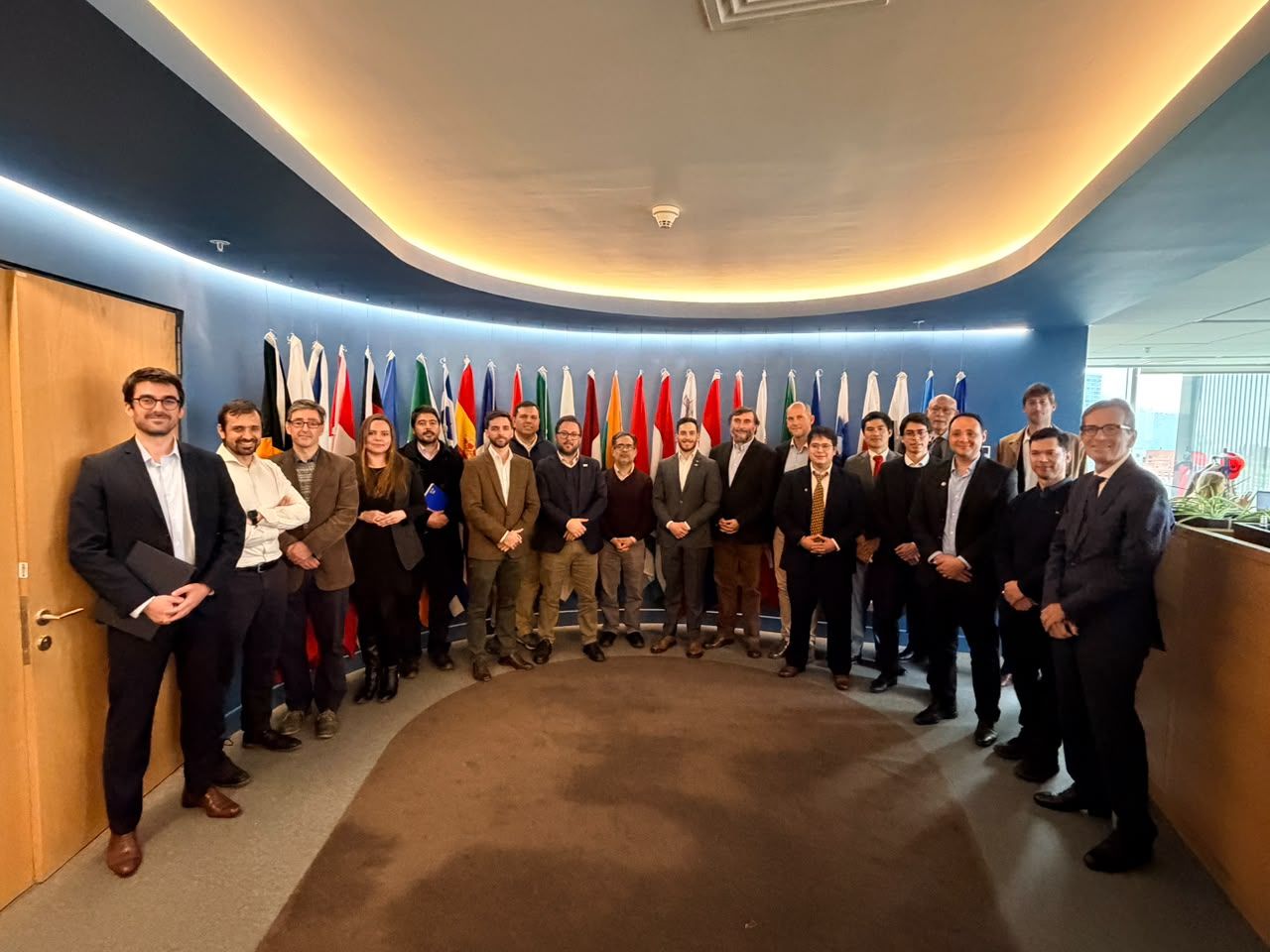
The initiative is being spearheaded by the Chilean office of German development cooperation agency GIZ, which formed a 23-member public-private working group, among them owners of Chile’s most advanced projects. During the final formal meeting of the working group, project companies AustriaEnergy and MAE, behind green ammonia projects US$11 billion (bn) HNH and US$2.5bn Volta, respectively, were among those present. HNH secured its environmental license this year and Volta in December 2025.
The final report is due in November, Álvaro Castro, GIZ Chile renewable hydrogen financial adviser and a key figure behind the project, told BNamericas.
The fund is designed to widen access to devex by attracting the participation of commercial and multilateral lenders, the former typically averse to injecting capital into early-stage projects, given the associated risk and, in the case of hydrogen, limited internal technical knowledge.
The proposed fund may comprise several operational units geared to both the financial and technical aspects. The final report will be reviewed and analyzed by the government, which would take the lead role in any possible implementation.
During the working group meeting, to which BNamericas was invited, European and Chilean government officials said financing-focused efforts would continue and that it was a “work in progress.”
Earlier this month, Europe and Chile signed a joint statement of intent to deepen cooperation on renewable hydrogen and Power-to-X derivatives, with the aim of bringing projects to the investment stage.
Chile has a multibillion-dollar pipeline of hydrogen and derivatives projects, which could one day supply external markets looking to achieve decarbonization and energy security goals.
Between 2023 and 2026, the first phase of a bilateral renewable hydrogen initiative–known as the Team Europe Initiative Renewable Hydrogen for Chile (RH2)–carried out groundwork to help the sector develop, including in the spheres of permitting and financial advisory services. The GIZ-led financing work is being carried out under RH2.
In Chile, the focus is sharpening on the domestic market, given that international demand is taking longer than originally expected to activate.
Earlier this month, Ana María Ruz, executive director of Corfo’s green hydrogen committee, identified the three most advanced projects, all of them geared to derivatives production: Volta (Antofagasta region), Comasa’s green fertilizer project (La Araucanía region) and HIF’s US$830 million (mn) Cabo Negro e-fuels project (Magallanes region). They are either in the feasibility or advanced pre-feasibility phases.
(The original version of this content was written in English)


