

A finance-focused initiative to help Chilean renewable hydrogen and derivatives projects advance has reached its first milestone.
Specialists presented the findings of the initial supply-side diagnosis, which identified access to development capital (devex)–needed to complete front-end engineering design (FEED) work–as a key area requiring attention, along with securing offtake agreements.
Chile has multiple projects, some in the pre-FID (final investment decision) phase, and abundant energy resources, but like other jurisdictions, it faces challenges chiefly linked to financing, offtake and production costs.
During the first technical meeting of an associated committee, project owners said time-to-FID is longer than expected and underscored the importance of securing devex support and advancing offtake negotiations.
Devex demand ranges from US$5 million to US$50 million (mn), the event heard.
The initiative is led by the Chilean office of German development cooperation agency GIZ, under the Team Europe for the Development of Renewable Hydrogen in Chile (RH2) program, which is co-financed by the EU and Germany’s federal ministry of economics and energy (BMWE).
“There is an initial pipeline that is advancing towards FID; however, projects need to complete devex in order to finish their FEED engineering and obtain value from their product with less uncertainty, ergo, allowing them to go to market and deliver an offer with greater certainty,” Álvaro Castro, GIZ Chile renewable hydrogen financial adviser and a key figure behind the project, told BNamericas.
The supply-side diagnosis work was conducted on behalf of GIZ by global consultancy NIRAS, which will now begin talking to project owners about their specific financing needs.
Among other findings was that grid costs for northern projects eroded project competitiveness, reflecting an issue often highlighted by Chile’s nonregulated electricity clients. Spurring local demand, via the likes of mandated usage quotas, could also get wheels and cogs turning, the event heard.
“Chile doesn’t have a problem in terms of its project portfolio; it’s missing public tailwinds, coordination and action to support the industry, which generates a systemic lack of bankability, driven by a lack of offtake, of devex and of risk-sharing mechanisms,” NIRAS said in a presentation.
Associated work includes developing finance tools, which could involve combinations of existing instruments, the technical meeting–attended by public and private-sector stakeholders and BNamericas–heard.
NIRAS’s remit includes liaising with parties such as national hydrogen industry association H2 Chile, the energy ministry, state development agency Corfo, financial market commission CMF, multilateral banks, investment funds, local lenders and insurers. Final recommendations are due in Q4.
Projects
Among companies involved in the initiative is Chilean firm Consorcio Austral, which has green ammonia project Acuario in Magallanes region. The company is preparing to submit the project’s environmental evaluation study for review.
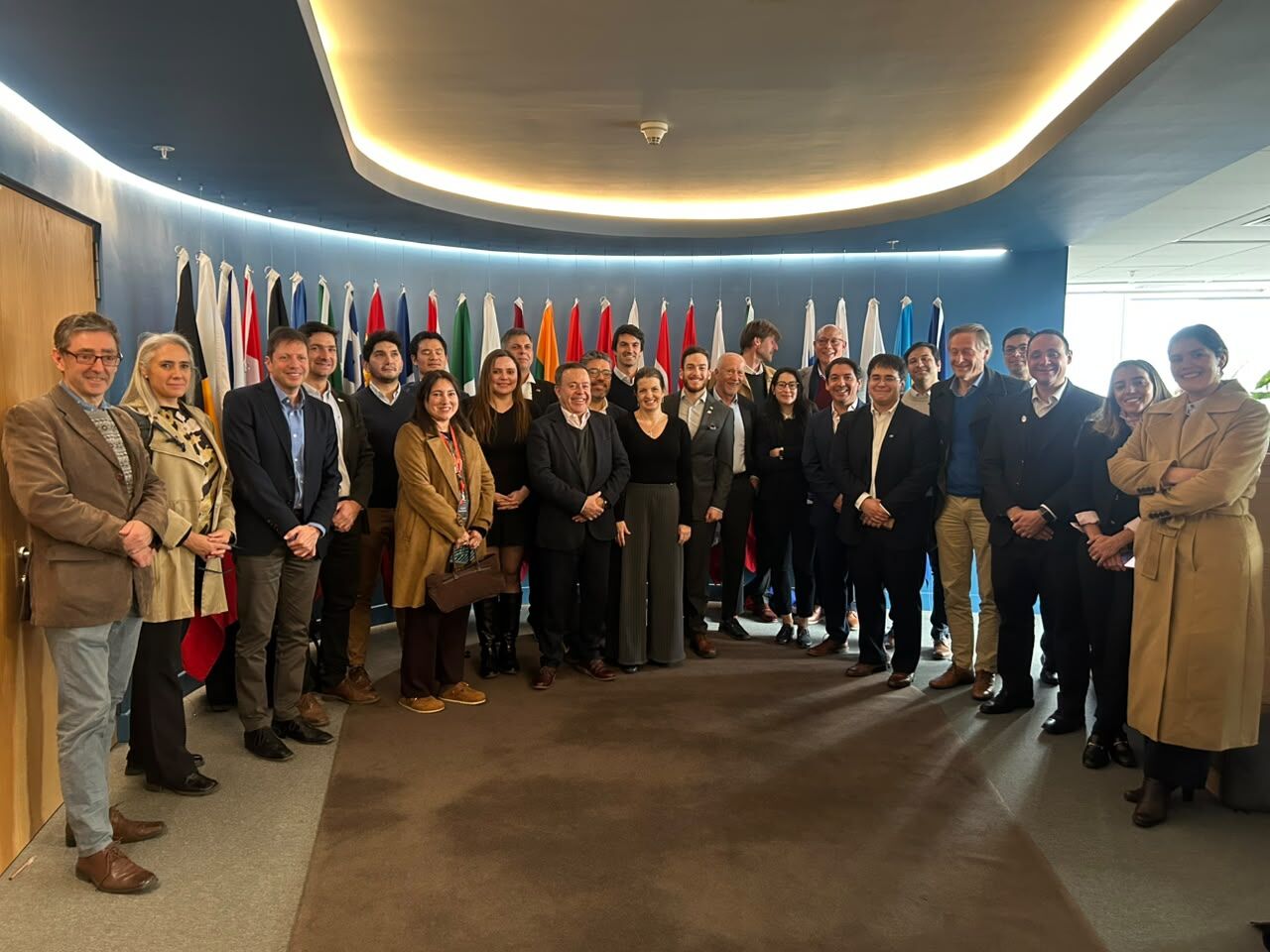
Another is the US$11 billion (bn) HNH Energy green ammonia project, led by a consortium of the same name formed by AustriaEnergy, Ökowind and Copenhagen Infrastructure Partners. Planned for Magallanes region and in the FEED phase, it should get the environmental green light this half, attendees (pictured) of the meeting were told.
Consorcio Austral and HNH Energy have begun talks on infrastructure usage cooperation, widely seen as a way to help enhance project economics.
In Magallanes, state oil company Enap is building a 1MW green hydrogen plant. Output will be used by Enap and for third-party projects, the company said last year.
Elsewhere in the windswept region, another committee participant, HIF Global, has built an e-fuels demonstration plant.
Among others is a Chilean company developing an innovative, circular economy-based project. Branded Green Tech Mining, the initiative involves using green hydrogen to process copper mining slag, an abundant input in Chile. Components include a hydrogen plant and a cathodes plant, which would be powered by a behind-the-meter solar PV-energy storage hybrid park. Officials, who envisage a small-scale project that can be expanded in phases, are looking for a project sponsor.
Chile has multiple projects in the pipeline, and several have secured environmental licenses, including committee member MAE’s US$2.5 billion (bn) green ammonia project Volta in Antofagasta region. Volta could eventually supply both local and export markets and is the country’s most advanced large-scale project.
Another given the environmental green light is HIF Global’s large-scale Magallanes region e-fuels production plant, the US$830 million (mn) Cabo Negro project.
The overall pipeline–where around 80 projects have been publicly announced–has been undergoing a cleaning process, leaving only the most robust projects standing.
Demand signals
Among current demand drivers for alternative fuels, under Europe’s FuelEU Maritime, shipowners operating from, to or within the EU are required to gradually reduce the greenhouse gas emission intensity of their onboard energy use, calculated on a well-to-wake basis.
The International Maritime Organization’s Net-Zero Framework (NZF), if adopted, would send out a strong demand-side signal. An associated vote on the NZF is planned for Q4.
A role is also seen for green ammonia in spheres such as fertilizers, where prices rocketed and supply contracted last half following the US attacks on Iran.
Beyond sustainability, energy security is also shaping how green hydrogen and its derivatives are perceived, with the aviation industry seen as another potential demand driver.
(The original version of this content was written in English)


