


Hydrogen did not contract sharply in Q1 2026. Instead, the market became more selective. GlobalData describes a stable quarter for low-carbon hydrogen, but with fewer new project announcements and a modest 360ktpa decline in total announced capacity. On its own, that reduction is limited. More significant is what it suggests about investor behaviour. Developers appear increasingly reluctant to add speculative projects while financing, offtake and policy conditions remain uncertain.
The more consequential trend sits further down the development cycle. GlobalData reports growth in projects progressing through feasibility, FEED and construction. That points to a market shifting away from expansion by headline and towards execution. For renewable energy companies, hydrogen is becoming less a standalone technology play and more a test of whether generation, grid access, permitting and industrial demand can be combined into commercially credible projects.

Discover B2B Marketing That Performs
Combine business intelligence and editorial excellence to reach engaged professionals across 36 leading media platforms.
Find out more
Green hydrogen retains momentum as blue weakens
Green hydrogen remained stable through Q1 and continues to dominate announced capacity. Blue hydrogen moved in the opposite direction, with announced capacity falling 6.2% over the quarter. GlobalData attributes the decline partly to rising natural gas prices and expectations of further volatility linked to the Middle East conflict.
The underlying issue is investor exposure to commodity risk. Blue hydrogen economics remain tied to gas markets in ways renewable-powered electrolysis is not. Sharp changes in feedstock pricing can alter production costs quickly, weaken confidence in long-term supply agreements and increase financing risk.
That shift also marks a change from 2025, when policymakers and developers increasingly embraced “production pathway pragmatism”, accepting that multiple low-carbon routes would be needed to accelerate scale. Q1 suggests investors are becoming more cautious about pathways exposed to volatile fuel markets.
Green hydrogen, however, still faces structural constraints. Electrolysis projects require access to low-cost renewable electricity, workable grid arrangements and regulatory compliance that remains technically and administratively demanding. Strategic preference alone will not move projects forward. Developers with secured renewable generation, credible permitting strategies and clear compliance pathways are likely to hold a growing advantage.
Policy consistency is becoming a financing requirement
The clearest indication of market fragility is the spread of delays. GlobalData reports that 40 projects previously expected to begin operations in 2026 revised their timelines during the quarter. The causes extend across North America, Europe and the Middle East, where subsidy structures, emissions definitions and public funding decisions remain unsettled.
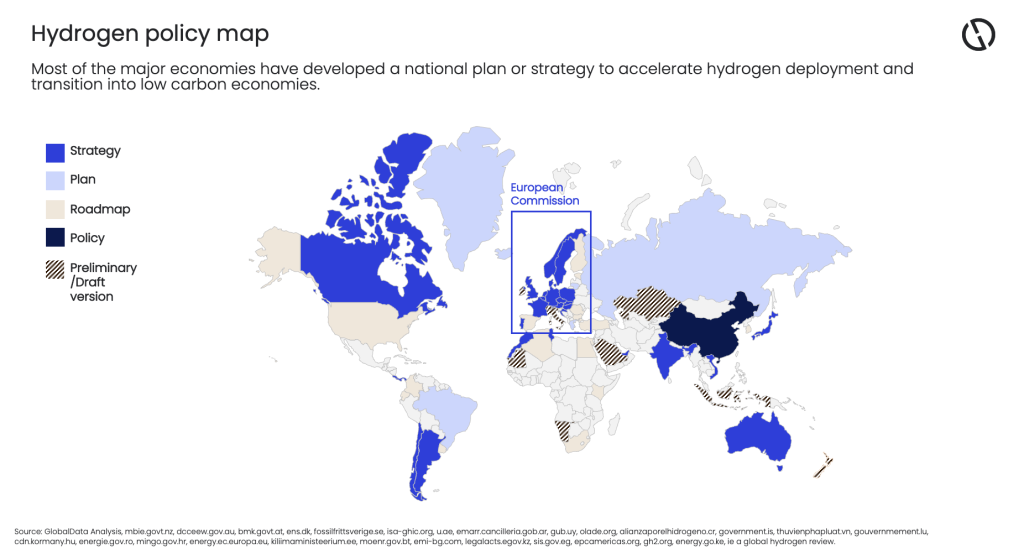
The US provides the starkest example. North America maintained its ranking position in Q1, but its global capacity share fell 22% between Q1 2025 and Q1 2026, largely because of a rollback of state support in the US. GlobalData highlights a March 2026 announcement of a $3bn reduction to previously agreed funding under the Trump Administration’s 2026 to 2027 budget, followed by a 3 April 2026 proposal to permanently cancel a further $3bn allocated to hydrogen hubs under the Infrastructure Investment and Jobs Act.
Those measures still require congressional approval and are likely to face legal challenge from recipient states. Yet investment decisions rarely wait for final legal outcomes. Once governments signal that agreed support mechanisms may be revisited, developers and lenders tend to price in higher political risk. In hydrogen, where projects often rely on long development timelines and complex subsidy structures, that uncertainty can slow contracting well before funding is formally withdrawn.
Europe’s approach is more supportive, though still operationally complex. Germany’s Hydrogen Acceleration Act, adopted on 26 February 2026 after government approval in October 2025, classifies hydrogen infrastructure as being in the overriding public interest. The legislation covers production, transport, storage, import and export provisions and e-fuels, while aiming to simplify and digitalise permitting.
That focus matters because permitting delays increasingly carry direct commercial consequences. Long approval cycles can leave renewable generation underused, complicate power procurement strategies and weaken negotiations with industrial buyers seeking delivery certainty.
Italy’s $6.9bn subsidy programme for hydrogen derived from renewables or biomass reflects a similar emphasis on investment visibility. The scheme uses contracts for difference to support production economics and narrow the gap between electrolytic hydrogen costs and industrial demand.
Europe’s unresolved issue is regulatory complexity. Pressure from Germany, Spain, the Netherlands, Poland and Austria to revise RFNBO criteria underlines how commercially important additionality and time-matching rules have become. The stricter the compliance framework, the harder it becomes to optimise renewable sourcing, storage and grid interaction without increasing project costs or delaying development.
Electrolyser competition is becoming industrial policy
Hydrogen’s next bottleneck may be manufacturing economics rather than project ambition. The European Commission’s proposed Industrial Accelerator Act, announced on 4 March 2026, aims to reduce dependence on external suppliers in sectors including low-carbon hydrogen. Yet GlobalData notes that exemptions could still allow Chinese electrolysers to dominate procurement if imported systems are 20% cheaper than European alternatives or manufactured in qualifying trade partner countries.
That tension reflects a broader industry reality. Developers remain under pressure to reduce capital costs even as governments push for industrial resilience and domestic manufacturing.
China’s strategy combines scale with standardisation. Its 2026 to 2028 programme focuses on technology improvements, industrial-scale plant design and efficiency standards for electrolysers operating on renewable electricity, grid power or waste heat. One target is direct DC consumption below 4.2kWh per cubic metre of hydrogen.
That matters beyond manufacturing volumes. Standardisation can reduce financing risk, improve procurement confidence and shorten delivery schedules. China is positioning itself not only as a supplier, but increasingly as a setter of cost and performance benchmarks.
India is pursuing a different model centred on domestic industrial demand. Under the National Green Hydrogen Mission, the government signed sales and purchase agreements in March 2026 with most successful bidders from an August 2025 auction. The programme targets low-carbon fertiliser production and tenders covering more than 700,000 tonnes (t) a year of green ammonia across 11 fertiliser sites. Bid prices fell as low as 49.75 rupees per kg, with ACME contracted to supply 370,000t of green ammonia.
The significance lies less in export ambition than in demand creation. India is using policy-backed industrial consumption to accelerate project viability. For renewable developers, that offers a more immediate commercial pathway than relying solely on future global hydrogen trade.
GlobalData’s 2030 scenarios, ranging from 34mtpa in the low case to 56mtpa in the high case, show how uncertain the sector’s eventual scale remains. The low case is considered more likely despite substantial European funding, with further US consolidation expected if funding withdrawals continue.
The sector is entering a phase where execution risk matters more than announced capacity. Developers able to secure renewable power, structure compliant supply arrangements and move through permitting quickly are likely to consolidate advantage while weaker projects drift further into delay. In the next stage of the low-carbon hydrogen market, delivery discipline may prove more valuable than scale ambitions.
This article is derived from and informed by a GlobalData report. All data, forecasts and project metrics are sourced from that GlobalData extract unless otherwise indicated.
To access the full report, visit the GlobalData Power Intelligence Centre: www.globaldata.com/industries/power.


