

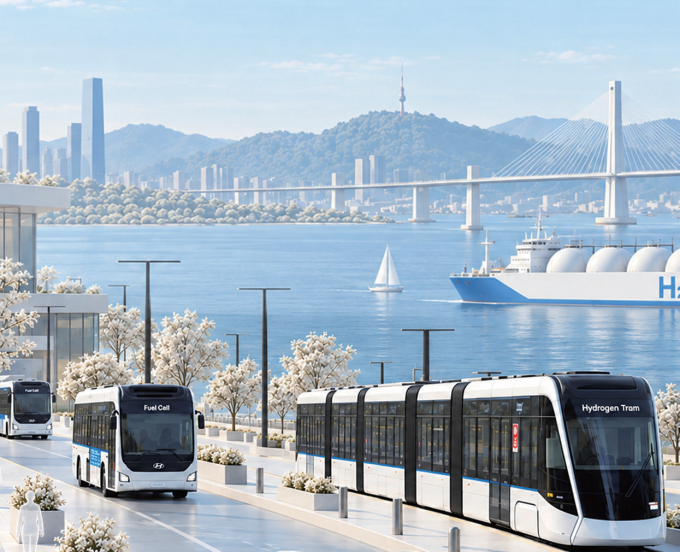
A city where hydrogen powers everything from mobility to heating and electricity in daily life—hydrogen energy has already entered the household economy of an entire city. Provided by Hyundai Motor Group
There are places where hydrogen is the default energy source for every aspect of life, from mobility to heating and electricity. These are the “hydrogen cities” designated in Korea. Ulsan, the city that produces the most hydrogen in the country, and Jeju, an island experimenting with green hydrogen made from wind and sun as a hydrogen-friendly city. In these hydrogen cities visited in person, hydrogen energy has already crossed the road and flowed into the everyday life of an entire city.
Ulsan is a hydrogen city designated by the Ministry of Land, Infrastructure and Transport, but Jeju is not. In this article, the term “hydrogen city” is used in a broader sense to refer to regions that utilize hydrogen as a key means of future energy transition and are actively building related ecosystems.
● Ulsan, hot water without boilers? Hydrogen flowing into apartment homes
On September 8, a reporter visited an apartment complex in Buk-gu, Ulsan. A signboard reading “Carbon Zero Apartment” at the entrance greeted visitors first. “The residents love it,” said Lee Jong-gyu, a team leader at Ulsan City Corporation, with a smile as he guided the way. “There are no boilers.”
“Even without boilers, hot water gushes out. When you open the front door, you’ll find a heat exchanger instead of a boiler under the shoe cabinet.” The source of the warmth generated in this heat exchanger is a hydrogen combined heat and power (CHP) plant located just behind the apartment complex—essentially a small-scale power station that generates electricity and heat using hydrogen.
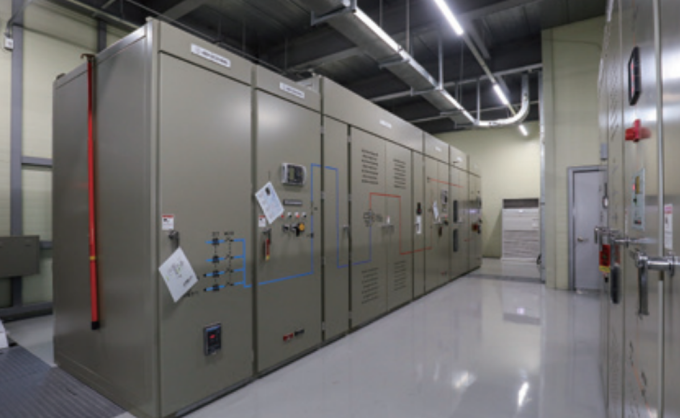
Interior view of the hydrogen combined heat and power plant located behind the ‘Carbon Zero Apartment’ complex in Buk-gu, Ulsan. Heat and electricity are produced here year-round and supplied to residents. Provided by Dong-A Science
“When hydrogen enters the fuel cell, it produces water, electrical energy, and heat at about 75 °C. We collect that heat and send it to the apartments.” Do residents notice a difference compared with conventional heating? Lee said they definitely feel it in their monthly bills. “Heating and hot water charges are about 70% of the rates presented by the district heating corporation.”
This hydrogen apartment project will be expanded from here to all of Ulsan. At present, 437 households share this warmth, and by 2030 more than 2,000 hydrogen-powered apartments are planned.
● Clean fuel enters heavy industry
Hydrogen is now used beyond mobility and apartments. At Hyundai Motor’s Ulsan plant, visited on September 9, work was underway to replace burners that previously burned city gas with hydrogen-burning units to generate heat. Small hydrogen burners have already been installed at Paint Shop 52, where the NEXO is produced, and medium-to-large hydrogen burners are being prepared for installation next door at Paint Shop 51.
“In the paint shop, the oven systems are among the processes with the highest carbon emissions,” explained Lee Yong-seok, manager of Hyundai Motor’s Paint Production Engineering Team 1. Painting is the process of coloring the car’s exterior. The painted surface is dried with hot air, and in this step the oven chamber is heated to about 500 °C by burners, releasing a large amount of carbon. Switching to hydrogen burners is therefore a way to replace the fuel with one that does not emit carbon.
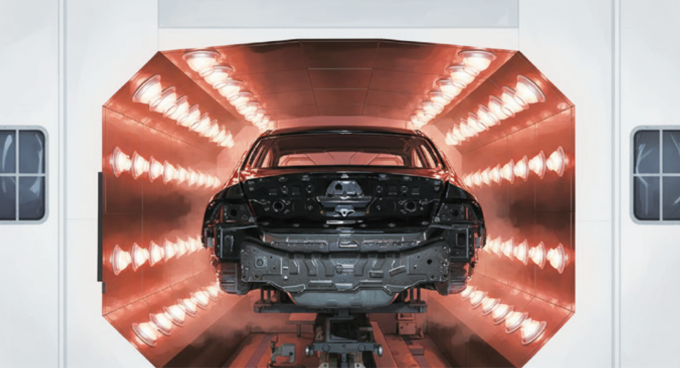
To cut carbon emissions during vehicle production, Hyundai Motor Group is attempting hydrogen conversion at the plant level. At the Ulsan plant, this includes introducing hydrogen forklifts (top) and replacing conventional burners with hydrogen burners in the paint shops (bottom), where the most carbon is emitted in the manufacturing process. Provided by Hyundai Motor Group
In the same plant’s electric vehicle production line, two hydrogen forklifts busily carry steel pallets. “Hydrogen forklifts use fuel cells that continuously generate electricity, so as long as hydrogen is supplied, they can operate with stable output whether the remaining hydrogen is at 90% or 50%,” said Cho Chang-hyeon, manager of Hyundai Motor’s Production Logistics Planning Team, as he stepped down from a hydrogen forklift. Diesel forklifts posed problems of exhaust fumes and vibration for indoor use, while battery-electric forklifts had relatively limited power. Hydrogen forklifts fill this gap.
Hydrogen burners and hydrogen forklifts may look like different types of equipment, but they share the same goal: reducing fossil fuel use in production and logistics, thereby lowering carbon emissions across the entire product life cycle. As global initiatives such as RE100 (a campaign for companies to procure 100% of their electricity from renewable energy by 2050) spread the push for carbon reduction, companies face the challenge of cutting emissions across their operations and supply chains. In response, industrial sites are increasingly adopting hydrogen to decarbonize both production and logistics processes.
● Ulsan, a leading hydrogen city built on pipelines and infrastructure
The secret behind warm apartments without boilers and burners operating without fossil fuels is the “hydrogen pipeline network” spreading across Ulsan. The city hosts Asia’s largest petrochemical industrial complex, and hydrogen is produced there as a by-product of petrochemical processes—so-called “by-product hydrogen.”
“Ulsan is the city that produces the most hydrogen in Korea. It has an annual hydrogen production capacity of 970,000 tons, of which 147,000 tons are supplied to the hydrogen market. On a national scale, Ulsan accounts for about half (49.2%) of total hydrogen production capacity and around 62% of distribution volume,” explained Lee Han-woo, head of Ulsan Technopark, in an interview on September 9. This by-product hydrogen is distributed via pipelines to fueling stations, apartments, factories, and other sites.
Ulsan already has 200 km of hydrogen pipelines in the ground—longer than the distance between Seoul and Daejeon. The Integrated Operation and Management Center monitors and manages this network. “We visualize pipeline pressure across Ulsan, consumption at each user site, and heating and hot water use by household,” said team leader Lee Jong-gyu. “This helps prevent accidents and predict damage, and the data will also be used to plan future pipeline expansion.”
Ulsan plans to further densify this hydrogen pipeline network, which forms the backbone of the hydrogen city. “Hydrogen transition in Ulsan does not start from building an entirely new base from scratch; it starts by expanding the existing industrial infrastructure into a citywide energy system,” said Ulsan Mayor Kim Sang-uk, outlining the city’s hydrogen infrastructure plan. The city intends to add 11.9 km of pipelines in Buk-gu and around the Ulsan Mipo National Industrial Complex by 2028.
The changes starting from the pipeline network are already visible in traffic statistics. As of September 2026, about 4,000 hydrogen electric vehicles are on the road in Ulsan, supported by 16 hydrogen fueling stations. By 2030, the city aims to expand this to around 5,600 hydrogen electric vehicles, 22 fueling stations, 210 km of pipelines, and 250 MW of fuel cell power generation. To ensure economic viability, safety, and public trust, Ulsan is also upgrading its safety management system by introducing AI-based leak prediction, real-time monitoring, and remote surveillance across the entire hydrogen value chain—from production to end use.
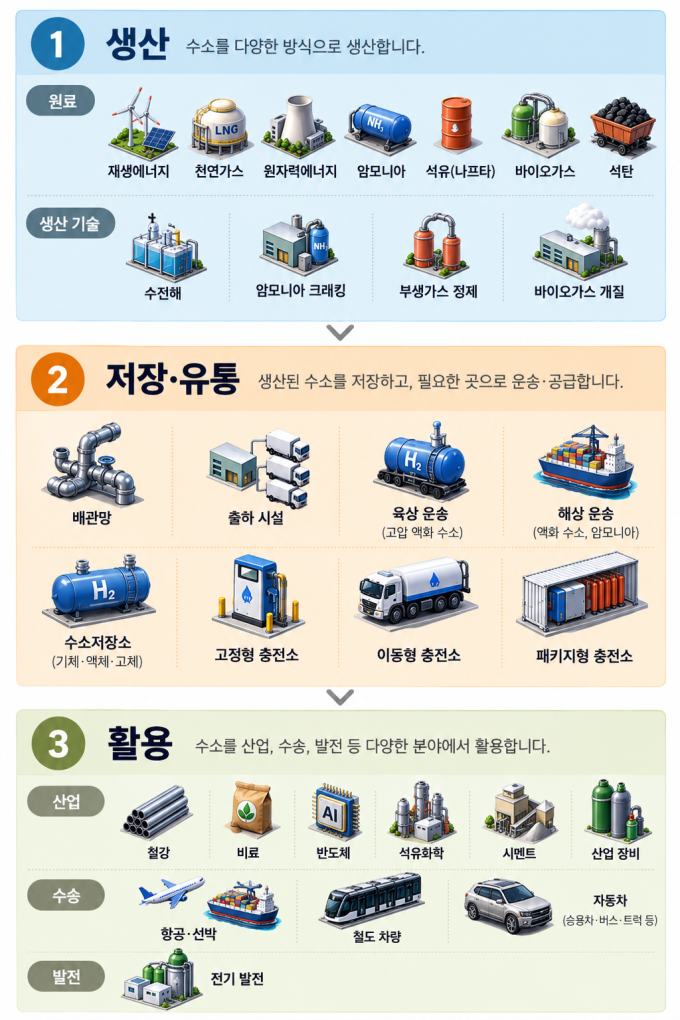
The A to Z of the hydrogen journey: the hydrogen value chain. Source: Hyundai Motor
Ulsan’s next milestone is 2040. “We will build an energy network that links hydrogen production, storage, transport, and utilization so that hydrogen becomes Ulsan’s core energy source across transport, power generation, industry, and housing. Hydrogen City Ulsan is ‘a future that has already arrived,’” said Mayor Kim.
● Jeju, where wind and sea produce green hydrogen
On September 16, a bus pulled into the Hamdeok Green Hydrogen Station in Jeju. Once the dispenser was connected, refueling was completed in just 15 minutes—more than twice as fast as charging an electric vehicle, which typically takes at least 40 minutes. This is the only hydrogen station in Korea supplied exclusively with “green hydrogen.”
A green hydrogen station dispenses green hydrogen produced using renewable energy. “Why call it green hydrogen? Because Jeju is windy and very sunny,” explained station manager Kim Hyeong-uk on site. “Water electrolysis to produce hydrogen consumes a lot of electricity, and we get that power from wind and sun.”
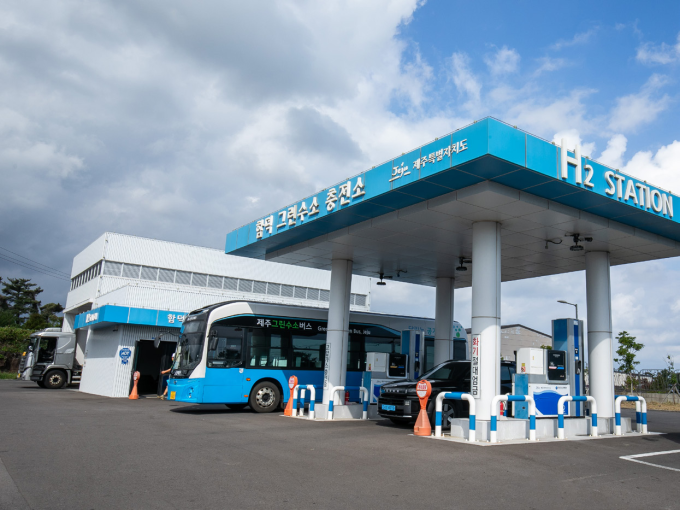
Jeju’s Hamdeok Green Hydrogen Station, the first in Korea to introduce green hydrogen. Twenty hydrogen electric buses and NEXO vehicles on the island refuel here. Provided by Dong-A Science
As Kim noted, Jeju boasts a high share of renewable energy. As of 2025, renewables account for 24.3% of the island’s power generation—more than double the national average of 10.5%. Building on this high share, Jeju is pushing energy transition with the goal of achieving carbon neutrality by 2035, and constructing a green hydrogen ecosystem is part of that effort.
All of Jeju’s green hydrogen is currently produced at the Hangwon Green Hydrogen Production Facility. About 400 kg of green hydrogen is produced daily and used to fuel 20 hydrogen electric buses and NEXO vehicles on the island, as well as to support the recovery of Jeju firefighters. To see this in action, a visit was made on September 17 to the Fire Service Training Center, where a hydrogen electric bus dedicated to firefighter recovery support was on standby.
Inside the vehicle, comfortable seats, a TV, and cooking facilities were installed to help firefighters regain their strength. “Before we had this recovery support vehicle, we often had to rest on the ground at the work site,” said Fire Sergeant Ko Young-ho of Jeju Fire Safety Headquarters. “Now, during long rescue operations lasting over 10 hours, we can use our shift breaks to recover more safely and efficiently.”
The main renewable source for Jeju’s green hydrogen is wind. “This is the only facility that has moved beyond demonstration and actually supplies hydrogen to a green hydrogen station,” said Kim Yong-wan, a specialist in the Clean Hydrogen Business Team, Energy Activation Division at Jeju Energy Corporation, on September 16 while pointing to the water electrolysis system. Wind turbines rotating nearby generate electricity, which is used to split water into oxygen and hydrogen. The hydrogen is stored in tube trailers and delivered to hydrogen fueling stations.
Jeju is also looking to the sea for natural forces to produce green hydrogen. At the coast near Yongsu-ri in Hangyeong-myeon, visited the same day, a black-and-red structure was floating offshore. This is an open sea test site for wave power generation operated by the Korea Research Institute of Ships and Ocean Engineering (KRISO).
A wave power plant is a facility that generates electricity from ocean waves. As waves cause the water level to rise and fall, air inside the power unit is compressed or expanded. This airflow drives a turbine to produce electricity. KRISO is studying ways to use various forms of ocean energy, including offshore wind and wave power, as electricity sources for water electrolysis.
The wave power test site currently under demonstration by KRISO uses a fixed structure anchored to the seabed. “Beyond fixed installations, we are also developing floating production facilities that sit on the sea surface,” said senior engineer Lim Chang-hyeok of KRISO’s Jeju Wave Power Test Site at the Eco-friendly Marine Development Research Division. “Far offshore, winds are stronger and more frequent, making it ideal for offshore wind power, but because it’s difficult to fix structures to the seabed there, we need floating facilities.”
The next challenge for green hydrogen from ocean energy is developing equipment suited to harsh marine conditions. “Materials that can withstand salinity are crucial. Producing hydrogen via water electrolysis requires desalinating seawater, and to reduce the power needed for desalination, we are also researching ‘seawater electrolysis’ technologies that can directly split seawater into hydrogen,” he said.
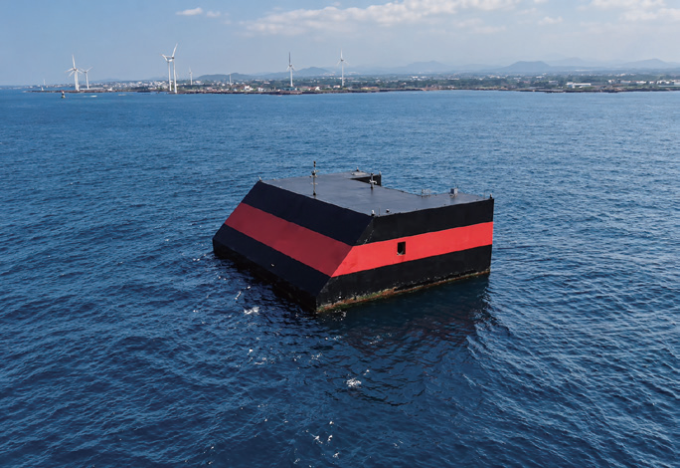
Wave power test site in Yongsu-ri, Jeju. The Korea Research Institute of Ships and Ocean Engineering conducts various studies using ocean energy such as wave power to produce green hydrogen. Provided by Dong-A Science
● Green hydrogen, a step toward energy self-reliance
Jeju turned its attention to green hydrogen in pursuit of energy self-reliance. “In 2006, a power outage lasting two and a half hours hit the entire island. The cause was a problem with the submarine transmission cable that supplies electricity from the mainland,” recalled Lee Il-gwon, head of the Household Energy Team in the Climate and Energy Policy Division at Jeju Special Self-Governing Province, in an interview at the provincial government office on September 17. “With oil prices soaring due to the Iraq War in 2003 and a large-scale blackout in 2006, Jeju began to take an interest in energy self-reliance.” To this end, the island has been expanding wind power and other renewables since 2008.
However, this expansion of renewables brought an unexpected problem: output curtailment. Output curtailment is a measure that reduces power plant output to prevent grid overload when generation capacity exceeds demand. In 2023, the number of output curtailment events in Jeju rose to 181 per year. To manage the variability of renewable power supply and demand, Jeju turned to hydrogen as a flexible resource that can adjust generation and consumption. The idea was to store surplus renewable electricity as hydrogen using water electrolysis. “Everything from production to refueling and utilization takes place within the island of Jeju. That’s why it’s attracting international attention,” Lee said.
Jeju’s green hydrogen project draws global interest because it attempts to integrate the island’s renewable energy conditions and energy challenges into a single system centered on hydrogen. This effort includes communicating the fact that hydrogen is a safe energy source. At the Hamdeok station, the reporter could see hydrogen being vented and directly experience its safety characteristics. Because hydrogen gas is less dense than air, any leakage disperses quickly into the atmosphere, reducing the likelihood of secondary damage compared with conventional gas stations, even in the event of an accident.
Lee emphasized that for the green hydrogen ecosystem to expand stably, “securing the economic viability of the early-stage industry is paramount.”
“Right now, the production cost of green hydrogen is relatively high due to the price of renewable electricity and the cost of water electrolysis equipment. In Jeju, demand is currently centered on mobility, so until the initial market matures, we need to develop business models linked with government support to bring production costs down. We also have to establish a virtuous cycle that ensures enough economic viability for private-sector participation.”
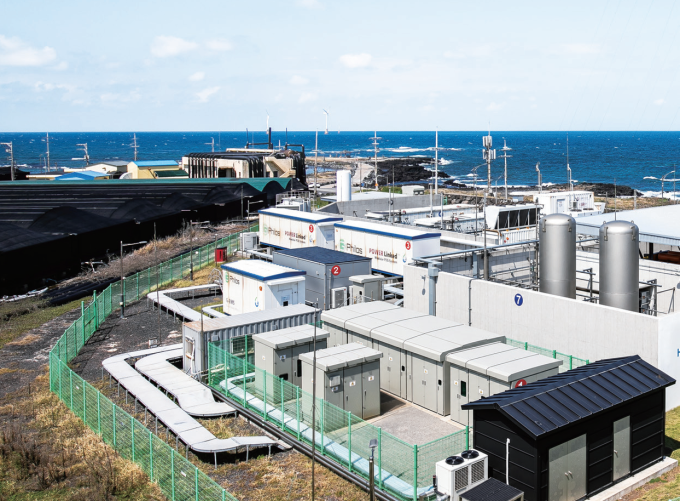
The Hangwon Green Hydrogen Production Facility on Jeju’s blue shoreline. Wind power is used to generate electricity that splits water into hydrogen and oxygen to produce hydrogen. Provided by Dong-A Science
● The future hydrogen society envisioned by Incheon, Ulsan, and Jeju
Hydrogen cities can serve as a window into energy systems beyond fossil fuels. Incheon, Ulsan, and Jeju are places where this change can be observed. In Incheon, robust hydrogen mobility infrastructure is already in operation. Ulsan is building a practical hydrogen ecosystem by linking hydrogen production and utilization based on massive industrial output and distribution networks. Jeju, by producing hydrogen from renewable energy, presents a vision of the ideal direction for a future hydrogen society.
Although Incheon, Ulsan, and Jeju each look different, they share a common trait: they leverage their regional strengths to solve current problems while laying the foundation for a future energy society. In other words, a society that combines the hydrogen infrastructure of Incheon and Ulsan with Jeju’s clean green hydrogen would represent the ultimate form of a hydrogen city. When asked for his final thoughts on the blueprint for hydrogen cities, Ulsan Mayor Kim Sang-uk responded as follows:
“The goal for Ulsan as a global hydrogen city is not simply to become a place that produces a lot of hydrogen. It is to build a city that supplies clean hydrogen at competitive prices, uses it safely, and gives citizens the confidence to rely on hydrogen. While utilizing our existing industrial base centered on by-product hydrogen, we will gradually expand the production base for clean hydrogen—including green and low-carbon hydrogen like in Jeju. Through this, we will create a hydrogen city that draws attention not only from Korea, but from around the world.”
※ This article was produced with support from Hyundai Motor Group. For more information on W2H technology and hydrogen energy, please click the banner below.
Copyright ⓒ DongA Science. All rights reserved.


