

A demonstration held at the Port of Tilbury highlighted how hydrogen is being deployed on large construction projects to replace diesel generators and fuel heavy machinery.
At the event, hosted last week, contractors and equipment manufacturers described how the future of construction sites powered by hydrogen will improve reliability and local air quality while reducing carbon emissions.
The showcase was held at the Port of Tilbury, in east London, following UK hydrogen producer GeoPura’s £32.6M contract win to supply what was described as the “largest volume of green hydrogen ever produced for a UK construction project” for use on Lower Thames Crossing (LTC).
Under the agreement, GeoPura will provide 2,500t of green hydrogen during the main construction phase of the new road and tunnel scheme. Located right next to LTC’s planned northern portal in Essex, the Port of Tilbury will host GeoPura’s production facility.
Six hydrogen‑powered generators from GeoPura are already operating on the LTC project, charging batteries for electric machinery at a work site in Essex.
On a visit to LTC’s site as part of the showcase, NCE witnessed a working compound in which hydrogen fuel cells are powering welfare units, site offices and electric machinery in place of traditional diesel generators.
The site, which is currently about half its planned size, is using mobile hydrogen storage units and two hydrogen generators to supply electricity to battery banks and on-site equipment.
Bouygues-Murphy JV (BMJV), who won the tunnel and approaches contract worth £1.34bn when awarded in December 2023, are the main contractor on the site.
BMJV LTC zero emissions construction management John Scannell told NCE how the organisation had generated about 39MWh of electricity using hydrogen to date, consuming roughly 2.33t of hydrogen.
This corresponds to about 16KWh of electricity per kg of hydrogen, he said. The hydrogen supply is currently provided by large trailers that each hold around 450kg of hydrogen.
“It’s working really well,” he said.
“It’s very efficient and no one’s really paying much attention to it anymore. It’s doing exactly what it was supposed to do.
“In fact, it’s probably doing more than it was supposed to do originally because when we were designing this compound, we were supposed to have a grid connection and the hydrogen setup was supposed to complement the grid connection, essentially, but the grid connection is late (and has yet to arrive).”
Scannell also stressed the system’s operational benefits, stating “you never see the light bulbs flicker in the office.”
He also pointed out how the current plan is for hydrogen to be used to power some of the construction equipment.
“We started our first trial and it’s been working really well,” Scannell said.
“This is all scalable and the intention is if that trial continues on its trajectory, we’ll be using it for a large piling rig for some ground improvement works at the northern portal to essentially launch our TBM.”
Last year, a JCB hydrogen‑fuelled digger, a British‑made machine, was deployed on survey work in Kent for LTC, the first such use outside a test environment.
Equipment manufacturers were also at the showcase where JCB demonstrated its hydrogen-combustion excavator. The excavator contains onboard storage of around 9kg of hydrogen, enabling roughly seven hours’ operation per refuel.
JCB principal engineer Mark Richards told NCE that hydrogen refuelling is faster than recharging large batteries, addressing a common logistics obstacle on sites without reliable grid access.
“We have a challenge with batteries as engineers, we can make batteries for the machinery, but the challenge is, where do you charge them? Especially when on a construction site where there’s no grid connection,” he said.
Richards further pointed out the difference in using diesel to power an excavator compared to hydrogen.
“Usually with a diesel engine the exhaust is black but because there’s no carbon in the engine, we get a very clean exhaust,” he said.
“There’s no carbon around the tailpipe and we get a clean engine too.”
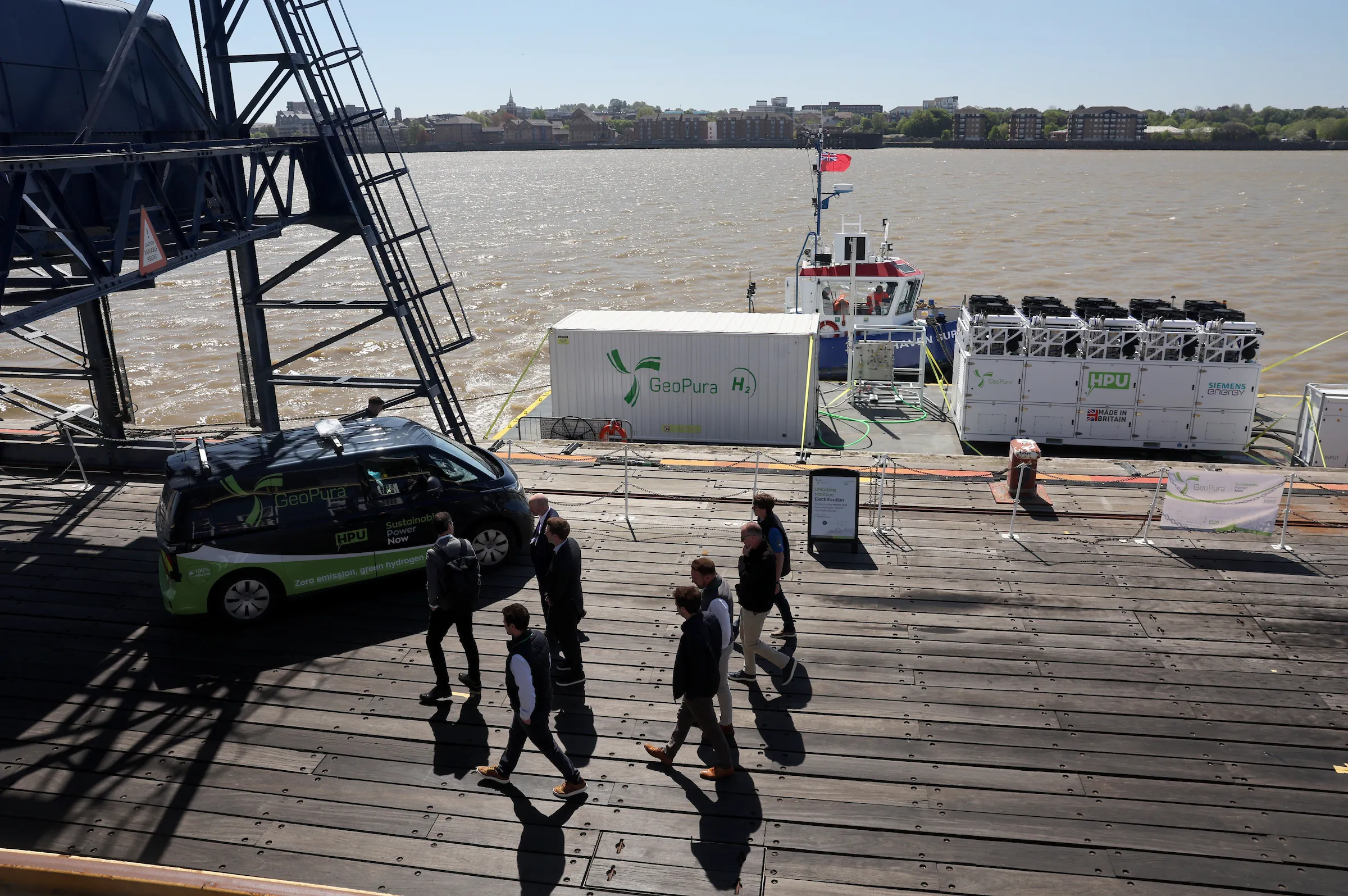
A GeoPura hydrogen fuel container used to refuel vehicles and equipment located on the Port of Tilbury’s pontoon
GeoPura chief hydrogen business officer Matt Barney further discussed the reliability of using hydrogen to power construction plant.
“It’s not carbon that drives them to come and use the system, it’s the fact it’s so reliable,” he said.
“There’s no moving parts in our hydrogen power unit, so it’s infinitely more reliable than a generator, which, if you work in construction, you know can break down rather more than you’d like them to.”
Materials handling firm Briggs, who supply equipment for the Port of Tilbury, sustainable solutions manager Mark Ridley also discussed with NCE how hydrogen can now be used to power heavier port equipment than it had previously been able to. He did, however, point out that continuous operation of large equipment depends on a steady hydrogen supply and local production infrastructure.
“We’re developing the port equipment, so the really heavy side of stuff, so things will be lifting the 40t containers off and on,” he said.
“The consumption rate pushing back through basically means that infrastructure and supply are key to be able to run big equipment constantly and continually.
“This is where Port Tilbury in conjunction with GeoPura for producing, or in any area that’s producing has a continued supply, makes it ideal, rather than relying on two trailers coming from wherever the production may be.”
With hydrogen now being considered alongside electric and hybrid options to replace diesel across the LTC fleet, the project’s sustainability and supply chain director Katharina Ferguson said it will plan to replace around 63Ml of diesel.
National Highways is using LTC as a proving ground for greener road building, seeking to embed sustainability and design thinking into the fabric of future major schemes. With this it has hailed LTC as a carbon neutral construction “pathfinder”.
Ferguson further stated how hydrogen being touted as an alternative on construction sites in the UK is down to supply chain partnerships LTC is intending to foster.
“Hydrogen fuel is easy because it can be taken far away through to our sites where we don’t have a grid connection,” she said.
“We started off a few years ago thinking, how on earth is this going to work? It’s only really through partnerships with supply chain that we have really been able to progress and see some of the really amazing ambition that we have come into fruition.
“The challenges don’t stop here though.
“We’ve got quite a lot of work to do, and probably one of the biggest challenges we have is behaviour, and it’s people thinking it can’t be done.”
As a result, Ferguson outlined how the main mantra of LTC is to challenge those that believe construction can’t be decarbonised in the way the project intends to do so.
“Everything we do with LTC is about challenging the status quo and the only way that we can change how our industry is moving forward and change how we currently do things, or actually just doing things better, is always asking why.”
Like what you’ve read? To receive New Civil Engineer’s daily and weekly newsletters click here.


