

A new report commissioned by the Australian Renewable Energy Agency (Arena) aims to breathe fresh hope into green hydrogen, by claiming that the capital cost of producing the potentially game changing renewable fuel could fall by 68 per cent in a little under a decade.
But the Worley-written report has won mixed reviews from experts, who note this optimistic outlook depends heavily on the levels of success achieved in China and the costs of core electrolyser technology coming down, significantly.
It provides a technology roadmap of the kinds of decisions developers could take to make their future projects cheaper, but does not address electricity costs or the absence of political will in Australia to develop the industry.
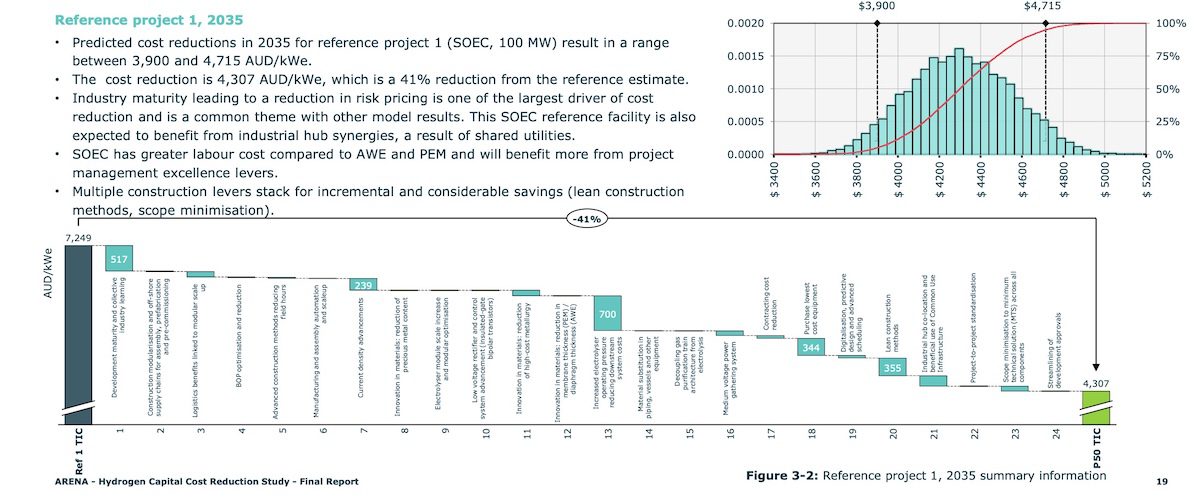
Where significant progress could be made, the report says, is in digitising construction processes and modular, standardised kit, which combined could provide the tools to cut costs by as much as 68 per cent by 2035.
Original equipment manufacturers (OEMs), could slice another 32 per cent out their costs, it says.

AWE is alkaline water electrolysis, PEM is proton exchange membrane technology, and SOEC is solid-oxide electrolyser cell technology. Image: ARENA
“Cost reduction in the long-term is expected, and this contrasts with cost increases in the years since 2020,” the report says.
“All estimates are of project-only costs, and exclude costs of finance, costs of operation and short-term supply chain impacts and other macroeconomic trends, such as foreign exchange fluctuation.”
Using the engineer’s favourite waterfall chart, it details the 24 “levers” available, from buying the cheapest kit to using AI to better organise staffing.
It also includes every industry’s favourite fantasy: streamlining development approvals.
But the report gets a thumbs up from the Australian program lead of Mission Possible Partners, James Boyle, who says it’s a credible, granular roadmap for reducing capital spending.
“It’s good as a piece of technoeconomic analysis,” he told Renew Economy.
“It’s ARENA doing what they can do, which is to say here are some things to do next, these are still positive signals.
“Is it going to help you secure a data centre or an end customer? No. So to my mind it doesn’t solve the issues the market is facing.
“It also doesn’t address the elephant in the room which is electricity costs.”
It does suggest green hydrogen can have the same learning curves as solar and wind and while it doesn’t fix the business case for the industry, it does give a sense of where technology innovation needs to be and the kinds of choices available to developers, he says.
The kinds of things that InterContinental Energy (ICE) is trying to do with prefab node templates that standardise electricity and hydrogen production designs, for example.
ICE told Renew Economy last week that it is “well progressed” with environmental approval to produce and sell 15 gigawatts (GW) of power from its proposed Australian Renewable Energy Hub (AREH) project in WA’s Pilbara region, with land tenure in place and an Indigenous Land Use Agreement for Phase 1.
Phase 1 is targeting 1GW of power to be transported via the proposed Pilbara Green Link transmission line to Port Hedland, to support renewable energy for power and the development of green iron, green ammonia and data-centre pathways within the Port Hedland region.
While ammonia export from the AREH site is no longer part of the development concept, AREH says renewable hydrogen production “remains an important long-term component of the project, particularly given the role hydrogen is expected to play in future green-iron production.”
Arena kicked $21 million into that project in January for technical studies, which ICE says is assessing the technical, commercial, environmental and stakeholder requirements associated with potential renewable hydrogen development at Boodarie to support future green-iron production.
Buy cheap
The biggest way to cut costs is simple to buy cheaper kit, the report says, but this is not always possible for Australian projects, many of which have taken equity investments from European equipment companies looking for sales channels.
“The biggest lever sounds really dumb but is just ‘buy the cheapest equipment available’, which I interpret to mean Chinese electrolysers,” Boyle says.
“They say this could have this 15 per cent capex cost reduction which is pretty meaningful for these sorts of things.
“The awkward bit… Chinese electrolysers still don’t comply with ISO standards, so there are some reasons people still don’t buy them. But partnering with Chinese supply chains [could] be a way forward for the Australian industry.”
Look to east Asia
Climate Energy Capital director Tim Buckley says attempting green hydrogen without access to China’s capital or capex costs, or its scale “is a waste of time”.
“Let China lead, prove it, and once they’ve commercialised it, partner with them,” he told Renew Economy.
“No one’s building anything in Australia. Even AREH has moved away from hydrogen, saying let’s just be an energy provider to the big mining companies. That was one of the biggest hydrogen proposals.
“Australia is doing nothing, nothing has got to financial investment decision.
“Let’s put it on hold for a year or two, let the dust settle, and see some dollars on the table in China.”
Envision has built a 350,000 tonne per annum green ammonia plant in Inner Mongolia and is exporting to Korea and Japan; it thinks green hydrogen could be on par with grey by 2028, but it is still proving up how to get there.
With commerciality, and electricity prices, still a sticking point the trick to getting cheap green hydrogen could be, in the absence of vertical integration with a solar or wind project, tapping very cheap debt from China, Korea or Japan.
Boyle says the electricity question could be avoided if developers were to tap Japanese or Korean technology providers, given those markets are the ones keenest for green molecules.
“[You could] do it at $50/MWh, but would have to be vertically integrated to make that possible,” he says.
“If you could get absurdly cheap Chinese, Japanese or Korean debt, some of those markets have a cost of capital that is structurally lower than ours so you can get debt at or lower than rates the CEFC would provide… that could have a material impact on your power price assumptions.”
But Buckley also laments the lack of political will behind a green hydrogen industry.
The federal government cut its original budget for production credits in half with only two projects funded, $432 million for Orica’s in-house ammonia project and $812 million for Copenhagen Infrastructure Partners’ 1,500 megawatt (MW) Murchison project in Western Australia.
South Australia shelved its half a billion dollar green hydrogen fund.
“We need Green Energy Statecraft to build a bilateral partnership with China before we bother talking about green hydrogen, otherwise we are talking about a solution at least a decade away,” Buckley says.
“For China I see green hydrogen as just 3-5 years away from commercial scale and deployment.
“My trigger point will be when China builds the next 10 green hydrogen plants… China’s commercial scale are still pilots, they’re still doing first-of-a-kind tests to debug it.”
To join more than 29,000 others and get the latest clean energy news delivered straight to your inbox, for free, click here to subscribe to our free daily newsletter.


