

WindShot in the arm
Floating wind in the U.S. got a jolt in 2022, when the Biden Administration announced a goal of bringing down the cost of electricity from the technology by 70%.
The effort, labeled the “Floating WindShot” was one of eight “energy earthshots,” patterned in their ambition after the “sun shot,” which helped slash the costs of solar power by an even greater margin, and the moon shot before it. The Floating WindShot funded research, stakeholder convenings, and critical infrastructure, like ports.
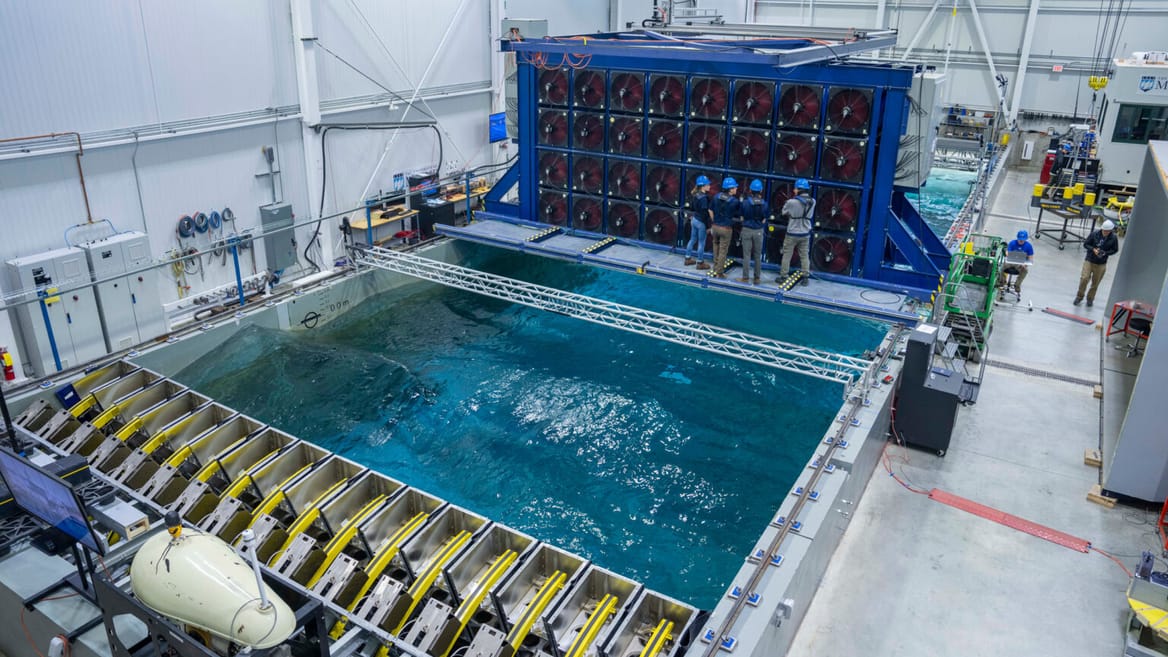
The U-Maine Center won one of the research prizes, as did several subsidiaries of European floating platform companies.
“The learning that happens all over the world is something that the United States was taking and learning from, and those were really important partnerships,” said Liz Klein, who was the director of BOEM for the final two years of the Biden Administration.
By the end of Biden’s presidency, BOEM had auctioned off several commercial-scale floating offshore wind lease sites in areas of the Gulf of Maine and California coast.
Strong headwinds
Substantial challenges remained, however, starting with cost. The levelized cost of electricity from a new floating wind project (a metric which attempts to make apples-to-apples comparisons between different types of energy possible) was about double that of fixed-bottom wind when the WindShot was announced, as much as three times that of a combined-cycle gas plant and roughly equivalent to a new nuclear plant, based on data from Lazard and the Department of Energy.
All of those other technologies, however, were mature. And if floating therefore had significant potential to catch up to the other technologies on price, it was (and is) also facing some growing pains.
“The deployment of commercial-scale [floating] projects is still held back by some technical challenges in our view that have yet to be solved,” says Harrison Sholler, a wind energy analyst at BloombergNEF, citing in particular the dynamic power cables and offshore substations needed to transmit power from the structures to land.
Then there is the supporting cast: the ports, supply chains, and transmission lines, without which a major floating project often can’t be built — all quite costly to develop.
Take just the ports, which, due to floating platforms’ size, must have large staging areas immediately adjacent to deep water. Studies conducted under the Floating WindShot priced the new and upgraded ports that would be required at upwards of $1 billion each.
These challenges, combined with macroeconomic factors like inflation and policy shifts (attributed by some to overambitious initial targets), have delayed auctions and permits for the next generation of projects in Europe and Asia.
The administration has also, for now, effectively ended further offshore leasing. It has bought back many existing leases, including some suitable for floating wind. The deals have often included the lessees reinvesting the money into gas power plants and export terminals that do not serve the same regions as the proposed projects.
“Under President Trump, companies are shifting investment back toward dependable, secure energy infrastructure that can power our economy and lower utility costs,” Interior Secretary Doug Burgum said after announcing one such deal with Invenergy, a developer that held leases off both California and Maine.
Those states and at least seven others have sued, seeking to invalidate the agreements.
And the administration has cancelled grants made by the Biden administration to support wind port construction, including in California and Salem, Massachusetts. “[W]e are prioritizing real infrastructure improvements over fantasy wind projects that cost much and offer little,” Transportation Secretary Sean Duffy said at the time.
These actions have, to say the least, tarnished the image of the U.S. as a potential hub for investment in the sector, according to knowledgeable observers.
“Financiers and developers now see the U.S. as a politically risky market for offshore wind development,” said Sholler.
It’s unclear if they’ll ever come back.
Keeping the fire burning
Edwards leads a network of early career professionals at the Supergen Offshore Renewable Energy Hub, which connects academia, industry, and policymakers in the U.K. She acknowledged the difficulties that some of her American colleagues face in continuing to partner on offshore wind research today: “It’s been hard for the U.S.-based people to continue some collaborations, not because of lack of desire but because of not having the funding or not being able to be publicly seen doing this research.”
Yet beneath the surface, where research happens and projects are launched, technology, expertise, and funding for floating wind do continue to circulate between Europe and North America.
Canada has taken over pole position to develop floating wind in North America, with Nova Scotia launching a solicitation for 5 GW of offshore wind, including sites suitable for floating, last year.
Although the Advanced Structures and Composites Center has had to let go of some staff working on wind energy and reassign others, it is still signing contracts to test component technologies at its facilities. And the center’s private sector spinoff, DeepCWind, is in the running for several contracts to supply planned floating wind projects in Europe, according to Viselli and Dagher.
Principle Power, another American firm, licensed its WindFloat platform technology to demonstration projects in Portugal, Scotland, and France, where it has ongoing contracts for operations and maintenance. A company spokesperson declined to answer questions.
In Europe and Asia, several ongoing collaborative efforts bring industry together, at times with academics and policymakers, to solve the technological and policy barriers to commercialization.
“If you all collaborate, there’s certain bits and pieces of the puzzle that become cheaper and less risky for yourself,” Arturo Anderson, who leads one such collaboration for Carbon Trust UK, said of developers’ motivation to share information.
Dagher said that through all the challenges, his team has kept “the fire” that drove them to develop this technology burning.
“What you learn in life is that you really need to believe in what you do,” he said. “If you believe in what you do, and it’s a good thing for society, it’s a good thing for the people involved—you don’t really stop.”
This reporting was supported by a Transatlantic Media Fellowship from the Heinrich Boll Foundation.


