

A new path has opened for producing high-efficiency green hydrogen by simultaneously ensuring both water electrolysis performance and stability. Water electrolysis is a technology that produces clean hydrogen by electrolyzing water. However, it has the limitation that bubbles generated during the electrolysis process block the channels, reducing efficiency. A Korean research team has solved this problem by developing an innovative technology that allows bubbles to escape quickly, like a wide-open expressway, thereby increasing hydrogen production efficiency.
On May 28, KAIST announced that the research team led by Professor Jinwoo Lee from the Department of Chemical and Biomolecular Engineering collaborated with Dr. Seongjun Kim’s team from the Korea Research Institute of Chemical Technology and Professor Jangyong Lee’s team from Konkuk University. Together, they successfully ensured both the performance and stability of water electrolysis by newly designing the pathways for water and gas flow within the catalyst layer.

(Top row from left) Jaeho Byun, PhD candidate at KAIST; Minkyeong Ban, PhD candidate at KAIST; (Bottom row from left) Jinwoo Lee, Professor at KAIST; Seongjun Kim, PhD at Korea Research Institute of Chemical Technology; Jangyong Lee, Professor at Konkuk University. KAIST
View original image
First, the joint research team created a low-tortuosity structure using two-dimensional mesoporous carbon (a thin carbon structure with numerous nanometer-sized pores), which allows substances to move smoothly. Instead of narrow and complex alleys, they realized “expressway-like channels” inside the catalyst layer, enabling water and gas to pass through rapidly.
In addition, ruthenium (Ru) nanoclusters (ultrafine metal particles just a few nanometers in size) were stably anchored on the carbon surface to increase the hydrogen generation reaction rate, and the interfacial structure (the boundary where different materials meet) was controlled so that the catalyst would not be damaged even during long-term operation.
When this technology was applied, it was confirmed that bubbles generated during the water electrolysis process did not accumulate inside the catalyst layer but were quickly discharged. The reaction also maintained stability even in extreme environments with high current flow.
The core of this research is that the team addressed existing problems by newly designing the very pathways through which hydrogen is produced. Conventional water electrolysis devices suffered from bubbles accumulating inside during the reaction process, which hindered the flow of water and electricity, resulting in poor performance. In contrast, the joint research team solved this problem by redesigning the catalyst layer structure so that bubbles could escape rapidly.
Currently, hydrogen is attracting attention as a key clean energy source in the carbon-neutral era, but high production costs and low system efficiency have been significant limitations. In particular, conventional high-performance water electrolysis devices required large amounts of expensive precious metals, making mass commercialization challenging.
In contrast, the technology developed by the joint research team is significant in that it opens the way to produce eco-friendly hydrogen more efficiently and at a lower cost.
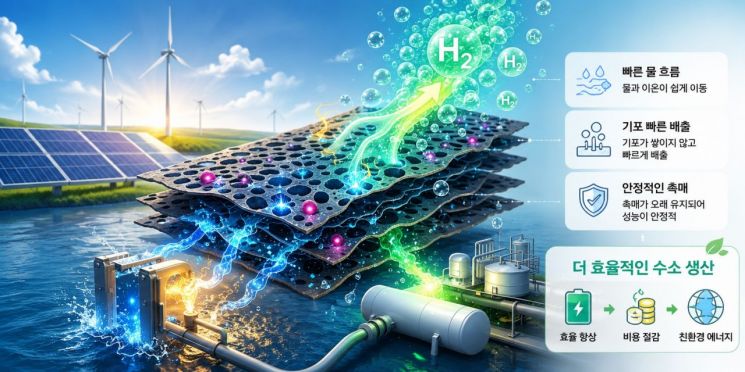
Overview Diagram of Green Hydrogen Production Technology Based on 2D Mezoporous Catalyst Layer (AI Generated). KAIST
View original image
The joint research team emphasizes that this technology demonstrates the potential to achieve high performance and stability with only small amounts of precious metals. Based on this, they foresee that the technology can be expanded and applied to various fields such as large-scale green hydrogen production, eco-friendly power generation systems, hydrogen vehicles and eco-friendly mobility, and carbon-neutral industrial processes.
Professor Jinwoo Lee stated, “The key to this research is that we improved water electrolysis efficiency by newly designing the pathways through which energy flows. It is possible to produce high-efficiency green hydrogen with only small amounts of precious metals, which will also help accelerate the commercialization of eco-friendly hydrogen production in the future.”
Hot Picks Today

Will the ‘255 Trillion Sell-Off Bomb’ Be Defused? The Fate of the KOSPI Hinges on the National Pension Service’s Decision
Meanwhile, Jaeho Byun and Mingyeong Ban, PhD candidates at KAIST’s Department of Chemical and Biomolecular Engineering, participated as co-first authors. The research results were published online in the international energy journal “Joule” on May 22 and will be included in the official September 16 edition of Joule.
This content was produced with the assistance of AI translation services.
© The Asia Business Daily(www.asiae.co.kr). All rights reserved.


