

Airport World shines the spotlight on Sydney Airport’s new electric bus fleet and hydrogen-powered ground equipment trials at Exeter Airport.
Sydney Airport in Australia has unveiled its new electric bus fleet featuring bespoke First Nations artwork celebrating the stories and culture of the Dharawal People of Coastal Sydney.
The new fleet features 50 new electric buses which will progressively replace diesel-powered vehicles used to transport passengers and staff across landside and airside operations.
The move is an important milestone for the airport as it transitions to net zero carbon emissions for scope 1 and 2 by 2030.
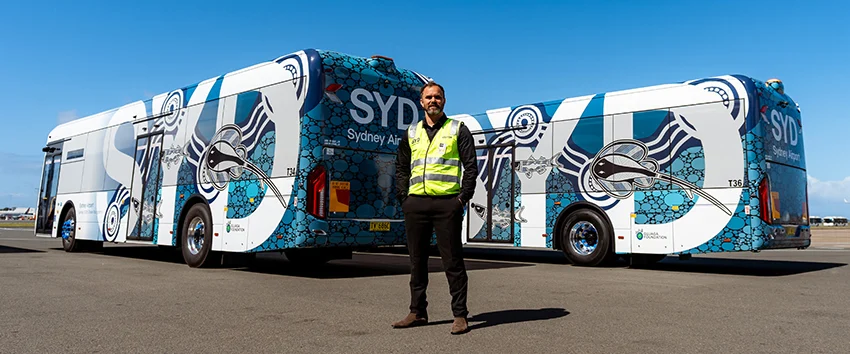
Marking the significance of the project, the buses feature commissioned artwork by Shane Youngberry, a proud Dharawal artist, developed in partnership with the Gujaga Foundation.
Sydney Airport’s group executive for government relations, sustainability and legal, Karen Tompkins, noted: “The new fleet meets the airport’s commitment to Net Zero for Scope 1 and 2 by 2030, while celebrating the cultural significance of the lands on which it operates.
“The 50 new electric buses reduce our scope 1 emissions from our operations, with the bus being powered by 100% renewable through our power purchase agreement.
“Importantly, they also improve the passenger experience by providing quieter, cleaner and more comfortable transport across the airport precinct.”

Meanwhile, in the UK, it is being claimed that a trial has generated new operational evidence that could help the global aviation industry understand how hydrogen-powered ground equipment can be introduced safely and practically, and what is needed to support wider adoption.
The study, led by Exeter Airport, Cranfield University and ULEMCo, tested a dual-fuel hydrogen–diesel ground power unit over multiple days in winter operating conditions.
A new Cranfield University report finds that the equipment performed safely and reliably, delivered measurable reductions in diesel use and carbon emissions, and required little change for the ground teams operating it.
The findings are also said to provide insights into where dual-fuel hydrogen technology may be most effective, suggesting that its greatest benefits could be achieved in equipment used continuously or for longer operating cycles.
The Winter Operations HyGPU project follows the groundbreaking Zero Carbon Turn trial at Exeter Airport in April 2025, which achieved several UK firsts when three different hydrogen-powered technologies supported the live turnaround of a TUI Boeing 737.
Across eight operational days, the equipment completed 15 tests lasting a total of almost six hours. It consumed 7.41kg of green hydrogen, displacing an estimated 24.23 litres of diesel and avoiding approximately 63.9kg of carbon dioxide emissions.
No safety incidents or significant operational problems were reported. Airport ground crew also found little practical difference between operating the converted equipment and using a conventional diesel GPU.
Dr Thomas Budd, associate professor of airport decarbonisation at Cranfield University and author of the report, said: “This trial has taken us another step beyond a one-off demonstration and given us valuable operational evidence about how dual-fuel hydrogen equipment performs in winter conditions.”


