

India’s growing solar deployment, expansion of battery energy storage systems (BESS) and emerging green hydrogen sector are creating new opportunities for power conversion and power quality solutions, according to Rajesh Kaushal, Vice President and Business Group Head for Power & Energy Solutions/Energy Infrastructure & Industrial Solutions at Delta Electronics India & the SAARC region.
Kaushal said the growth in utility-scale solar is supporting demand for central inverters, while C&I installations are driving demand for string inverters.
The battery energy storage market has also recorded significant growth. According to data published on the Central Electricity Authority (CEA) website, sourced from the India Energy Storage Alliance (IESA), India had 63.1 GW/198.4 GWh of battery energy storage system (BESS) projects with a capacity of 1 MWh and above across various stages of development as of Sep. 30, 2026. Of the total, 5.3 GW/14.5 GWh across 19 projects was operational, while 27.7 GW/79 GWh across 63 projects under construction. Another 9.7 GW/28.9 GWh across 28 projects was awarded, while 20.4 GW/76 GWh across 85 projects at the tendering stage.
Kaushal said besides solar and battery storage, Delta Electronics is also seeing a lot of opportunities coming up in power quality.
To address the growing demand across these segments, the company is offering central inverters, power conversion systems (PCS), energy management systems and power quality solutions.
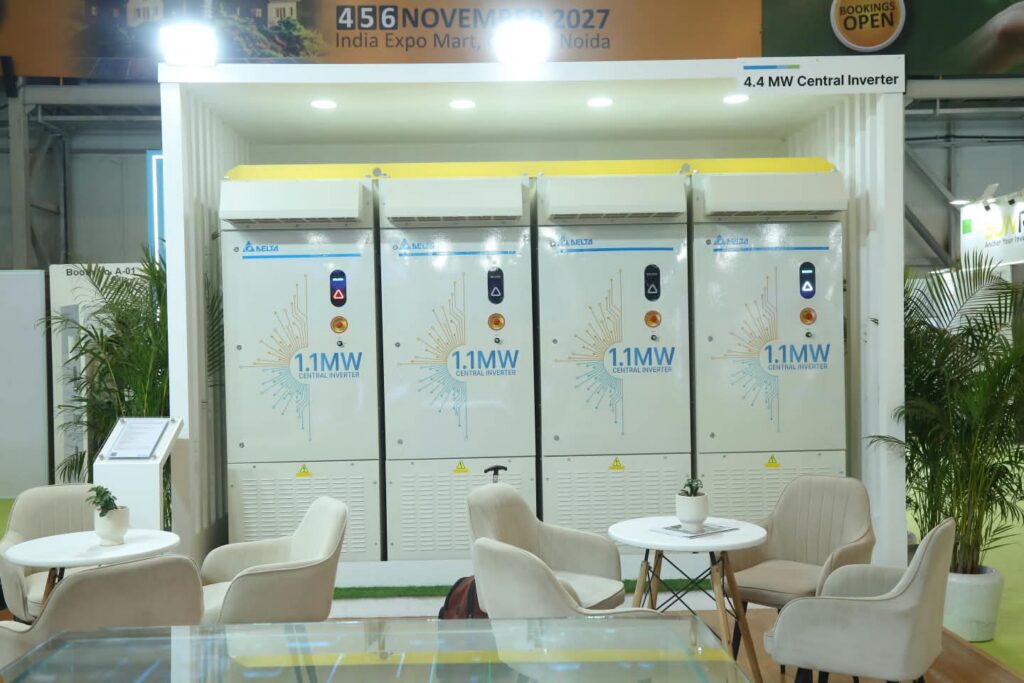
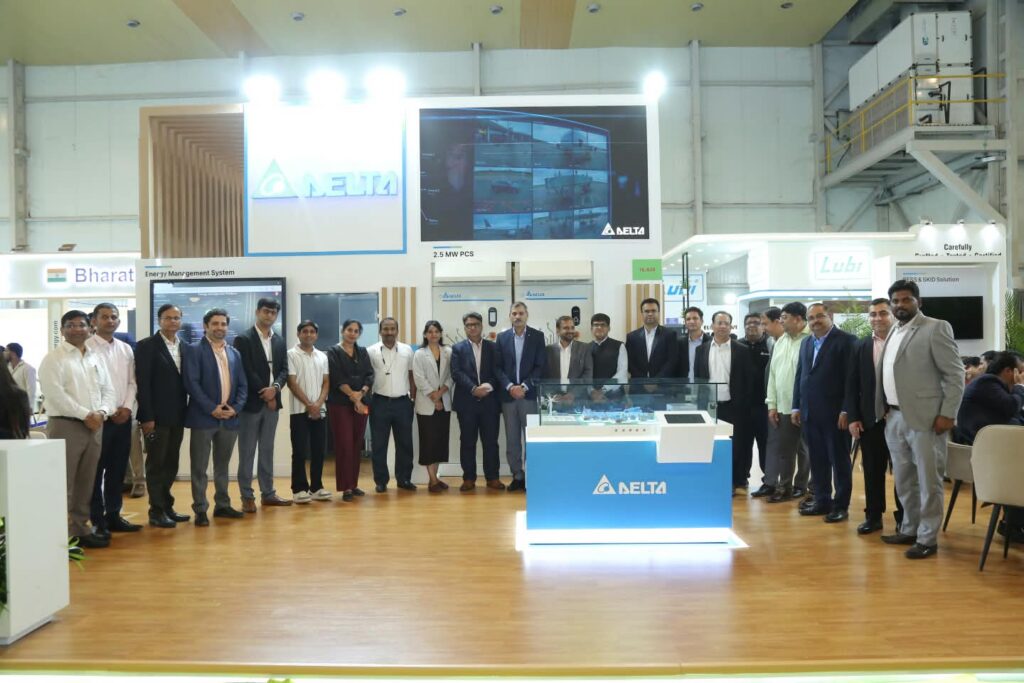
At the product level, Delta showcased a 4.4 MW central inverter for utility-scale solar applications and a 2.5MW PCS for battery energy storage systems.
“PCS is a bidirectional power conversion system which can power the battery energy storage system,” Rajesh explained.
The company is also offering 1.25 MW DC-DC converters for projects adopting DC-coupled configurations. In such systems, DC power generated by solar installations can be integrated with battery storage before being converted for grid use.
Rajesh said Delta is among the few manufacturers offering megawatt-scale DC-DC converters for utility-scale applications. In the power quality segment, the company is offering solutions commonly referred to as STATCOMs or static var generators (SVGs). Its solutions are available at medium-voltage levels of 6.6 kV, 11 kV and 33 kV.
Green hydrogen creates new opportunities
Green hydrogen is emerging as another growth area, particularly as lower solar power costs improve the economics of renewable hydrogen production.
Rajesh said green hydrogen could support the decarbonisation of hard-to-abate industries that cannot easily transition to conventional renewable electricity.
“Green hydrogen will actually go into hard-to-abate sectors, which cannot be decarbonised by traditional energy,” he said, identifying the steel, fertiliser and heavy engineering industries as potential demand segments.
Green ammonia also presents an export opportunity for India. Hydrogen can be combined with nitrogen to produce green ammonia, which can then be supplied to international markets.
Delta is positioning itself to serve this emerging market through high-capacity power supply systems for electrolyser applications.
Kaushal said the company is also aligning its product portfolio with India’s emerging electrolyser manufacturing ecosystem, which includes domestic manufacturers working with international technology partners.
Manufacturing and localisation plans
Kaushal said Delta Electronics designs and develops most of its products in India, including central inverters, PCS, energy management systems and power quality solutions.
However, its power supply systems for green hydrogen applications are currently sourced from its global business unit in Taiwan. The company intends to leverage its global technology platforms and gradually localise production.
The company plans to localise its green hydrogen power supply systems in India in 2027.

