

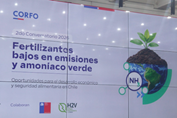
The pilot phase of a Chilean green fertilizer project is due to enter service by year-end as the focus sharpens in the country on ways to ease exposure to global supply and price volatility and spur resilience.
A pillar of Chile’s updated green hydrogen strategy involves using green hydrogen and its derivatives in local production value chains.
Belonging to generator Comasa and co-financed by state development agency Corfo, the initiative is designed to produce a nitrogenous fertilizer using green hydrogen, captured carbon dioxide and combustion ash from a company biomass-fired power plant.
The circular economy project is the first of its kind in farming nation Chile, which imports over 80% of its fertilizers but has potential to produce them locally and sustainably, a Corfo event heard.
Initially, up to 2,000t/y of key input ammonia would be produced by combining hydrogen, obtained via electrolysis, and nitrogen, obtained via air separation technology. This would then be combined with flue gas and ash from the power plant to produce fertilizer.
Comasa has the green light from environmental review service SEA to eventually expand the La Araucanía region project, branded Comasa H2V, to produce up to 40,000t/y fertilizer, via 10MW of electrolysis capacity and 7,300t/y ammonia. This second-phase work would involve producing hydrogen on-site as well as purchasing it.
Once the pilot project is completed in December, the next stage involves validation of the fertilizers in the field, work that is due to get underway in March.
To help with de-risking, given Comasa is blazing a technological trail, Corfo is providing financing for 60% of the price tag.
Macarena Aljaro, deputy director of Corfo’s technology programs, told BNamericas following the event: “Without doubt it’s a pioneering initiative for Chile.”
Comasa was awarded the support following a Corfo call, held several years ago, for projects that employ green hydrogen in the agricultural sector and tick the circular economy box.
Aljaro cited a global trend of consumers placing increasing value on products that are produced sustainably.
On the overall objective of the Comasa project, Aljaro said: “To be a hub for green fertilizer production for southern Chile. That’s the goal.”
Global prices of fossil fuel-based fertilizers climbed following the outbreak of the war in the Middle East in the first half of the year. Supply, particularly in Asia, has also been impacted, putting food security at risk. Extreme weather events across the globe, particuarly droughts in Europe, have generated further challenges.
Chile imported around 500,000t of nitrogenous fertilizer urea in 2025, a figure that illustrates the potential for import substitution, space in the market.
On the global markets, in April this year, the price of urea spiked at US$857/t, the highest since April 2022, when a record price of US$925/t was registered. In 2015-20, prices averaged US$235/t.
In terms of prices paid by farmers in La Araucanía region, these reached US$1,341/t in June, compared with levels of under US$600/t seen last year. In a presentation, Comasa said prices associated with its solution were in the ballpark of those being seen today.
Farmers seek environmental, financial and social sustainability, said Diego Machuca, an analyst at Chile’s national agricultural society SNA.
“Today the problem isn’t just about producing, but also securing inputs,” said Machuca, adding that the global food system has reduced capacity to absorb and respond to shocks.
Large global producers of nitrogenous fertilizers include China, US, Russia and India. Gulf Arab states are also producers
In general, in terms of the impact fertilizer price premiums – typically associated with sustainable variants – have on the price tags of consumer packaged goods, this is less than 1%, delegates heard. This, in turn, illustrates the scope for non-fossil fertilizer projects in the region.
Energy transition expert and consultant Hans Kulenkampff said: “There are many studies that have calculated how the fertilizer or ammonia price premium passes down the chain […],” adding that it works out to a small percentage.
Kulenkampff was bullish on the prospects for a plant in the region: “I believe a fertilizer plant will be built on Latin America’s Pacific coast […]. No question about it. What I don’t know is whether it will be in Peru, Colombia or Chile.”
A US$2.5bn green ammonia project, branded Volta, has secured an environmental license in Chile. The project, planned by MAE for sundrenched Antofagasta region, is the most advanced of its kind in the country.
Antofagasta is home to other ammonia projects. Far-south region Magallanes, which boasts world-class wind resources, also has ammonia initiatives. This week, US$11bn Magallanes green ammonia project HNH Energy was granted an environmental license.
The Chilean project pipeline is going through a cleaning phase, leaving only the most robust standing.
Elsewere in the region, a green fertilizer project in Paraguay has reached FID. In Argentina, oil and gas company Pampa Energía has reached FID on a fossil fuel-based fertilizer project.
In Colombia, senator Juan Espinal has introduced a bill to promote the production and sale of low-emission hydrogen-derived fertilizers.
ALSO READ: Where Chile’s MAE sees potential offtake for US$2.5bn ammonia project Volta
ALSO READ: Chile’s multibillion-dollar renewable hydrogen project pipeline: State of play
ALSO READ: Latin America’s US$240bn hydrogen projects
Overall, in the region total demand exceeds 15Mt ammonia equivalent, with Brazil – heavily reliant on imports – accounting for around 9Mt of the total.
(The original version of this content was written in English)


