

Pretty much every type of energy is getting more expensive in the U.S., but clean energy is still a better bet than fossil fuels.
That’s the topline from investment bank Lazard’s latest annual report on the levelized cost of energy, or LCOE — a metric widely used to compare how expensive different sources of electricity are. Put simply, it expresses the present-day price of generating a megawatt-hour of electricity from a solar farm, a gas plant, or another power source, all while accounting for that source’s full lifetime operating costs. For example, it takes into consideration that a solar farm’s fuel and operational costs are tinier than a fossil fuel plant’s.
For the last decade, Lazard’s reports have basically reached the same conclusion: Onshore wind and utility-scale solar have a lower LCOE than fossil fuels. While that’s still true this year, the average LCOE of onshore wind and solar did surge by 11% and 18%, respectively, from last year, thanks to the loss of federal renewable energy tax credits, increased tariffs, high interest rates, and other challenges.
But the fossil fuel sector also faced headwinds over the past year, as a supertight market for turbines drove up the cost and timeline of building a gas plant. The LCOE of gas power from modern “combined-cycle plants” — which was already about $20 higher per megawatt-hour than solar’s and onshore wind’s in 2025 — rose by 15%. Still, those higher prices and construction delays haven’t stopped developers from pursuing ambitious gas projects as the AI boom sparks a scramble for on-demand power.
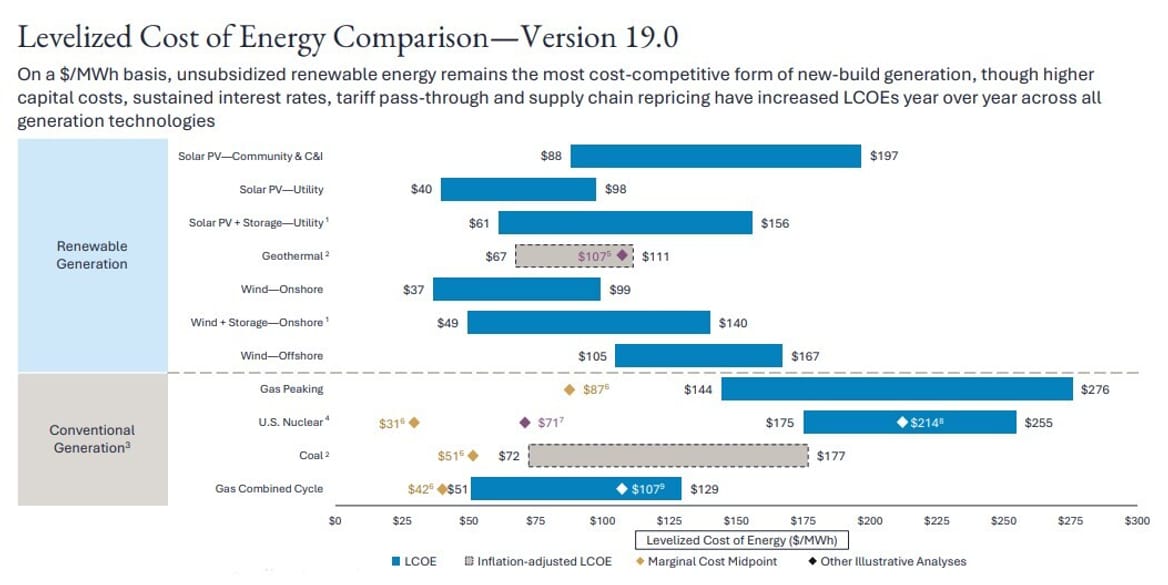
Although LCOE is a pretty handy way of comparing energy costs across sources, it has its limitations, the Clean Air Task Force argued in a report last year. The climate advocacy group says LCOE isn’t a good method for long-term decarbonization planning because it doesn’t account for many real-world concerns, like a power source’s land and health impacts or its ability to generate nonstop electricity.
Even so, plenty of evidence indicates that renewables will retain their cost-competitive edge. For one, they’re not subject to rocky fuel prices like oil and gas are — something that’s been on full display as conflict in the Middle East continues. And while solar and wind power generation remain at the mercy of the weather, batteries are making their fatal flaw of intermittency a thing of the past.
More big energy stories
A first-in-the-nation data center ban
New York has become the first state to enact a moratorium on building hyperscale data centers. After a few weeks of will-she-won’t-she uncertainty, Gov. Kathy Hochul (D) signed an executive order barring data center construction for up to a year as the state hammers out regulations.
The move comes as data centers face criticism from both sides of the political aisle over their power use, and especially their potential to drive up electricity costs for residential utility customers. But despite the facilities’ widespread unpopularity, other governors have been reluctant to go as far as Hochul. In April, Maine Gov. Janet Mills (D) vetoed a bill that would have halted construction through November 2027. And just this week, Michigan Gov. Gretchen Whitmer (D) asked data center developers to pledge they wouldn’t raise power costs for state residents, but stopped short of calling for a total ban on construction.


