

China Energy Engineering Group (CEEC) has started construction of the second phase of the Qingqing No. 1 Songyuan Hydrogen Energy Industrial Park in Songyuan, Jilin Province, China. The US$1.62 billion expansion is expected to increase the facility’s annual green ammonia production capacity to 600,000 metric tons. This is in a bid to strengthen China’s ambitions to commercialize renewable hydrogen and low-carbon fuels at industrial scale.
According to CEEC, the RMB 10.83 billion (US$1.62 billion) expansion will double the project’s renewable energy capacity to 1,600 megawatts (MW).
Songyuan Hydrogen Energy Industrial Park Phase 2 Expansion: Project Overview
The expansion is designed to build on Songyuan Hydrogen Energy Industrial Park Phase 1 operational experience while improving production efficiency. The second phase of Songyuan Hydrogen Energy Industrial Park also aims to reduce the cost of manufacturing green ammonia.
CEEC expects the second phase to lower unit green ammonia production costs by more than 10%. This is compared with Phase 1 through optimized facility design, upgraded domestic equipment and digital industrial management systems.
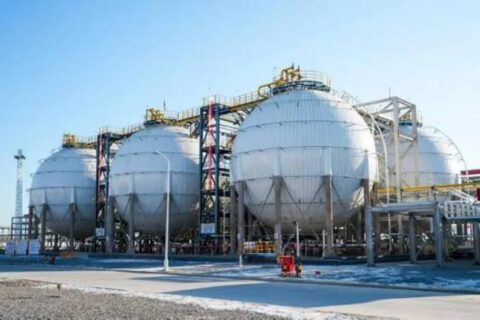
Qingqing No. 1 project to scale up green fuel production
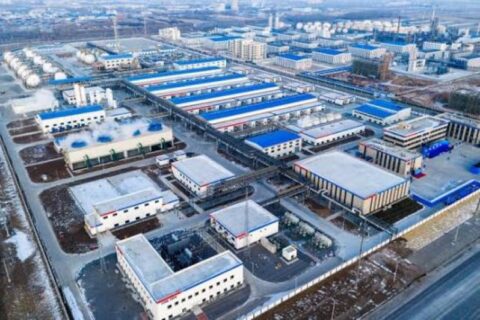
Songyuan Hydrogen Energy Industrial Park is designed to integrate renewable electricity generation with hydrogen production, ammonia synthesis and methanol manufacturing. The facility uses renewable power. This includes wind and solar energy. They will be used to produce hydrogen through electrolysis before converting it into fuels and chemical products.
The project also addresses a major challenge in the renewable energy sector. This is the storing and transporting hydrogen economically. Converting hydrogen into ammonia and methanol provides alternative ways to transport and utilize renewable energy. This is also importantly particular to industries where direct electrification remains difficult.
According to CEEC’s project information, the industrial park is being developed in phases. The broader plan involves 3,000 MW of renewable energy generation and large-scale production of green hydrogen, ammonia and methanol. The current expansion will increase the site’s green ammonia output to 600,000 metric tons annually.
The facility also incorporates flexible production technologies. These are designed to match fluctuations in renewable electricity generation with the continuous energy requirements of industrial chemical processes. This integration is intended to improve the utilization of renewable power while maintaining stable production.
Songyuan Phase 1 establishes operational foundation
The first phase of the Songyuan Hydrogen Energy Industrial Park started operations in December 2025. It established the initial production and operational framework for the larger industrial park.
Phase 1 includes 800 MW of renewable energy generation capacity. It was designed to produce 45,000 metric tons of green hydrogen and 200,000 metric tons of green ammonia annually, alongside green methanol production. The development also incorporates hydrogen storage.
Contractors involved
China Power Engineering Consulting Group’s Northeast Institute served as the engineering, procurement and construction (EPC) contractor for the original project, according to CEEC.
The wider project has also involved specialist equipment suppliers. This includes Sungrow Hydrogen for hydrogen production systems, Goldwind for wind turbines and CIMC Enric subsidiaries for hydrogen storage equipment.
ISCC EU certification
The project received ISCC EU certification in December 2025, according to CEEC. This supported its positioning in international renewable fuel markets. Certification is particularly relevant as prospective buyers increasingly seek evidence of the origin and environmental attributes of low-carbon fuels.
Songyuan Hydrogen Energy Park and green ammonia targets maritime and industrial markets
A major potential application for the expanded facility is the production of green ammonia for international shipping. Ammonia can be used as a marine fuel or as a hydrogen carrier. This way, it offers a potential route to reduce emissions in long-distance shipping and other energy-intensive sectors.
October 2026 milestone
Songyuan Hydrogen Energy Industrial Park – the world’s largest green hydrogen-ammonia-methanol project – reached an important operational milestone in October 2026. Ammonia produced at the facility was used in a ship-to-ship green ammonia bunkering operation in Zhoushan, Zhejiang Province.
The demonstration connected production with storage, transfer and maritime fuel application – an example of how renewable fuels could be supplied to the shipping industry.
Green ammonia and chemical markets
Green ammonia could also serve established chemical markets. This includes fertilizer manufacturing. However, its environmental benefits depend on the production pathway, electricity source, supply-chain emissions and eventual use.
Ammonia combustion and handling also require specialized safety measures. The development of suitable vessels, engines and bunkering infrastructure also remains important to broader adoption.
By expanding production, CEEC is seeking to improve the economics of green ammonia. The state-owned company also seeks to position Chinese suppliers to serve emerging international markets. Industry interest in renewable fuels is also growing as shipping operators and industrial consumers explore alternatives to conventional fossil-derived fuels.
Songyuan hydrogen energy park expansion advances China’s clean energy industrial strategy
The Songyuan development reflects a broader effort to move renewable hydrogen technologies beyond pilot projects and into large-scale industrial applications. China has substantial wind and solar manufacturing capacity.
The East Asia country also has established chemical production infrastructure and major domestic demand for ammonia. This provides a foundation for integrating renewable electricity with fuel manufacturing.
Scaling up integrated facilities can also help distribute capital costs across larger production volumes. It will also improve the utilization of equipment.
Nevertheless, the commercial viability of green ammonia will depend on renewable electricity prices and electrolyzer performance. This is alongside financing costs, infrastructure availability and long-term purchase agreements.
The second phase of Songyuan Hydrogen Energy Industrial Park will therefore serve as benchmark. It will be a test on whether technological improvements and larger production volumes can make renewable ammonia more competitive with conventional ammonia produced using fossil fuels.
The expansion also has implications for international trade. Potential exports of renewable ammonia could connect Chinese clean-energy manufacturing with shipping and industrial demand in overseas markets. Market access will however depend on certification requirements, fuel standards, logistics and the willingness of buyers to pay for lower-carbon products.
With Phase 1 operational and Phase 2 now under construction, the Qingqing No. 1 Songyuan Hydrogen Energy Industrial Park is moving toward a larger-scale role in China’s emerging green hydrogen and renewable fuel industry. Its performance will provide an important indication of whether integrated wind, solar, hydrogen and chemical production can deliver the cost reductions needed for wider commercial adoption.
Qingqing No. 1 Songyuan Hydrogen Energy Industrial Park: Project Fact Sheet
Name: China Energy Engineering Group Songyuan Hydrogen Energy Industrial Park (Integrated Green Hydrogen-Ammonia-Methanol Project)
Project brand: Qingqing No. 1.
Project location: Songyuan City, Jilin Province, China
Renewable energy site: Qianguo County, Songyuan City
Chemical production site: Jilin Songyuan Petroleum and Chemical Industry Circular Economy Park
Project owner and developer: China Energy Engineering Group Hydrogen Energy (CEEC Hydrogen Energy Company)
Project construction company: Energy Construction Green Hydrogen, Ammonia and New Energy (Songyuan) Co., Ltd.
Parent group: China Energy Engineering Group Co., Ltd.
Initial construction start: September 2023
Phase 1 operational milestone: December 16, 2025
Phase 2 construction start: October 20, 2026
Total planned renewable energy capacity: 3,000 MW (3 GW)
Phase 1 renewable energy capacity: 800 MW
Phase 1 annual green hydrogen production capacity: 45,000 metric tons
Annual green ammonia production capacity at Phase 1: 200,000 metric tons
Overall planned annual green ammonia production: 600,000 metric tons
Overall planned annual green methanol production: 60,000 metric tons
Total planned investment: RMB 29.6 billion (US$4.4 billion)
Hydrogen production technology: Alkaline water electrolysis powered by renewable electricity
Renewable energy sources: Wind and solar
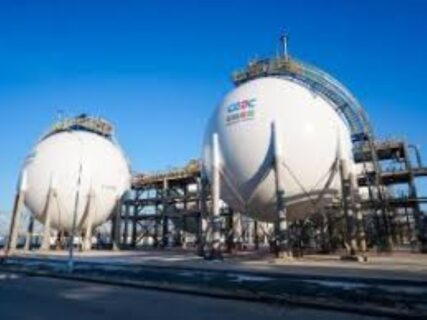
Hydrogen storage infrastructure: Medium-pressure spherical tanks and high-pressure compressor buffer tanks
Certifications: ISCC EU certification
Government recognition: Selected for China’s green and low-carbon advanced technology demonstration program
Who is involved in the construction of the largest green hydrogen-ammonia-methanol project in the world?
Owner and developer: China Energy Engineering Group Hydrogen Energy Co., Ltd.
Construction company: Energy Construction Green Hydrogen, Ammonia and New Energy (Songyuan) Co., Ltd.
Parent company: China Energy Engineering Group Co., Ltd.
EPC contractor: Northeast Electric Power Design Institute Co., Ltd., under China Power Engineering Consulting Group Co., Ltd. (CPECC)
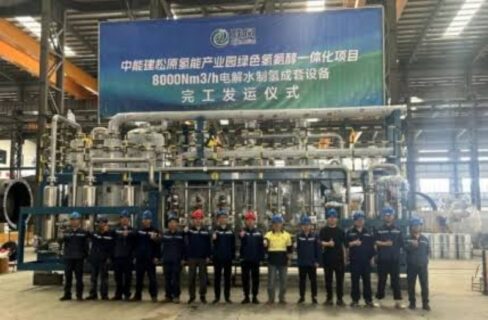
Hydrogen production equipment supplier: Sungrow Hydrogen. Sungrow supplied a 1,000 Nm3/h alkaline hydrogen production system for the project.
Storage equipment supplier: Jingmen Hongtu Special Aircraft Manufacturing Co., Ltd. The company was awarded the Phase 1 contract for 15 medium-pressure hydrogen storage spherical tanks.
Hydrogen storage and compressor buffer tank supplier: Shijiazhuang Enric Gas Equipment Co., Ltd. Enric was awarded the contract for eight sets of high-pressure compressor buffer tanks.
Project commissioning and operations support: China Energy Engineering Group Science and Technology Development Co., Ltd. (CEEC-STDC). CEEC-STDC was associated with Qingqing No. 1 Songyuan Hydrogen Energy Industrial Park Phase 1 commissioning and operations.
Green certification provider: Bureau Veritas – issued the project’s ISCC EU certification.
Wind turbine supplier: Goldwind
Source: constructionreviewonline.com All rights reserved. Unauthorized reproduction prohibited.


