
China’s hydrogen energy sector is accelerating on all fronts, spanning production, storage, transportation and application, emerging as a vital driving force in the country’s green and low-carbon energy transition.
In August 2026, China launched comprehensive hydrogen application pilot programs across five major city clusters, including Beijing-Tianjin-Hebei and the Guangdong-Hong Kong-Macao Greater Bay Area. Driven by diverse applications, including fuel cell vehicles, these initiatives are further strengthening the country’s hydrogen supply capacity.
In Zhangjiagang, east China’s Jiangsu Province, a heavy-duty truck can run more than 500 kilometers on a single 37-kilogram fill of hydrogen.
“For the same cost as diesel, a traditional fuel truck can travel about 400 kilometers. My hydrogen truck runs about 100 kilometers further, which translates to more savings for me,” said a truck driver. As a clean energy source, hydrogen is also quietly making its way into everyday life. At a cafeteria in Weifang, east China’s Shandong Province, hydrogen has been blended with conventional fuel gas, producing a stronger, cleaner flame on the stove.
China’s hydrogen production capacity now accounts for over half of the global total, with an annual output exceeding 39 million tons, ranking first in the world.
The 15th Five-Year Plan (2026-2030) has incorporated hydrogen energy into the non-fossil energy supply system for the first time. In the western regions, local areas are leveraging abundant wind and solar resources to produce green hydrogen through water electrolysis.
Construction is currently underway on China’s first cross-provincial hydrogen pipeline, stretching from north China’s Inner Mongolia to Beijing. To date, the combined length of completed and planned hydrogen pipelines nationwide has surpassed 13,000 kilometers.
“Hydrogen energy is transitioning from demonstration applications to scaled development. The next five years will be a critical period for hydrogen to shift toward market-driven growth, and the rise of the entire ‘production, storage, transportation, and utilization’ industry chain holds immense potential for green transformation and a trillion-yuan market,” said Zhang Lin, director of the Planning and Development Department at the China Electricity Council.
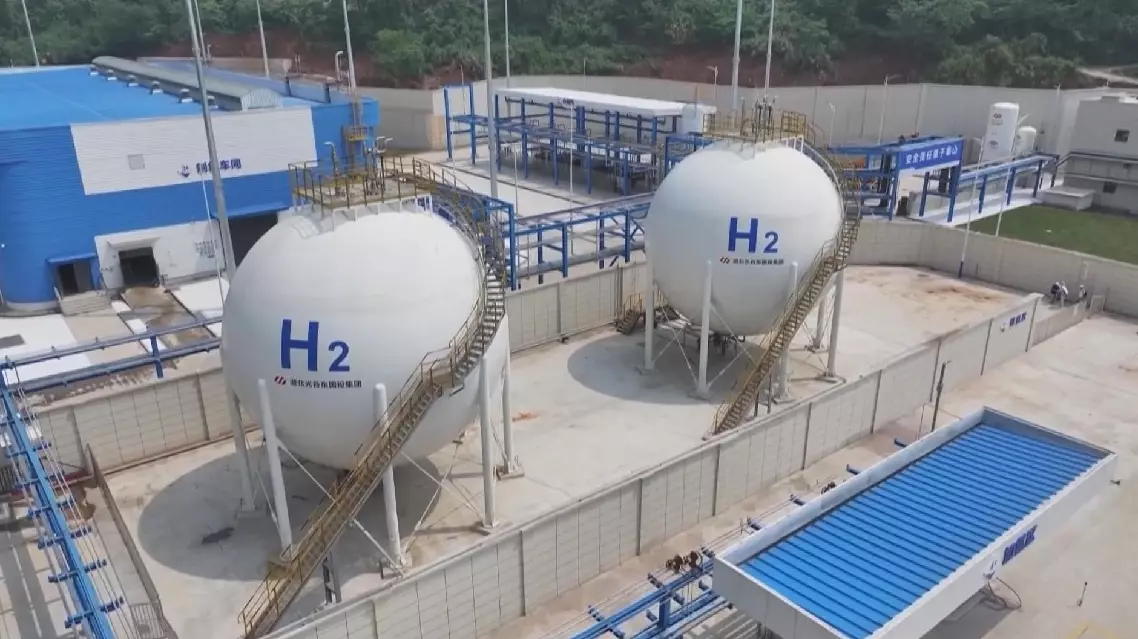
China accelerates hydrogen sector growth in green energy push
The Navy of the Islamic Revolutionary Guard Corps (IRGC) released a video clip on Sunday, showing a supertanker being rocked by a massive explosion after striking a naval mine in the Strait of Hormuz.
The IRGC said the supertanker carrying crude oil deactivated all its navigation systems and intended to exit the Strait via an unauthorized route.
The vessel was engulfed in a massive blaze after striking a naval mine, according to the IRGC.
The IRGC said this was the third supertanker to have struck a mine and caught fire while passing through an unauthorized shipping route in the Strait of Hormuz since Saturday.
The IRGC also announced on Sunday that all vessels that turn off their navigation and positioning systems in the Strait of Hormuz will be regarded as hostile targets and subject to severe and decisive action.

Iran’s IRGC releases footage of supertanker on fire after hitting mine in Hormuz


