


Members of the Brazilian Green Hydrogen Industry Association (ABIHV) have more than 115 billion reais (US$23.1bn) in planned investments in green hydrogen through 2030, but projects still depend on purchase contracts and/or financing, licensing, and infrastructure to move forward.
The portfolio of the association’s members comprises 10.4 GW of electrolysis capacity, with projects at different stages of development, according to Fernanda Delgado, CEO of ABIHV.
“The implementation of the projects should take place in stages, with the schedules subject to final investment decisions (FIDs) and the completion of the development phases,” he told BNamericas.
Among the projects with operation dates announced by the developers, Qair plans to start a first 20 MW phase of the Fraternité project in 2028, while FRV estimates that H2 Cumbuco will come online by 2030.
Read more: CELA: Cost of green hydrogen should drop even further in Brazil
The outlook for the sector also depends on the evolution of international demand and the ability to structure long-term contracts, especially for projects aimed at exports.
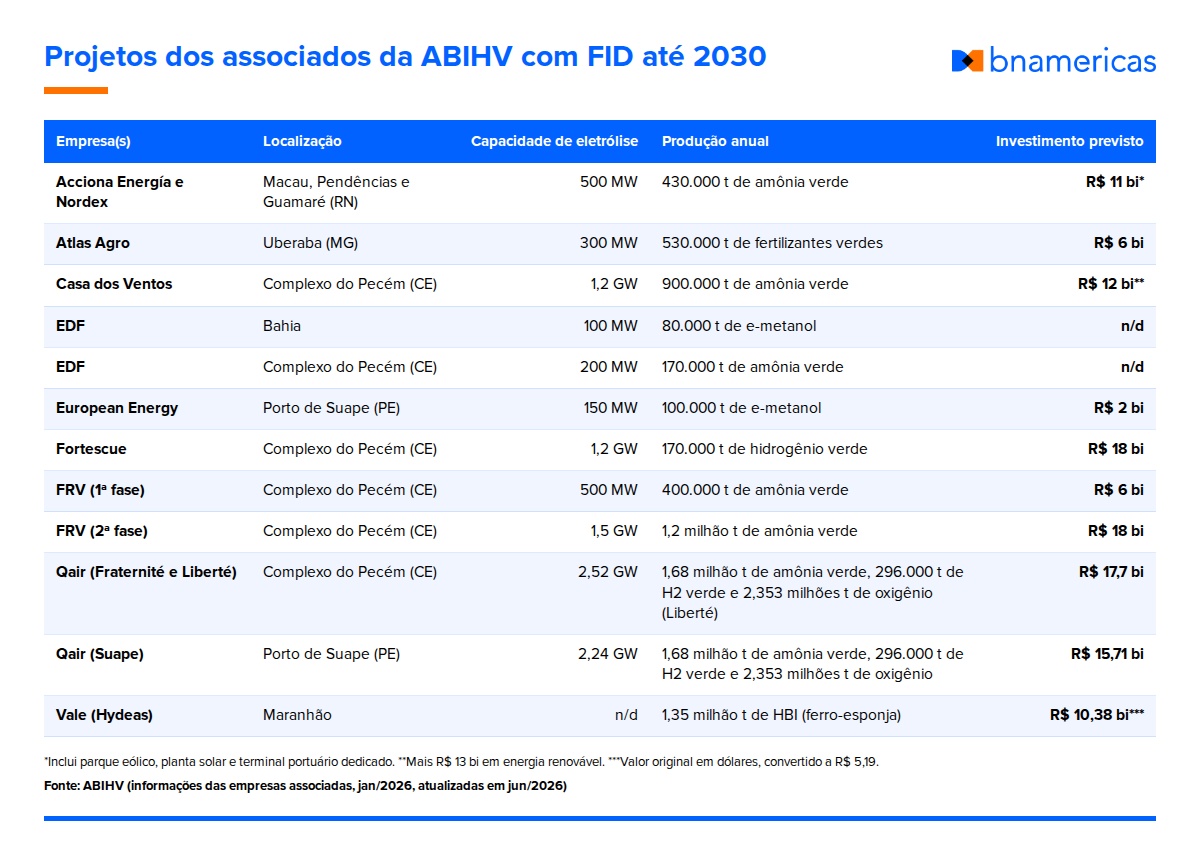 Source: ABIHV
Europe and demand for green hydrogen
The reprioritization of European investments, with greater attention to energy security and military capacity, may affect the pace of development of Brazilian projects, especially those intended for export.
“The competition for public resources and the uncertainties about European demand may prolong the negotiation of purchase contracts and investment decisions,” Delgado told BNamericas.
She pointed out that, although Europe maintains decarbonization policies that include renewable hydrogen and its imports, these guidelines still need to translate into contracts and financing conditions.
“Brazil brings together significant advantages in the supply of renewable energy, but the competitiveness of the projects also depends on infrastructure, cost of capital, logistics, and access to markets,” emphasized Delgado.
In light of this, ABIHV considers it important to develop domestic demand, expanding marketing possibilities and offering greater support for investments.
An opportunity for Brazilian producers is in the second round of H2Global. The South America and Oceania Lot (South American & Oceanian Lot, SAL) has already been launched, and the registration deadline for interested parties has closed. The process is now in the evaluation and contracting phase of the proposals.
The lot has a minimum budget of €587 million and includes three products: renewable hydrogen, renewable ammonia, and renewable methanol. The products must meet the European criteria for renewable fuels of non-biological origin (RFNBO).
In H2Global’s first renewable ammonia tender, no Brazilian project was selected. The winner was Fertiglobe, with production in Egypt. In this mechanism, Hintco acts as an intermediary buyer, entering into long-term contracts with producers and reselling the products to the European market.
Delgado stressed that H2Global must be distinguished from the auctions already carried out by the European Hydrogen Bank, which support production in the European Economic Area. The bank’s international pillar, focused on imports, remains under development.
Different development models
The green hydrogen projects in operation or in pilot phase in Brazil illustrate different paths to develop the market, according to the executive.
White Martins already produces certified green hydrogen on an industrial scale in Pernambuco and supplies gases for industrial applications. In Jacareí, São Paulo, the company has announced that it will serve glass manufacturer Cebrace and other industrial consumers.
“This connection with defined applications and clients favors the commercial structuring of investments,” said Delgado.
Neoenergia, in turn, developed a pilot plant focused on the production and supply of hydrogen for mobility, with resources from the Research, Development and Innovation Program regulated by the National Electric Energy Agency (Aneel).
In this case, the research funding and the goal of technological demonstration help explain the implementation of the unit.
“Large-scale projects, especially those intended for export, need to coordinate larger volumes of purchasing, financing, and infrastructure, which makes their implementation more complex,” noted the CEO of ABIHV.
Access to the network is decisive
Access to the basic transmission grid remains among the determining factors for the viability of green hydrogen projects. The connection requires an assessment of available capacity, deadlines, technical requirements, and financial guarantees.
The National Policy for Access to the Transmission System (PNAST), established by Decree No. 12.772/2025, created access seasons to organize requests and capacity allocation. The National Electric System Operator (ONS) has already announced the end of the first season, which represents progress in the implementation of the model.
The effects of the policy on hydrogen projects, however, need to be assessed based on concrete results in terms of access, the costs involved, and the compatibility between the transmission expansion schedules and those of the projects.
“There may be competition with data centers when projects seek connection in regions or locations with limited capacity,” warned Delgado.
Read also: Data centers secure access to the power grid in São Paulo
For ABIHV, transmission planning needs to be coordinated with the needs of different consumers, in order to enable the development of digital infrastructure and the green hydrogen industry with safety and predictability.
(The original version of this content was written in Portuguese)


