

Researchers from RMIT University and partner institutions in China have demonstrated a new method of increasing green hydrogen production using low-cost materials, in findings they say could contribute to efforts to reduce the cost of producing clean hydrogen.
According to RMIT, the study focused on improving titanium dioxide, a widely used material, and achieved hydrogen production more than 80 times higher than that of commercial untreated titanium dioxide under the same laboratory test conditions.
Lead researcher Dr Derek Hao, from RMIT’s School of Science, said the work contributed to ongoing research aimed at making green hydrogen production more efficient and affordable.
“By showing how a common material can be improved to produce more hydrogen, the study points to a practical direction for future work,” Hao said.
“If similar gains can be achieved under real-world conditions, it could help bring down the cost of clean hydrogen production at scale.”
Green hydrogen is widely expected to play a role in reducing emissions from sectors such as shipping, steelmaking and aviation, although improving the efficiency and cost of production remains a challenge.
The research, conducted in collaboration with Zhoukou Normal University and Xinyang University in China, sought to enhance titanium dioxide rather than develop an entirely new hydrogen production system.
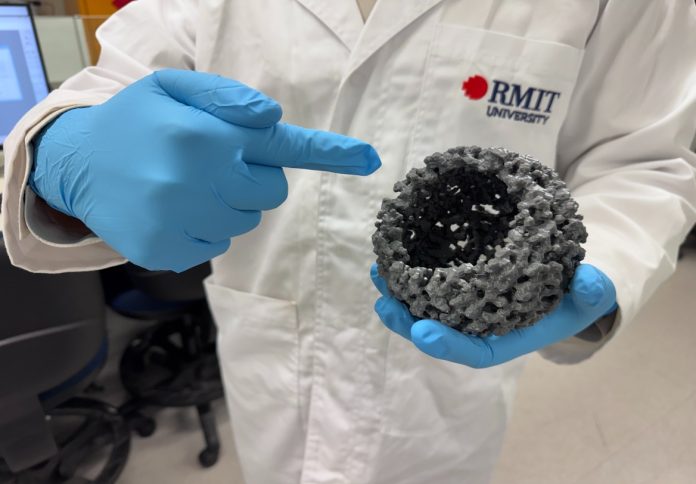
The team modified the material by adding small amounts of nickel, introducing defects to influence energy movement and shaping it into microscopic hollow spheres designed to improve light capture.
According to the researchers, these combined changes enabled the material to retain energy for longer and direct more of it towards hydrogen production.
Hao said the findings also highlighted the potential of using readily available materials instead of more costly alternatives.
“This work shows that comparable performance can be achieved using low-cost, widely available materials, which is critical if hydrogen production is to scale up,” he said.
The researchers reported that the enhanced material maintained its performance over repeated laboratory tests and produced the strongest results under ultraviolet light, while also showing some activity under visible light.
RMIT noted that the experiments were conducted under controlled laboratory conditions using a methanol-containing solution, representing a simplified hydrogen production system rather than complete water splitting. The university said further research would be needed to evaluate the technology under full sunlight and without the use of added chemicals.
The study, co-authored by RMIT researchers Associate Professor Ravichandar Babarao, Dr Li Gao and Associate Professor Yichao Wang, was published in Applied Catalysis B: Environment and Energy under the title Nanoconfined Ni single-atom Ni–O–Ti atomic asymmetric sites for highly efficient and stable photocatalytic hydrogen evolution.


