

All eyes are on Jind, Haryana’s political nerve centre, from where Prime Minister Narendra Modi will flag off the country’s first indigenously built hydrogen-powered train on Friday morning. As the 10-coach train (74010) hits the tracks at 9am, India will join a select group of nations, including Japan, Germany, the United States and China—to have introduced hydrogen-powered rail transport. HT looks at the technology, the groundwork and the significance of the milestone in India’s clean mobility mission.
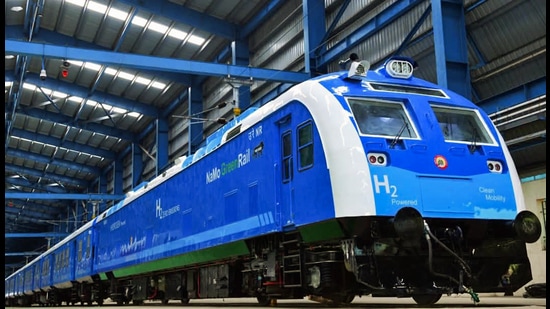
What makes this hydrogen train so special?
The broad-gauge train is among the world’s longest hydrogen-powered trains and reflects the success of the Make in India and Atmanirbhar Bharat initiatives, said chief minister Nayab Singh Saini, adding that PM Modi is expected to travel by train from Jind to Pandu Pindara station, accompanied by around 200 schoolchildren. Two Northern Railway officials familiar with the project said the train will enter regular service under the “Hydrogen for Heritage” initiative after the launch. The project envisages introducing 35 hydrogen-powered trains on heritage, hill and other non-electrified routes where conventional electrification is either difficult or economically unviable. A railway official said the project supports the goal of achieving net-zero carbon emissions by 2030, reducing dependence on fossil fuels and promoting the National Green Hydrogen Mission. The success of the pilot will pave the way for hydrogen trains on heritage and hill routes, like Nilgiris, Darjeeling and Kangra. According to railways, the proposed fleet of 35 hydrogen trains will be introduced under the “Hydrogen for Heritage” initiative at an estimated cost of ₹80 crore per train, with an additional ₹70 crore to develop ground infrastructure for each route.
When was the project conceived?
According to railway officials, the hydrogen train project was conceived in 2020–21, when ₹136 crore was sanctioned for a pilot project to retrofit a Diesel Electric Multiple Unit (DEMU) rake for the 89-km Jind–Sonepat section. In April 2022, Hyderabad-based Medha Servo Drives won the ₹70-crore contract to convert a diesel train to hydrogen fuel-cell technology. In September 2022, the company partnered with Canada’s Ballard Power Systems to supply a hydrogen fuel-cell system. In October 2023, Green H Electrolysis secured the contract to build a 1MW green hydrogen production and refuelling plant at Jind. Over the next three years, the Research Designs and Standards Organisation (RDSO) developed the technical specifications, replacing the diesel propulsion system with hydrogen fuel cells, lithium batteries and new power systems. The 10-coach trainset, comprising two driving power cars and eight passenger coaches, was completed in December 2025. Following necessary technical and safety clearances, the railway board granted approval for operations on the Jind–Sonepat section on May 22, 2026. The train subsequently underwent a series of low- and high-speed trials, touching 120 kmph during its final trial on June 26, 2026. Railway minister Ashwini Vaishnaw, in a statement, described the project as a landmark achievement under the Atmanirbhar Bharat initiative, saying it involved developing hydrogen traction technology from the ground up.
Why was the Jind-Sonepat route selected?
Technical experts said the Jind–Sonepat section was selected as the pilot route for India’s first hydrogen-powered train because it offered the ideal conditions for testing new technology. This short, non-electrified section allowed the train to complete two round trips daily, covering 356 km, making it practical for frequent testing and operations. The route also had existing Diesel Electric Multiple Unit (DEMU) services, enabling the easy retrofitting of an existing rake into a 10-coach hydrogen trainset instead of building a new one. It was also feasible to set up the supporting green hydrogen production and refuelling plant at Jind with a 3000-kg storage capacity. Its proximity to Delhi was another key factor, offering logistical advantages and enabling maintenance support from Shakurbasti (a railway hub in Delhi division).
How does a hydrogen fuel train work?
Railway officials said the train will be powered by a 1,200 kW hydrogen fuel-cell propulsion system to generate electricity for traction. The train is a retrofitted Diesel Electric Multiple Unit (DEMU) rake. Experts say hydrogen has a significantly higher energy density than diesel (120 MJ/kg (megajoules per kilogram) compared with 43 MJ/kg). The hybrid propulsion system combines a Proton Exchange Membrane Fuel Cell (PEMFC) as the primary power source with a battery bank to meet both average and peak power requirements. The hydrogen fuel cells generate electricity through a chemical reaction, emitting only water vapour and providing a cleaner, more sustainable alternative.
How is the fuel stored?
The train will carry about 440 kg of hydrogen, stored as compressed gas in 27 cylinders, each at the front and rear. Green hydrogen will be produced at the Jind plant via electrolysis using a 1MW Proton Exchange Membrane (PEM) electrolyser, with a 3000 kg storage capacity. Inside the fuel cells, hydrogen combines with oxygen from the air to generate electricity through an electrochemical reaction with water vapours and heat as the only by-products. The train uses Proton Exchange Membrane (PEM) fuel cells from Ballard Power Systems and has a total power of 2400 kW (1,200 kW per DPC). Each DPC has four integrated power packs, with each producing 300 kW (115 kW from the fuel cell plus 185 kW from a lithium ferro phosphate battery). The train can cover approximately 250 km on a single refuelling. According to experts, its safety features include hydrogen leak and flame detectors, 24×7 monitoring of the refuelling system, trained and certified personnel, a licence for hydrogen storage, and an international safety assessment by a Germany-based company.
Will the train run daily?
During regular operations, the train no 74010 will depart Jind at 7:40 am and arrive at Sonepat at 9:40 am. The return service, train no 74009, will leave Sonepat at 10:40 am and arrive in Jind at 1pm. The train will make two round trips daily, covering about 356 km and carrying nearly 2,600 passengers. En route, it will halt at 12 stations — Jind City, Pandu Pindara, Lalit Khera, Bhambeva, Ishapur Kheri, Butana, Khandrai, Gohana, Rabhra, Lath, Mohana and Barwasni. Powered by a 1,200 kW hydrogen fuel-cell propulsion system, the train will generate electricity for traction using hydrogen, which offers a higher-energy density than diesel, requires less maintenance and has a lower carbon footprint. For the first three months of operations, trained specialists will travel onboard to monitor the train’s performance and ensure operational safety.


