

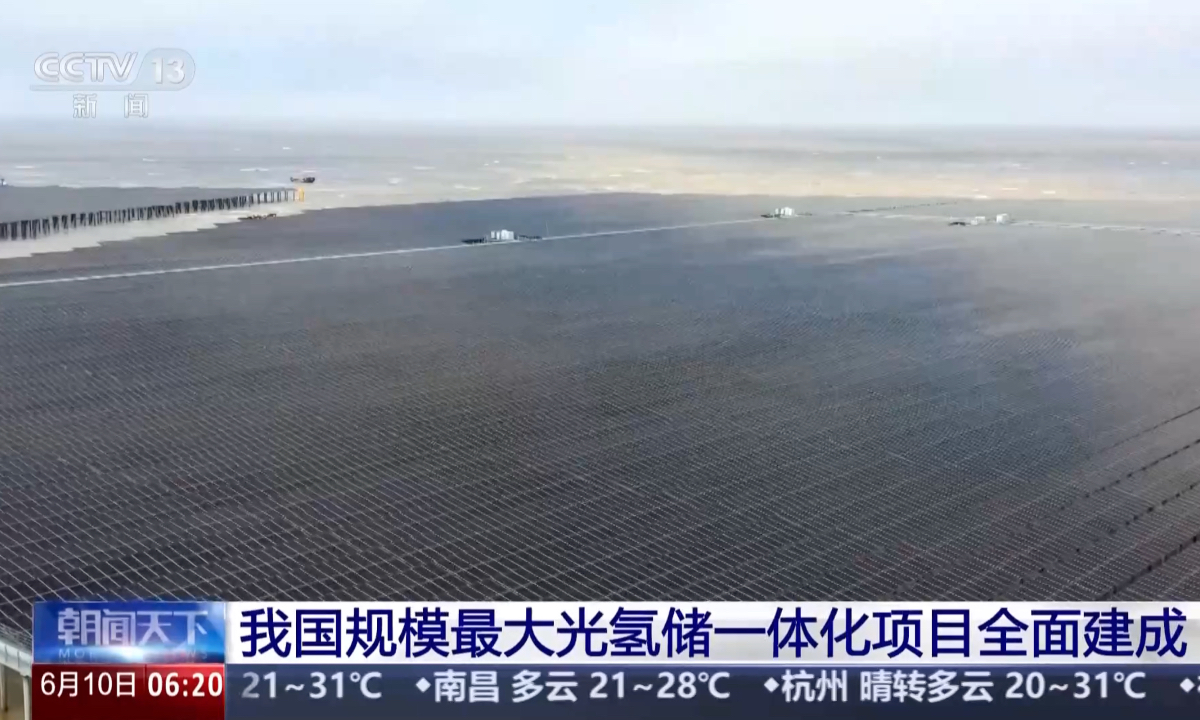
The solar-hydrogen-storage integrated project in Rudong, East China’s Jiangsu Province, invested by CHN Energy Guohua Energy Investment Co, is completed. Photo: Screenshot from China Media Group
The solar-hydrogen-storage integrated project in Rudong, East China’s Jiangsu Province, invested by CHN Energy Guohua Energy Investment Co, is completed. This is the largest offshore photovoltaic demonstration project of its kind integrating solar, hydrogen, and energy storage in China, the China Media Group reported on Wednesday.
The project is located in offshore Rudong, Nantong city. It has a photovoltaic capacity of 400,000 kilowatts and includes a newly built 220 kilovolt onshore booster station, a hydrogen production station with a capacity of 1,500 standard cubic meters per hour, and an electrochemical energy storage station, according to the report.
As China’s first project that integrates power generation, hydrogen production, and energy storage, while also incorporating comprehensive energy utilization and coastal ecological governance, it achieves highly efficient composite utilization of “electricity–storage–hydrogen,” said the report.
According to a Nantong Daily’s report on April, the photovoltaic power station achieved full-capacity grid-connected power generation on April 29 last year. Upon full completion, the energy storage station will be able to supply 120,000 kWh of peak-shaving electricity during daily peak hours, and the hydrogen production station will have an annual green hydrogen output of up to 180 tons.
Once the solar, hydrogen, and energy storage stations are fully completed, they will form a closed-loop energy system featuring “generation–storage–utilization–backup.” It will not only significantly improve the consumption rate of new energy, but also provide clean fuel for local industries such as chemicals and transportation through diversified applications of green hydrogen, injecting strong impetus into the transformation of the regional energy structure, the Nantong Daily reported.
Global Times


