

GCC Hydrogen and Ammonia Export Market Revenue Insights
Key Highlights
| Study Period | 2019 – 2032 |
| Market Size in 2025 | USD 1450.0 Million |
| Market Size in 2026 | USD 1508.0 Million |
| Market Size by 2032 | USD 2003.5 Million |
| Projected CAGR | 5% |
| Largest Country | Saudi Arabia |
| Fastest Growing Country | U.A.E. |
| Market Structure | Consolidated |
Market Size
Explore the market potential with our data-driven report
GCC Hydrogen and Ammonia Export Market Future Outlook
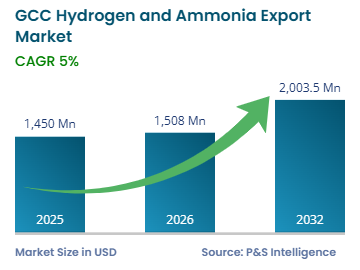
The GCC hydrogen and ammonia export market size is estimated at USD 1450.0 million in 2025, and it is projected to reach USD 2003.5 million by 2032, growing at a CAGR of 5.0% during 2026–2032. This remarkable growth trajectory is driven by the region’s strategic pivot toward clean energy exports, leveraging its abundant renewable energy resources and existing hydrocarbon infrastructure to become a global hub for hydrogen and ammonia production and export.
The GCC countries possess ample solar resources, existing gas infrastructure, strategic geographic location between major demand centers in Europe and Asia, and substantial sovereign wealth funds for project financing. Saudi Arabia, the UAE, and Oman have collectively announced over USD 100 billion in hydrogen and ammonia investments through 2030, in projects such as NEOM Green Hydrogen Company, ADNOC’s blue ammonia facilities, and Oman’s Green Energy mega-complex. The region’s competitive production costs for both blue and green hydrogen, ranging from USD 1.5–2.5 per kilogram, position GCC exporters advantageously against global competitors.
The export market is experiencing accelerated development as European and Asian nations implement hydrogen strategies requiring massive imports to meet their decarbonization targets. Germany’s H2Global initiative alone plans to import 90–110 TWh of hydrogen annually by 2030, while Japan targets 3 million tonnes of ammonia imports by 2030, creating substantial demand for GCC exports. The establishment of international hydrogen corridors, certification frameworks for green and blue products, and long-term offtake agreements with industrial consumers are providing the market certainty needed for large-scale project development across the GCC region.
GCC Hydrogen and Ammonia Export Market Trends & Drivers
Technological Maturity and Cost Reduction in Production Methods Are Trending
The rapid advancement in both green and blue hydrogen production technologies is fundamentally transforming the economics of the GCC export market. Green hydrogen production costs in the region have declined by over 40% since 2020, driven by the falling costs of solar PV and wind energy, improvements in electrolyzer efficiency, and economies of scale in project development. Saudi Arabia’s NEOM project, utilizing 4 GW of renewable capacity, is targeting production costs below USD 1.50 per kilogram by 2026, making green hydrogen competitive with gray hydrogen in many markets.
Blue hydrogen production in the GCC is also becoming increasingly competitive, with carbon capture rates exceeding 95% in new facilities and costs approaching USD 2.00 per kilogram. The UAE’s ADNOC has pioneered the integration of carbon capture and storage (CCS) with existing natural gas infrastructure, reducing capital requirements by 30% compared to greenfield projects. Qatar Energy’s North Field expansion includes dedicated blue hydrogen production facilities with integrated CCS, leveraging the country’s vast natural gas reserves and existing LNG infrastructure to minimize production costs.
The ammonia synthesis process has also seen significant technological improvements, with new catalyst systems reducing energy requirements by 20% and enabling lower-pressure operations. These advancements are particularly important for the GCC, where ammonia serves as the primary hydrogen carrier for export markets. NEOM Green Hydrogen Company’s mega-plant is expected to produce up to 600 tonnes per day (euqalling 1.2 million tonnes per year) of carbon-free hydrogen in the form of green ammonia. It was 80% complete by June 2025 across all sites including the wind and solar farms, dedicated transmission grid and green hydrogen facility. This single project represents an USD 8.4-billion investment.
Strategic Energy Partnerships and Long-Term Offtake Agreements Drive Market Growth
The proliferation of bilateral energy agreements between GCC nations and major importing countries is fundamentally reshaping the hydrogen and ammonia export landscape. These partnerships go beyond traditional buyer-seller relationships, encompassing technology transfer, joint venture development, and integrated supply chain creation. Saudi Arabia has signed comprehensive hydrogen cooperation agreements with Germany, Japan, and South Korea, while the UAE has established strategic partnerships with the Netherlands, Germany, and India for green ammonia supply. These government-to-government agreements are translating into concrete commercial contracts, with over 15 million tonnes per annum of ammonia export capacity already secured through long-term offtake agreements by 2025.
The importance of these agreements is underscored by the infrastructure investments being undertaken on both sides. The Government of Germany anticipates that the national demand for hydrogen and its derivatives will reach 95 to 130 TWh by 2030 and that 50 to 70% (equaling 45 to 90 TWh) of these products will need to be imported. It can be inferred that the share of imports is likely to increase beyond 2030. Meanwhile, Japan expects to import 3 million tonnes of clean ammonia by 2030, with demand rising to 30 million tonnes by 2050, says the Ammonia Energy Association.
Supportive Government Policies Offer Short-to-Mid-Term Opportunities
The GCC governments have positioned hydrogen and ammonia exports as cornerstone elements of their economic diversification strategies. Saudi Arabia’s Vision 2030 includes specific targets for clean energy exports, with hydrogen and ammonia playing central roles in reducing the kingdom’s dependence on crude oil revenues. The government has established the Saudi Green Initiative, allocating over USD 180 billion for renewable energy and hydrogen projects, creating a regulatory framework that streamlines project approvals and provides long-term price guarantees for green and blue hydrogen production.
Oman has emerged as another significant player, with groundbreaking green hydrogen projects in Dhofar valued at an impressive USD 11 billion following successful auction rounds. The country has established Hydrom as a dedicated entity to orchestrate its hydrogen sector development, with plans to achieve production targets of 1.38 million tonnes per year (mtpa) by 2030 and eventually 25 million tonnes per annum (Mtpa) of green hydrogen by 2050. The Omani government has allocated approximately 50,000 km² of land, primarily in regions with high wind and solar potential, demonstrating the scale of its commitment to becoming a major hydrogen exporter.
Qatar, Kuwait, and Bahrain are also developing comprehensive hydrogen strategies, with Qatar leveraging its position as the world’s largest LNG exporter to transition into blue hydrogen and ammonia production. The country’s North Field expansion project includes dedicated facilities for blue hydrogen production, with carbon capture infrastructure integrated from the design phase, positioning Qatar to supply both LNG and clean hydrogen through existing customer relationships and infrastructure.
GCC Hydrogen and Ammonia Export Market Segmentation Analysis
Product Type Analysis
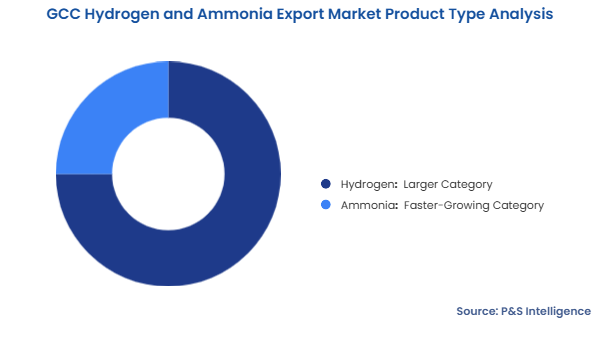
The hydrogen category holds the larger share of the GCC hydrogen and ammonia export market in 2025, of 75%, driven primarily by direct pipeline exports to neighboring regions and the growing demand for hydrogen in industrial applications. The versatility of hydrogen as both an energy carrier and industrial feedstock has positioned it as the preferred product for markets with established infrastructure, particularly for exports via pipeline to countries in the Middle East and North Africa region. Blue hydrogen currently dominates this category, leveraging the GCC’s vast natural gas reserves and established gas processing infrastructure, though green hydrogen is rapidly gaining market share as renewable energy costs decline and electrolyzer technologies mature.
Ammonia is expected to witness the higher CAGR, during the forecast period, primarily due to its advantages as a hydrogen carrier for long-distance maritime transport. The existing global ammonia trading infrastructure, established safety protocols, and the ability to transport ammonia at −33°C, compared to hydrogen’s −253°C, makes it significantly more economical for intercontinental exports. Additionally, the dual-use nature of ammonia – both as a hydrogen carrier and direct fuel for power generation and shipping – enhances its market appeal, particularly for Asian markets where ammonia co-firing in coal power plants is being rapidly adopted.
These product types are covered:
- Hydrogen (Larger Category)
- Ammonia (Faster-Growing Category)
Mode of Export Analysis
Maritime transport dominates the GCC hydrogen and ammonia export market in 2025 with 70% share, reflecting the geographic reality of major demand centers being located across oceans from GCC production facilities. The development of specialized vessels for liquid hydrogen carriers, ammonia tankers, and LOHC carriers has enabled cost-effective long-distance transport, with shipping costs declining by 25% since 2022 due to economies of scale and technological improvements. Major ports in the GCC, including Jebel Ali, King Abdullah Port, and Sohar, have invested heavily in hydrogen and ammonia handling infrastructure, establishing dedicated berths, storage facilities, and safety systems.
Pipeline transport is projected to grow at the highest CAGR, during 2026–2032, driven by ambitious cross-border pipeline projects connecting GCC countries with European and Asian markets. The proposed hydrogen pipeline corridor from Saudi Arabia through Jordan to Europe, and the Gulf-India hydrogen pipeline project, represent multi-billion-dollar infrastructure investments that will dramatically reduce transport costs and enable continuous, large-volume hydrogen delivery. These pipeline projects benefit from existing natural gas pipeline rights-of-way and technical expertise, reducing development timelines and costs compared to greenfield infrastructure projects.
These modes of export are covered:
- Maritime Transport (Largest Category)
- Liquid Hydrogen Carriers
- Ammonia Tankers
- LOHC Carriers
- Pipeline (Fastest-Growing Category)
- Road
- Others
End-Use Industry Analysis
The refining & petrochemicals sector represents the largest category in 2025, accounting for 35% of the hydrogen and ammonia exports value from GCC. This dominance reflects the established use of hydrogen in oil refining processes for hydrocracking and desulfurization, as well as ammonia’s role as a key feedstock for fertilizer and chemical production. European and Asian refineries are increasingly importing clean hydrogen to reduce the carbon intensity of their operations and meet regulatory requirements for low-carbon fuels, creating stable, long-term demand for GCC exports.
The power generation category is experiencing the fastest growth, during 2026–2032. This category is driven by the rapid adoption of hydrogen and ammonia co-firing in thermal power plants across Asia. Japan’s commitment to converting coal-fired power plants to ammonia co-firing, South Korea’s hydrogen power generation roadmap, and Europe’s hydrogen-ready gas turbine deployments are creating massive new demand for clean hydrogen and ammonia imports. The ability to retrofit existing power infrastructure rather than building entirely new facilities makes this transition economically attractive, accelerating adoption rates.
These end-use industries are covered:
- Refining & Petrochemicals (Largest Category)
- Power Generation (Fastest-Growing Category)
- Metallurgy
- Fertilizer
- Transportation
- Chemical
- Others
Export Destination Analysis
Asia accounted for the largest share of GCC’s hydrogen and ammonia exports value in 2025, of 40%, driven primarily by Japan, South Korea, and China’s aggressive decarbonization strategies and limited domestic production capacity. Asia already sources hydrogen from Australia, Latin America, the Middle East, and North America. The GCC’s geographical proximity and established energy trade relationships provide competitive advantages. The region’s demand is particularly strong for ammonia, which can be directly utilized in power generation and as a maritime fuel, aligning with Japan and South Korea’s significant share of hydrogen demand expected to come from electricity generation as ammonia and hydrogen are blended in existing coal and gas plants.
Europe is projected to experience the fastest growth, with a CAGR of approx. 5.5% during 2026–2032, as the continent accelerates its energy transition following the Ukraine crisis and implements ambitious hydrogen strategies. The European Union’s REPowerEU plan and various national hydrogen strategies have created strong policy-driven demand, with countries like Germany, Netherlands, and Belgium establishing dedicated import infrastructure and long-term offtake agreements with GCC producers. The development of hydrogen pipeline corridors from the GCC through the Mediterranean region will further accelerate European imports in terms of volume and reduce transportation costs.
These export destinations are covered:
- Asia (Largest Market)
- Europe (Fastest-Growing Market)
- Africa
- North America
- Latin America
- Oceania
Drive strategic growth with comprehensive market analysis
GCC Hydrogen and Ammonia Export Market Regional Outlook
Saudi Arabia Hydrogen & Ammonia Export Market Size
Saudi Arabia dominates the GCC hydrogen and ammonia export market in 2025 with a 40% share, leveraging its massive renewable energy potential, extensive hydrocarbon infrastructure, and substantial sovereign wealth fund investments. The kingdom’s integrated approach, combining green hydrogen projects like NEOM with blue hydrogen production from its vast natural gas reserves, provides unmatched production scale and flexibility. Saudi Aramco’s existing global customer network and logistics infrastructure have enabled rapid market penetration, with long-term supply agreements already secured with major importers in Europe and Asia.
Beyond NEOM, Saudi Arabia is accelerating its hydrogen export ambitions with additional mega-projects, including the Yanbu Green Hydrogen Hub, developed by ACWA Power in partnership with Germany’s EnBW, expected to be nearly twice the size of the ongoing 2.2-GW Neom project. This facility will feature 4 GW of electrolysis capacity, and it could produce up to 400,000 tonnes of green hydrogen per year.
UAE Hydrogen & Ammonia Export Market Share
The UAE is expected to witness the highest CAGR of approx. 6.0% during the forecast period, driven by its strategic location, advanced port infrastructure, and diversified production approach. The country’s focus on becoming a global hydrogen trading hub, similar to its role in oil markets, includes developing hydrogen storage facilities, trading platforms, and financial instruments. ADNOC’s integrated blue hydrogen projects and Masdar’s green hydrogen initiatives, combined with the UAE’s strong relationships with both Eastern and Western markets, position it for rapid export growth.
The UAE’s National Hydrogen Strategy 2050 aims to produce of 1.4 million tonnes per annum (mtpa) by 2031, 7.5 mtpa by 2040, and 15 mtpa by 2050. The strategy includes establishing hydrogen oases, dedicated R&D centers, and comprehensive regulatory frameworks that support the entire hydrogen value chain. The new national energy strategy pledges to increase public spending on all energy by between USD 48–54 billion (AED 150–200 billion) up to 2030. This ambitious plan is supported by investments exceeding USD 54 billion in clean energy infrastructure.
These countries are covered:
- Saudi Arabia (Largest Country Market)
- UAE (Fastest-Growing Country Market)
- Qatar
- Oman
- Kuwait
- Bahrain
GCC Hydrogen and Ammonia Export Market Share
The GCC hydrogen and ammonia export market is consolidated. This concentration reflects the capital-intensive nature of hydrogen and ammonia production, the importance of existing energy infrastructure, and the strategic role of national oil companies in driving the energy transition. The market is dominated by state-owned enterprises and their joint ventures with international partners, leveraging sovereign wealth fund investments, existing hydrocarbon infrastructure, and strategic government support to rapidly scale production capacity.
The consolidated nature of the market is credited to the massive capital requirements for green and blue hydrogen projects (typically USD 5–10 billion per project), the need for integrated value chains from production through to export terminals, and the importance of government backing for securing long-term offtake agreements. Major players benefit from economies of scale in renewable energy procurement, access to low-cost financing through sovereign guarantees, and established relationships with international customers from their traditional oil and gas businesses.
Market leaders are differentiating themselves through technological innovation, with investments in next-generation electrolyzers, advanced carbon capture systems, and novel ammonia synthesis processes. Saudi Aramco and ADNOC have leveraged their research and development capabilities to optimize blue hydrogen production, achieving carbon capture rates exceeding 95%, while reducing costs through process integration. Strategic partnerships with technology providers such as Air Products and Chemicals, Siemens Energy, and ThyssenKrupp have accelerated technology transfer and enabled rapid scaling of production capacity. The race to achieve the lowest green hydrogen production costs is intensifying competition and driving continuous innovation.
Companies are also competing on sustainability credentials, with third-party certification of carbon intensity becoming increasingly important for accessing European markets and securing premium pricing for truly green products.
Key GCC Hydrogen and Ammonia Export Companies:
- Abu Dhabi National Oil Company (ADNOC)
- Fertiglobe
- Mitsui & Co.
- Saudi Arabian Oil Company (Saudi Aramco)
- Saudi Basic Industries Corporation (SABIC)
- ACWA Power
- NEOM Green Hydrogen Company
- OQ Group
- Hyport Duqm
- Green Energy Oman (GEO)
- QatarEnergy
- ACME Group
GCC Hydrogen and Ammonia Export Market News
- In August 2025, Abu Dhabi National Oil Company (ADNOC) announced a USD 15-billion investment plan to develop five new blue hydrogen production facilities across the UAE. The plan targets 3 million tonnes per annum of hydrogen production capacity by 2030, with integrated CCS infrastructure.
- In June 2025, Saudi Arabia’s ACWA Power signed definitive agreements with European buyers for the supply of 2 million tonnes per annum of green ammonia from its projects in NEOM and other locations, with deliveries commencing from 2027.
- In April 2025, Hydrogen Oman (Hydrom) completed its third auction round for green hydrogen projects, awarding land blocks for an additional 2 GW of electrolyzer capacity to international consortiums, bringing total committed investments to over USD 50 billion.
- In February 2025, JERA Co. Inc. and ADNOC finalized a 20-year agreement for the supply of 500,000 tonnes per annum of blue ammonia for co-firing in Japanese power plants, with shipments beginning in 2027.
- In November 2024, QatarEnergy commenced the construction of its USD 1.2-billion blue ammonia facility in Mesaieed, featuring a single-train ammonia production unit with 1.2 million tonnes per annum capacity.
- In September 2024, the European Union and GCC countries signed a comprehensive hydrogen partnership agreement, establishing frameworks for certification, trade, and infrastructure development to facilitate hydrogen imports to Europe.
- In July 2024, Kuwait Petroleum Corporation announced plans for a USD 7-billion green hydrogen complex at Al-Zour, targeting production of 500,000 tonnes per annum by 2030.
