

In September, Spanish energy company Moeve started building a 300MW solar-powered electrolyser to make CO2-emission-free ‘green’ hydrogen in Huelva, in the south of the country. The Spanish government is contributing €300 million (£260 million) towards the over €1 billion cost of the site. Moeve intends to use the hydrogen to replace some of the fossil-derived hydrogen it uses at the existing refinery onsite, as well as hydrogenating waste vegetable oils to make low-emissions liquid hydrocarbon fuels for aviation, shipping and heavy-duty road transport, and in chemical manufacturing.
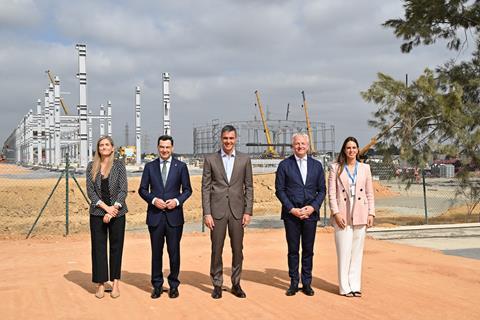
This is billed as the first phase of the Andalusian Green Hydrogen Valley, which Moeve has ambitions to develop to a total electrolysis capacity of 2GW. It follows similar projects in Lingen, Germany, where RWE intends to have a 300GW electrolyser operational next year, and Stegra’s 700GW plant that – once commissioned – will feed green iron and steel production in Boden, Sweden.
Adrian Odenweller from Potsdam Institute for Climate Impact Research, Germany, calls starting to build such a large project ‘encouraging’, although there are several larger projects worldwide. ‘This project may be particularly important for Europe, to demonstrate the feasibility of producing hydrogen in renewable-rich regions such as the Iberian Peninsula, co-located with demand,’ he says.
Odenweller’s research highlights ‘ambition gaps’ between announcements about green hydrogen and reality, with many projects being abandoned. He highlights that the Huelva plant is set to produce 45,000 tonnes of renewable hydrogen annually. This is only 0.45% the EU’s target for 2030, which Odenweller says ‘is clearly out of reach by now’.
Nevertheless, the project ‘is certainly an important building block in Spain and Europe’s clean hydrogen market,’ says Peter Collins, a spokesperson for industry group Hydrogen Europe. ‘The scale and significance of the project is clear for all to see, and the construction announcement shows what a strong developer can achieve – and how these ambition gaps can be closed – with clear policy frameworks and government support.’
Moeve will use a combination of dedicated solar power generation and electricity from the grid to run the plant. To produce 45,000 tonnes of hydrogen annually from a 300MW electrolysis plant would involve running it for around 7000 hours per year, Odenweller says. That will either require a very large solar plant with electricity storage to smooth out uneven generation, or taking significant electricity from the grid. Odenweller notes that from 2030 onwards, EU Renewable Fuel of Non-Biological Origin (RFNBO) rules will allow hydrogen production from grid energy to be classified as green through hourly matching of consumption with renewable power.
Odenweller expects green hydrogen demand from the plant to remain clustered within the nearby hydrogen valley region ‘for the foreseeable future’. Among the potential markets, Sustainable Aviation Fuel (SAF) is profitable due to relatively limited supply and government mandates for increased use, allowing for premium prices that cover the higher production costs.


