

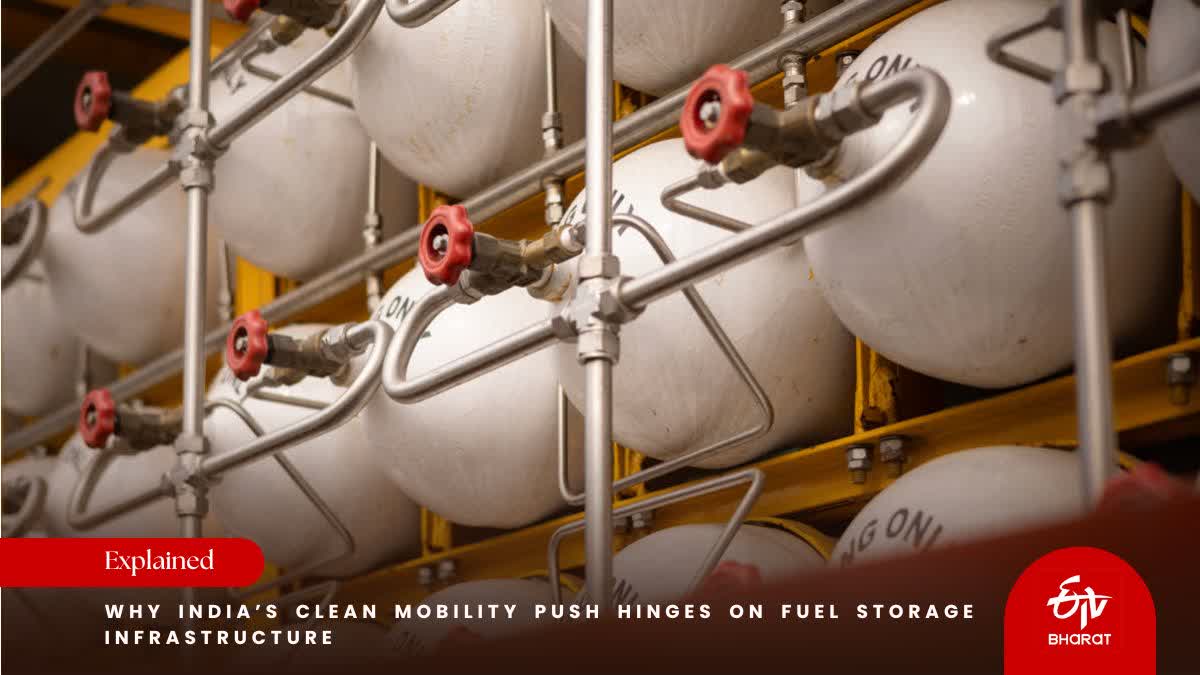
Explained: Why Fuel Storage Solutions Are Central To India’s Clean-Mobility Future (Getty Images)
Bengaluru: As India speeds up its journey to shift to cleaner fuels such as CNG, compressed biogas (CBG), and hydrogen, one key problem goes largely underreported: How will these fuels be stored, transported, and distributed at scale? Experts believe that the country needs to ensure that clean fuels are available not only in large cities but in transport corridors, local markets, and industry clusters as well.
Naman Jain, Director of NTF Group, explained, “India has long had the capability to manufacture cylinders itself. The challenge now lies in building the ecosystem — advanced materials, high-pressure engineering expertise, critical components, and sufficient certified manufacturing capacity to produce at scale.”
While much attention is focused on vehicle adoption and fuel production, advanced storage infrastructure will determine the pace of India’s clean mobility transition, he added.
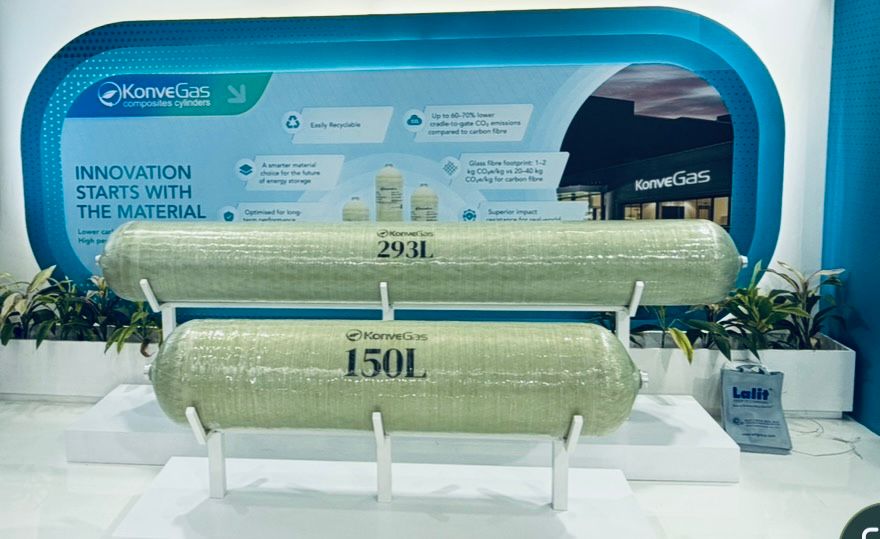
Storage technology determines fuel quantity per trip, refilling frequency, and efficiency of distribution networks (KonveGas)
Alexander Enulescu, Founder & CEO of KonveGas, a Sweden-based company developing next-generation Type-IV composite gas-storage solutions, said, “Producing clean fuel is merely a part of the energy transition. Its true value depends on the ability to store, transport and deliver it safely, efficiently and cost-effectively to end users. Without a reliable and scalable storage infrastructure, even abundant clean fuels can face constraints in availability, affordability and deployment.”
Advanced fuel storage solutions could facilitate the use of cleaner fuels in urban transit, bus operations and commercial mobility. Operators will be able to reduce downtime, better vehicle utilisation and more predictable lifecycle costs, he explained.
Strengthening Indigenous Capabilities and Regulatory Readiness
Highlighting India’s transition from an oil-based to a gas-based economy, Prof. Dhiraj Kumar Mahajan of IIT Ropar credited the country’s thousands of CNG stations and compressed biogas supporting circular-economy goals, with green hydrogen expected to expand in transport and industry. He stressed that CNG remains a vital bridge fuel in India’s hydrogen-CNG blending strategy, with a more extensive ecosystem than many European countries and largely indigenous storage technologies.
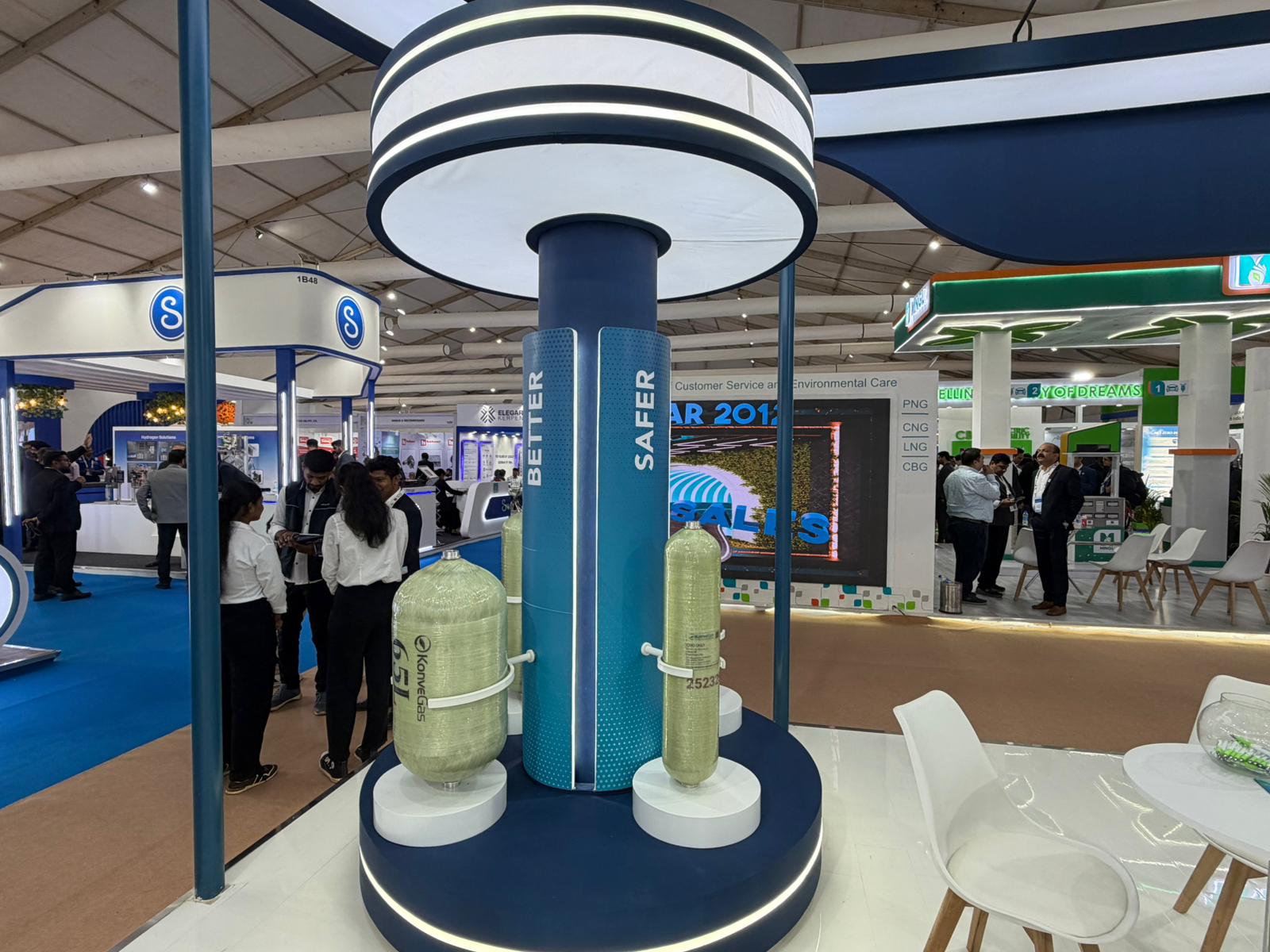
Storage technology determines fuel quantity per trip, refilling frequency, and efficiency of distribution networks (KonveGas)
Regarding India’s reliance on foreign technologies, materials, and components, Naman Jain pointed out that India is quite self-reliant in assembling, manufacturing, fabrication, and system integration of advanced fuel storage systems. However, dependence is higher in the value chain where advanced materials and certain specialised components account for a large share of technology and cost. To strengthen indigenous capabilities, India needs to invest in materials manufacturing locally, do more research and development and promote technology transfer globally. “No country becomes self-reliant by re-inventing everything from scratch,” he emphasised.
| Clean Mobility Through Efficient Fuel Storage and Distribution | |
|---|---|
| Role of Storage Technology | Determines fuel quantity per trip, refilling frequency, and efficiency of distribution networks. |
| Glass-Fibre Composite Cylinders | Offer performance, safety, cost-efficiency, and scalable manufacturing; suitable for CNG and compressed biogas. |
| Type-IV Composite Cylinders | Made with polymer linings and composite materials; provide low weight, rustproofing, increased safety, and high-pressure performance. |
| Much lighter than traditional steel tanks, improve fuel economy, reduce emissions, and enhance suitability for commercial vehicles like trucks and buses. | |
He said, “If we continue importing the systems that store our fuel, then a critical part of that security remains outside the country’s control, which is not a comfortable position to be in over the long term. Building these capabilities domestically keeps both the value and the decision-making within India, while creating manufacturing depth, skilled jobs, and a stronger industrial base. It also allows us to scale clean-mobility solutions at our own pace.”
Enulescu noted that local manufacturing can strengthen supply-chain resilience, improve serviceability, quality management and support employment while reducing dependence on imported components. It is essential for proper storage solutions to be safe, durable, efficient and scalable, he added.
Jain further said, “The regulatory structure of India is almost established. What is more difficult to do is to scale up testing and certification capabilities at the pace of development of the market.”
Hydrogen-Ready Technology for Future Mobility
The new Type IV cylinders have been designed to conform to international safety and reliability standards and can be used with hydrogen-CNG mixes. Prof. Mahajan noted that the development and mass production of advanced Type-IV composite pressure vessels will serve as a key enabler of India’s future hydrogen economy.
Jain said, “The Government plans to introduce hydrogen blending in CNG. This is the core technology we have developed, and we are now establishing manufacturing capabilities to bring these advanced cylinders to market.”
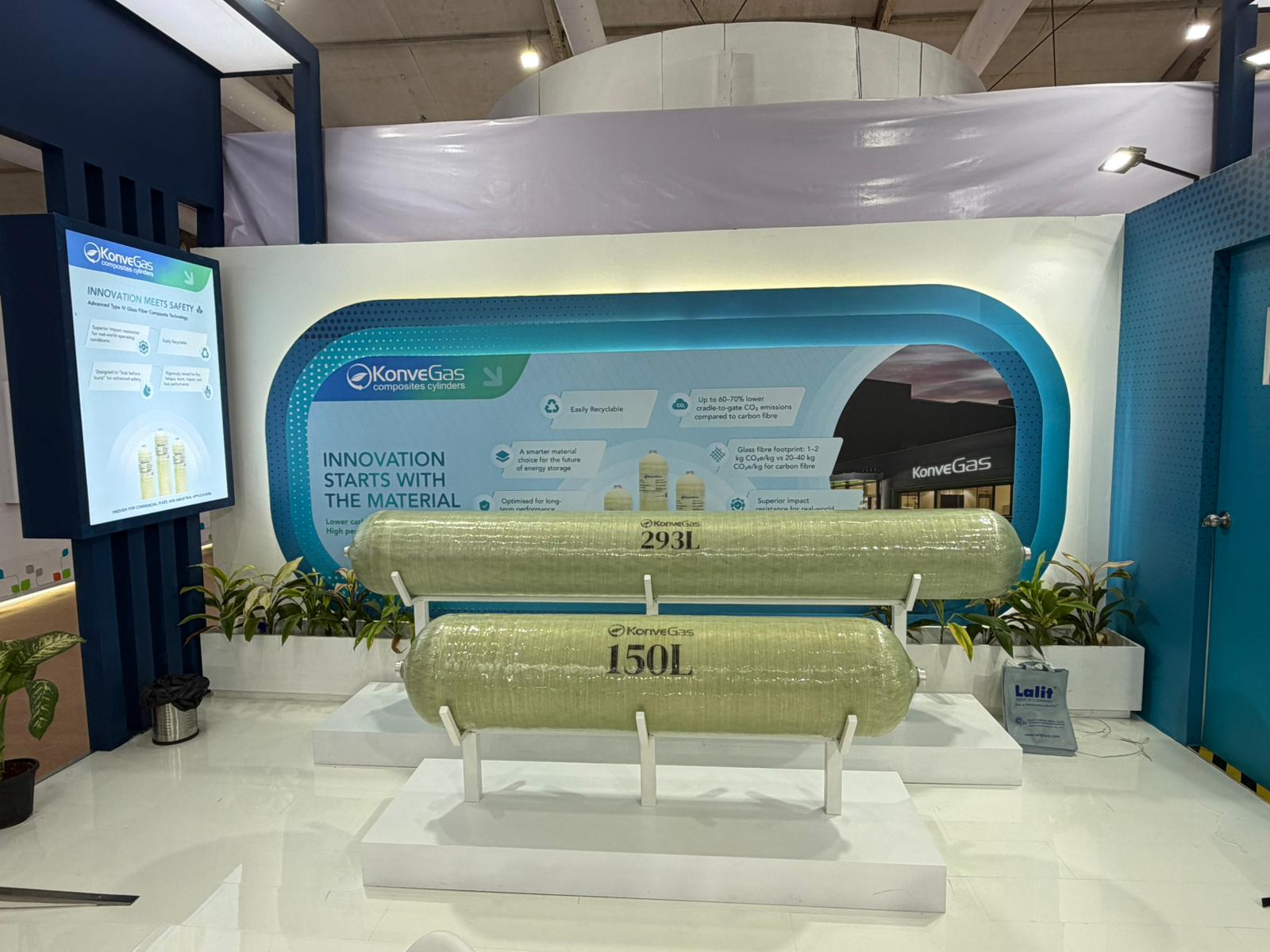
Storage technology determines fuel quantity per trip, refilling frequency, and efficiency of distribution networks (KonveGas)
Discussing the barriers to hydrogen adoption, Enulescu noted that the storage of hydrogen requires higher pressures and performance standards than CNG and compressed biogas. These challenges may be associated with the high cost of storage systems, lack of refuelling stations, and difficulty in large-scale production. Nonetheless, there is much for India to learn about hydrogen-storage infrastructure based on their experience with CNG and compressed biogas storage.
Why Storage Infrastructure Matters Beyond the Fuel
Jain pointed out that storage has been ignored within the context of the clean-fuel debate, but it is actually the crucial element that connects all other elements in the ecosystem. The biggest challenges in this case lie in scaling up the production of storage devices, building refuelling infrastructure, and decreasing reliance on imported feedstocks. The most important point here is that the problems have to be dealt with holistically.
Enulescu noted that without adequate storage and distribution infrastructure, clean fuels may remain costly to deploy and difficult to scale. There is also a broader industrial consideration. A clean-mobility strategy should focus not only on the fuel, but also on the materials, energy consumption, and supply chains behind storage systems. The environmental and economic performance of storage solutions is an integral part of the overall sustainability equation. This is why material selection, production energy requirements, local manufacturing capability, and long-term durability matter. Storage infrastructure should be safe and lightweight, but it must also be scalable, cost-efficient, and based on materials and production methods suitable for high-volume deployment, he added.
Enulescu stressed that for India, this implies developing an integrated fuel infrastructure system. Merely producing CNG, biogas, and green hydrogen is not sufficient. There also needs to be storage and distribution technologies that work well for India that are safe and that people can afford.
“If India can make globally competitive fuel storage technologies and manufacturing systems over the next ten years, storage will become a big advantage for clean mobility and energy security,” he said.


