

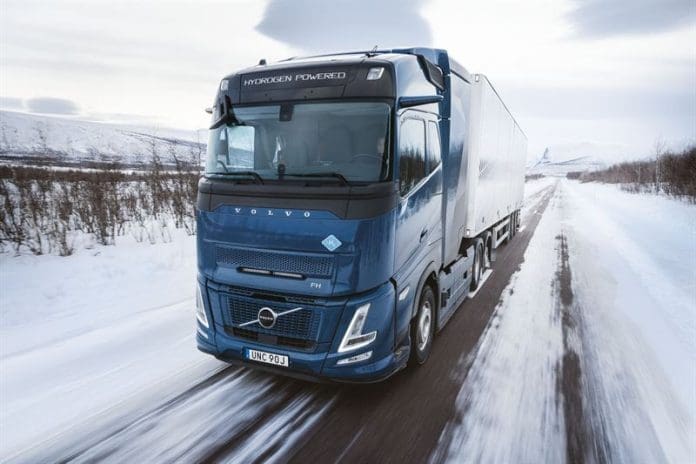
Volvo Trucks has started on-road testing of heavy-duty trucks powered by hydrogen combustion engines, marking a significant step in the Swedish manufacturer’s drive toward zero-emission transport, with a commercial launch planned in Europe before 2030.
The trucks use High Pressure Direct Injection (HPDI), a technology that injects a small amount of ignition fuel at high pressure to trigger compression ignition before hydrogen is introduced into the combustion cycle. Volvo already applies this same HPDI technology in its liquefied natural gas-powered trucks, with more than 10,000 units sold globally, giving the company an established performance baseline to build on.
Jan Hjelmgren, Head of Product Management at Volvo Trucks, said the trucks are expected to outperform competing hydrogen combustion solutions. “I feel confident that they will be the best in the industry if you look at fuel efficiency, power, torque and drivability. Customers will be able to operate them just like diesel trucks,” he said. “Our experience with HPDI technology in more than 10,000 gas-powered trucks is strong proof of its performance.”
The HPDI technology for the hydrogen trucks is supplied by Cespira, a joint venture between Volvo and Westport Fuel Systems. Westport Chief Executive Officer Dan Sceli said the system is “a cost-effective solution that operates on a zero-carbon fuel while delivering best-in-class power, torque, and efficiency,” and added that hydrogen use in an internal combustion engine with Cespira’s HPDI system delivers nearly 100% carbon dioxide (CO2) reductions compared with diesel-fuelled trucks.
When powered by green hydrogen and using renewable Hydrotreated Vegetable Oil (HVO) as ignition fuel, the trucks have the potential to deliver net-zero CO2 emissions across the full well-to-wheel cycle, and are classified as Zero Emission Vehicles (ZEV) under current European Union CO2 emission standards.
Volvo positions the hydrogen combustion trucks as particularly well suited for long-haul routes and regions where battery-electric recharging infrastructure remains limited or where operational schedules do not allow for extended charging times. The engine architecture is derived directly from Volvo’s existing diesel powertrain, which the company says allows fleet operators to manage the vehicles in ways that closely mirror their current diesel operations.
Hjelmgren said the hydrogen combustion option forms one part of a broader decarbonisation toolkit. “Several technologies will be needed to decarbonize. As a global truck manufacturer we offer a variety of decarbonization solutions and help our customers choose the best alternative based on transport assignment, available infrastructure and green energy prices,” he said.
Volvo’s three-path strategy toward net-zero emissions spans battery-electric trucks, fuel cell electric trucks, and combustion engines running on renewable fuels. The company also plans to launch fuel cell electric trucks in limited volumes before 2030. Unlike hydrogen combustion trucks, fuel cell electric trucks generate electricity on board and produce only water vapour from the exhaust.
In 2025, Volvo Trucks delivered approximately 120,000 vehicles worldwide and operates service points across roughly 130 countries, giving the company a substantial distribution network through which to eventually scale its hydrogen offering once the technology completes its testing phase and reaches commercial readiness.

![[Scitech NOW] KAIST boosts green hydrogen production threefold with seven-metal electrode](https://i3.wp.com/image.dongascience.com/Photo/2026/04/17753608295613.jpg?w=592&resize=592,444&ssl=1 "[Scitech NOW] KAIST boosts green hydrogen production threefold with seven-metal electrode")
