

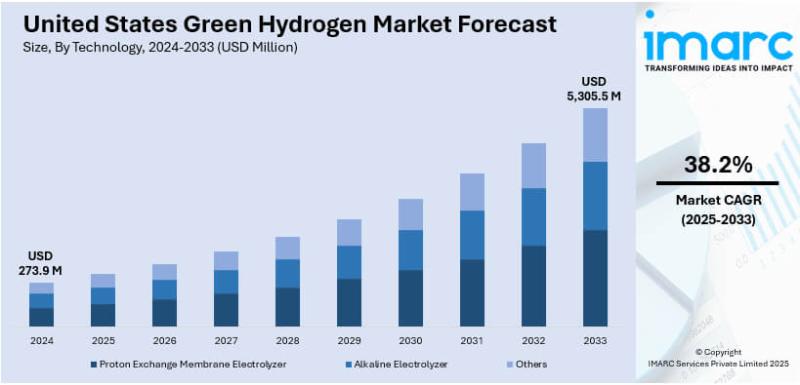
Market Overview
The United States green hydrogen market size was valued at USD 273.9 Million in 2024 and is expected to reach USD 5,305.5 Million by 2033, exhibiting a CAGR of 38.2% during the forecast period 2025-2033. Growth is primarily driven by supportive government policies including the Bipartisan Infrastructure Law and Inflation Reduction Act, rapid technological advancements in electrolyzer efficiency, expanding applications in transportation and heavy industry, growing private-sector investments, and the development of robust hydrogen production, storage, and distribution infrastructure.
Study Assumption Years
• Base Year: 2024
• Historical Year/Period: 2019-2024
• Forecast Year/Period: 2025-2033
United States Green Hydrogen Market Key Takeaways
• Current Market Size: USD 273.9 Million in 2024
• CAGR: 38.2%
• Forecast Period: 2025-2033
• Federal programs like Bipartisan Infrastructure Law and Inflation Reduction Act provide substantial financial support and tax incentives.
• Transportation sector accounts for approximately 37% of U.S. carbon dioxide emissions, driving demand for hydrogen fuel cell vehicles.
• Regional Clean Hydrogen Hubs Program receives $7 billion funding to establish nationwide hydrogen infrastructure.
• Proton exchange membrane and alkaline electrolyzers dominate technology segments with improving efficiency and cost structures.
• Power generation and transportation applications lead market adoption for grid stabilization and decarbonization.
• Growing corporate investments from energy majors, automobile manufacturers, and industrial producers accelerate market expansion.
Request Your Free Green Hydrogen Market Sample Report
https://www.imarcgroup.com/united-states-green-hydrogen-market/requestsample
United States Green Hydrogen Market Growth Factors
Government policies and regulatory frameworks which promote clean energy development serve as the primary forces driving growth for the United States green hydrogen market. Federal programs which include the Bipartisan Infrastructure Law and the Inflation Reduction Act offer financial support together with tax benefits for green hydrogen production and delivery operations and storage facilities. The U.S. government published draft regulations for clean hydrogen production in December 2023 which establish the criteria that companies must meet to receive the hydrogen tax credit worth $3 per kilogram. The initiatives target decarbonization for hard-to-abate sectors which include heavy industry and transportation because traditional renewable energy sources cannot adequately support these sectors. The regulatory environment creates favorable conditions for market participants to invest in hydrogen infrastructure and scale production capabilities.
The increasing demand for green hydrogen in transportation, which is driven by fuel cell vehicle development, serves as another key factor that drives business expansion. The transportation sector accounts for approximately 37% of U.S. carbon dioxide emissions from fossil fuel combustion, creating urgency for cleaner alternatives. Hydrogen-powered trucks, buses, and trains provide long-range capabilities and fast refueling times, which makes them suitable for heavy-duty and long-distance operations, in comparison to battery-electric vehicles. Major automotive and logistics companies are investing substantially in developing hydrogen infrastructure to facilitate this transition. The aviation and maritime industries need to explore hydrogen-based fuels because it will help them achieve their carbon emission reduction targets, which in turn expands the market potential for green hydrogen across different transportation sectors.
The development of hydrogen infrastructure serves as an essential factor which enables market expansion to proceed. The United States is receiving substantial funding to create hydrogen hubs which will include pipelines and storage facilities and production plants. The Regional Clean Hydrogen Hubs Program allocates $7 billion in funding to develop regional clean hydrogen hubs nationwide as part of the Bipartisan Infrastructure Law’s broader $8 billion hydrogen hub program. The hubs will establish the basis for a national clean hydrogen network which will help decarbonize heavy industry and heavy-duty transportation sectors. Market growth accelerates through technological advancements which increase efficiency and decrease costs for green hydrogen production and its subsequent application. Scientists achieved major advancements in creating electrolyzers which operate at high efficiency and use renewable electricity to separate water into its two components hydrogen and oxygen. American companies increasingly focus on scaling production and exploring innovative designs including solid oxide and anion exchange membrane electrolyzers to enhance efficiency and lower production costs. The market receives additional momentum from rising private sector investments which help businesses achieve their environmental and social governance goals through partnerships and complete hydrogen solution development.
Get Instant Access – Checkout Now:
https://www.imarcgroup.com/checkout?id=20363&method=3990
United States Green Hydrogen Market Segmentation
Breakup by Technology:
• Proton Exchange Membrane Electrolyzer: Efficient, compact systems with solid polymer membrane electrolyte enabling high-purity hydrogen production, rapid startup times, and compatibility with variable renewable energy loads. Popular for energy storage, industrial processes, and transportation applications requiring reliability and scalability.
• Alkaline Electrolyzer: Cost-effective, durable systems using liquid electrolytes suitable for large-scale industrial applications and continuous operations. Characterized by relatively low capital expenditures and high hydrogen production volumes, making them attractive for steelmaking, chemical manufacturing, and ammonia production.
• Others: Alternative electrolyzer technologies including solid oxide electrolyzers and emerging innovative designs.
Breakup by Application:
• Power Generation: Essential for grid stabilization and renewable energy utilization through hydrogen turbines and fuel cells. Provides environmentally friendly replacement for fossil fuels with capability to store excess renewable energy for deployment during periods of low wind or solar generation, ensuring reliable energy supply.
• Transport: Promising application reducing greenhouse gas emissions in long-distance and heavy-duty transportation. Hydrogen fuel cells deliver faster refueling times and higher energy density compared to battery-electric alternatives, making them ideal for trucks, buses, trains, and maritime vessels.
• Others: Industrial applications including steel manufacturing, chemical synthesis, refining, and ammonia production for decarbonization objectives.
Breakup by Distribution Channel:
• Pipeline: Provides regular, large-scale distribution to industrial centers and hydrogen refueling stations, delivering cost-effective and efficient transportation across extended distances while minimizing energy losses. Focus on repurposing or blending existing natural gas pipeline infrastructure accelerates distribution network development.
• Cargo: Encompasses shipping, rail, and road transportation methods delivering hydrogen to remote areas and smaller-scale users. Flexible approach suitable for regions lacking pipeline infrastructure, with hydrogen transported as compressed gas or liquefied in specialized containers. Critical during early market development phases enabling producers to reach diverse consumer segments.
Regional Insights
The United States green hydrogen market is analyzed across four major regions: Northeast, Midwest, South, and West. The Northeast demonstrates growing adoption driven by dense population centers, ambitious state-level climate policies, and focus on decarbonizing urban transportation, with substantial investment in hydrogen infrastructure and strong offshore wind renewable energy base. The Midwest leverages industrial and agricultural sectors to drive adoption, particularly for decarbonizing steel and fertilizer manufacturing, utilizing abundant wind energy resources. The South establishes itself as a green hydrogen powerhouse benefiting from vast natural gas infrastructure, renewable energy availability, and progressive state legislation, with abundant solar energy and energy infrastructure expertise. The West leads market development with stringent emissions regulations, ambitious renewable energy targets, vast solar and wind resources enabling cost-effective production, and strong focus on integrating hydrogen into public transit systems, trucking, and port operations.
Get Expert Insights – Talk to Our Market Analyst Today:
https://www.imarcgroup.com/request?type=report&id=20363&flag=C
Recent Developments & News
In May 2024, hydrogen solutions company Plug Power announced obtaining a conditional commitment of $1.66 billion loan guarantee from the Loan Programs Office of the U.S. Department of Energy to fund the creation, construction, and ownership of six green hydrogen production facilities across the United States, demonstrating significant federal support for scaling domestic production capacity.
In March 2024, ABB announced collaboration with Green Hydrogen International to build a large-scale green hydrogen facility in South Texas. The companies executed a Memorandum of Understanding enabling use of ABB’s digital technologies, automation, and electrification in the GHI Hydrogen City project. This Power-to-X initiative plans to operate a 2.2 GW electrolyzer plant using solar and onshore wind energy to generate 280,000 tons of green hydrogen annually, subsequently converting it into one million tonnes of green ammonia per year, representing one of the nation’s largest planned green hydrogen projects.
Competitive Landscape
The market research report covers a comprehensive competitive landscape analysis including market structure, key player positioning, winning strategies, competitive dashboards, and company evaluation quadrants. Detailed profiles of all major companies have been provided.
If you require any specific information that is not covered currently within the scope of the report, we will provide the same as a part of the customization.
About Us
IMARC Group is a global management consulting firm that helps the world’s most ambitious changemakers create a lasting impact. The company provides a comprehensive suite of market entry and expansion services, including market assessment, feasibility studies, company incorporation assistance, factory setup support, regulatory approvals, branding, marketing and sales strategies, competitive benchmarking, pricing and cost research, and procurement research.
Contact Us
IMARC Group
134 N 4th St., Brooklyn, NY 11249, USA
Email: sales@imarcgroup.com
Tel: +91 120 433 0800
United States: +1-201-971-6302
This release was published on openPR.


