

When the largest solar farm in Indiana came online in early 2025, nearby residents in rural Jasper County were not exactly excited.
“It will mess up their fields,” said long-time resident Gena Carlson, referring to solar panels on farmers’ land. Carlson’s concerns, which were echoed by other locals, highlight the growing on-the-ground opposition to Indiana’s remarkable boom in solar construction.
Last year, Indiana ranked third among states for the most new solar projects brought online. Only Texas and California — the nation’s clean energy leaders — built more. It’s a new position for Indiana, which ranked 15th for solar additions in 2023 and 10th in 2024. The Solar Energy Industries Association expects Indiana to maintain its momentum, projecting it will have the fourth-highest solar growth over the next five years.
“That’s a pretty notable fact since we don’t have the incentives and policy support for solar that a lot of other solar leaders do,” said Ben Inskeep, program director at the Citizens Action Coalition, the state’s primary consumer watchdog group.
The growth is due in part to the state’s data center boom, with solar developers taking advantage of Indiana’s level land, robust transmission networks, and relatively sunny weather to build clean power that meets tech companies’ sustainability goals. The utility NIPSCO, owner of the Jasper County solar farm, adopted ambitious clean energy goals in 2018 and brought more than a gigawatt of solar online in Indiana last year.
But as solar capacity has increased, so too has local opposition — and clean energy advocates say developers and officials must find common ground with communities in order to keep the solar buildout going.
Like Carlson and her neighbors in Jasper County, residents across the state are protesting that solar will eat up farmland, affect property values, or change the bucolic character of counties in America’s heartland. These claims are not unique to the Hoosier State — similar pushback is spreading around the country as solar grows, even if the tech uses only a sliver of farmland nationwide.
A recent study by researchers at Loyola University Chicago found that local opposition has been a prime reason why county officials in Indiana have denied approvals for solar projects, regardless of the economic benefits and other positives involved.
“There was not nearly as much opposition three to four years ago,” said Brian Flory, associate director of the Indiana program for the national advocacy organization Solar United Neighbors. “The opposition was less intense, we had less misinformation, and there were fewer examples of opposition pushing back against projects and deployable ordinances.”
Local battles over solar farms
Thomas Brelage remembers visiting his grandparents near the Clifty Creek coal plant in Jefferson County, Indiana, while he was growing up and seeing “the backdrop of the coal spires right there in town.”
At first he thought little of it, but later he became interested in the clean energy transition, securing an internship with a Chicago-based solar developer and earning his master’s degree at Loyola’s School of Environmental Sustainability.
When he visited his grandparents in 2024, he saw signs saying “Yes Solar” and “No Solar” in nearby fields.
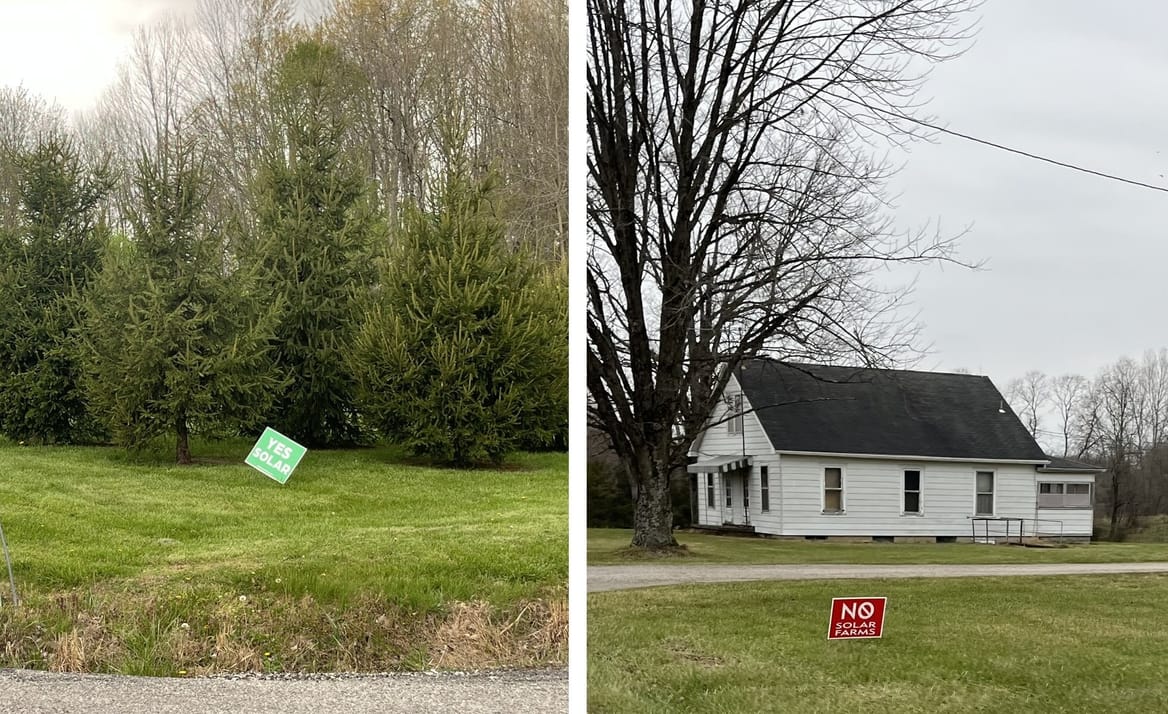
The brewing controversy over solar intrigued him, so he focused on the topic for his master’s thesis, which then became a study, published in May. It involved a survey of 22 local officials, many from counties that had been home to coal plants or mines.
“For a lot of these communities, the coal plant was one of the highest-paying jobs historically, one that anyone could take part in,” said Brelage. “As that industry started shutting down, it left a big hole.”
Some of the officials told Brelage they do not see solar as capable of filling the economic and employment gaps left by the closure of coal facilities. Others mentioned that colleagues lost reelection bids in part because of their support for solar.
Convincing residents that solar provides real financial benefits for communities is key to growing its acceptance, Brelage concluded.
A solar farm itself is never going to create the same type or volume of jobs as a coal plant. But the sector can contribute to the tax base — and it can create jobs in other ways.
The main mechanism is by luring in other businesses that want cheap, clean power, noted Michael J. Hicks, professor of economics and director of the Center for Business and Economic Research at Ball State University. He is lead author of a policy brief on the impact of renewable restrictions in Indiana, released in April by Ball State and Purdue University, and funded by the U.S. Department of Energy.
Such businesses could include factories that need a lot of electricity. Or they could include data centers, which don’t usually create a large number of jobs but can also pump up a county’s tax base.


