

Chile’s biggest green hydrogen demonstration plant – the US$78mn Haru Oni – is in far-south region Magallanes.
The end-product of the pioneering 1.2MW electrolyzer plant, powered by a wind turbine, is e-fuels, made by combining the hydrogen produced there with recycled carbon dioxide.
Further north, smaller pilot projects are also underway, including ones led by Universidad de Concepción and by Chile’s national center for mining technology pilot projects (CNP), a webinar hosted by events company Renmad was told.
Creating local uses for green hydrogen or derivatives is seen as a key strategy to build a green hydrogen economy in Chile, a country that depends almost completely on imported fossil fuels and is working to achieve carbon neutrality by 2050.
Other projects include one led by gas distributor GasValpo to blend hydrogen with natural gas in the domestic pipeline network in Coquimbo region.
Elsewhere on the project map, the country is home to dozens of large, or commercial-scale, projects, some targeting the local market, some the export market and others both.
ALSO READ Unlocking LatAm’s hydrogen potential: ‘Speed is of the essence’
For hydrogen, challenges include driving down the cost of production via more efficient processes and reducing uncertainty in all aspects of project development, said Sebastián Álvarez, head of engineering at hydrogen-focused consultancy and training company ECIT. Others include project permitting.
Hydrogen and its derivatives are seen playing an important role in decarbonizing those parts of the economy that cannot be electrified efficiently, such as heavy transport or certain industrial processes.
Universidad de Concepción
Universidad de Concepción leads Alianza Estratégica del Hidrógeno Verde para el Biobío, a state-funded innovation ecosystem initiative based in industrial hub Biobío region.
Projects underway include an initiative to process copper concentrates without producing emissions or residues.
Recently awarded US$10mn in co-financing by state development agency Corfo, the industrial validation-phase project utilizes hydrogen as a reducing agent. A focus is scaling up the technology, with support provided by Enami, Aurubis, Antofagasta Minerals, BHP, Codelco and Anglo American.
A pilot plant was established at the university, near to which a faulty 60kW fuel cell is located that university researchers are working to repair using technology from Chile.
The university is also part of a consortium, led by Spanish company Joltech Solutions, that was recently awarded a grant by Corfo to establish a plant in Biobío to produce electrolyzers of between 100kW and 1MW in capacity. The facility, due online by around the middle of next year, will have an automated production line to make alkaline electrodes. Two other parties were also awarded.
The university, working on a technical guide for safe deployment of technology, also has a project underway to optimize the transfer of electricity between solar panels and electrolyzer units. The project is in the implementation phase, involving lab-based prototypes. The next phase involves field trials, Andrea Moraga, head of the hydrogen unit of the university’s technological research institute IIT, told the webinar.
On top of this, IIT is working on an associated pyrolysis-based project to create sustainable aviation fuel from synthetic hydrocarbons derived from plastic waste.
CNP
CNP may ramp up installed hydrogen capacity amid ongoing work to test, monitor and evaluate associated industrial applications.
CNP has a small-scale solar-powered hydrogen production facility at the San Pedro mine in Til Til near Santiago, which is a testing bed for new technology across the mining value chain.
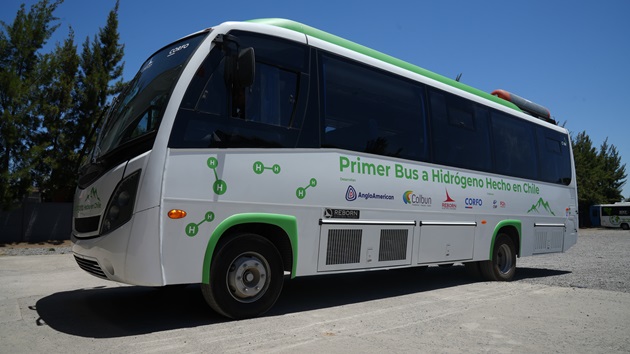
Daily hydrogen production at the facility stands at 0.7kg, which is used, for example, for blending with traditional hydrocarbons to fuel a boiler and as an input for a fuel cell-equipped bus. Clean energy comes from a 9.8kW rooftop solar system (pictured) and a 3MW plant at the mine.
“What’s coming? Scaling up a little capacity based on pilot project demand, testing new hydrogen technology across the value chain and looking at what complementary units, both hydrogen and derivates, we can incorporate in the pilot plant that, while small, has the versatility – and the purpose – to serve different pilot projects,” CNP CEO Andrés González said during the webinar.
Using hydrogen or blending the energy-carrier with other fuels would help miners reduce carbon footprints.
Chile’s permitting phase commercial-scale green hydrogen projects
Project: HNH Energy
Region: Magallanes
Output: Green ammonia
Capex: US$11.0bn
Owner: Austria Energy
Grid connection: No
Project: INNA
Region: Antofagasta
Output: Hydrogen and ammonia
Capex: US$10.0bn
Owner: AES Andes
Grid connection: Yes
Project: Volta
Region: Antofagasta
Output: Green hydrogen and ammonia
Capex: US$2.5bn
Owner: MAE
Grid connection: Yes
Project: Cabo Negro
Region: Magallanes
Output: E-fuels
Capex: US$830mn
Owner: HIF
Grid connection: No
Project: Green hydrogen for Calama mining district
Region: Antofagasta
Output: Green hydrogen
Capex: US$423mn
Owner: Susterra
Grid connection: Yes
A wind park – the US$500mn Faro del Sur, linked to the planned Cabo Negro plant – is also under evaluation.
The Valparaíso region Acciona-GNL Quintero 10MW green hydrogen project Bahía Quintero was last year given the environmental green light.
Renmad is holding a green hydrogen and energy storage event in Chilean capacity Santiago on July 30-31.


