
![[Scitech NOW] KAIST boosts green hydrogen production threefold with seven-metal electrode](https://i3.wp.com/image.dongascience.com/Photo/2026/04/17753608295613.jpg?w=1920&resize=1920,2515&ssl=1 "[Scitech NOW] KAIST boosts green hydrogen production threefold with seven-metal electrode")
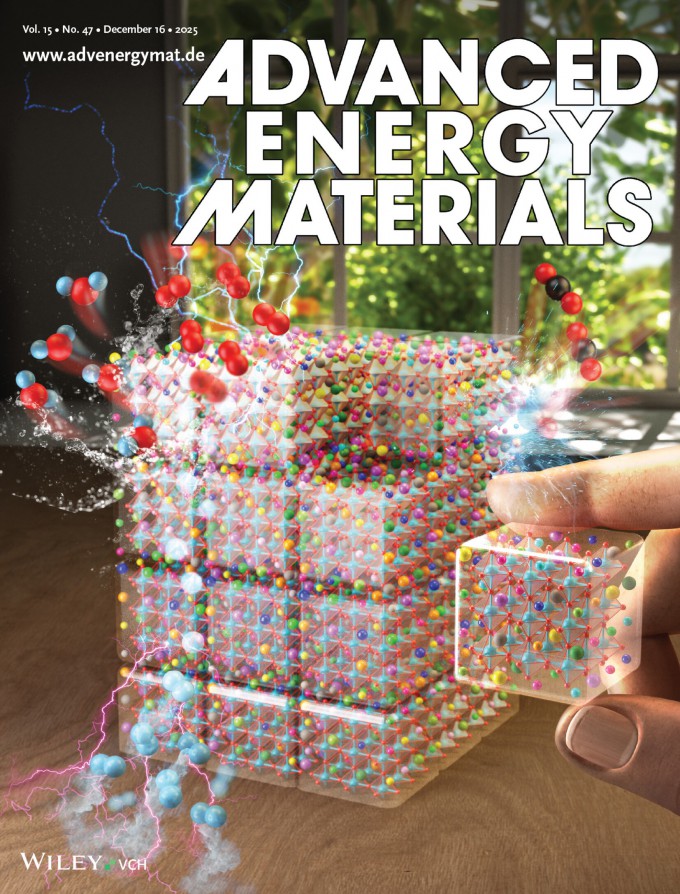
The cover of the international academic journal ‘Advanced Energy Materials’ from December 16 last year. The research on the high-entropy dual perovskite oxygen electrode by Professor Lee Kang-taek’s team at KAIST was selected as the cover article. Photo provided by KAIST
■ KAIST announced on the 5th that a research team led by Professor Lee Kang-taek of the Department of Mechanical Engineering has developed an oxygen electrode material for green hydrogen production using a ‘high-entropy’ strategy, which increases disorder by simultaneously introducing multiple metal elements. Proton-Conducting Electrochemical Cells (PCECs), which produce hydrogen by splitting water, have attracted attention for their high efficiency but have faced performance limitations due to the slow reaction rate at the oxygen electrode. The research team designed a ‘high-entropy dual perovskite oxygen electrode’ by simultaneously incorporating seven types of metal elements into the electrode structure. This lowered the oxygen vacancy formation energy by more than 60% and increased the proton transport rate by more than sevenfold. At 650°C, the power density was approximately 2.6 times higher and the hydrogen production performance was about 3 times higher than conventional materials. Long-term stability was also confirmed, with only 0.76% performance degradation over a 500-hour test.
■ The Brain and Cognitive Engineering Convergence Research Center at Daegu Gyeongbuk Institute of Science and Technology (DGIST) announced on the 5th that it hosted the ‘Glocal Lab Neuro-Replica Special Seminar’ from the 1st to the 3rd, featuring invited speaker Professor Denis Noble, an emeritus professor at the University of Oxford, UK. Professor Noble, who laid the foundation for modern systems biology by developing the first mathematical model of the heart’s electrical activity, delivered a special lecture on topics such as ‘A Physiological Bioengineering Approach to Finding the Causes and Cures for Complex Diseases.’ Attended by about 60 people from industry, academia, and research, the event also included presentations and discussions by early-career researchers, along with close research consultations and paper meetings for DGIST researchers.
Copyright ⓒ DongA Science. All rights reserved.


