

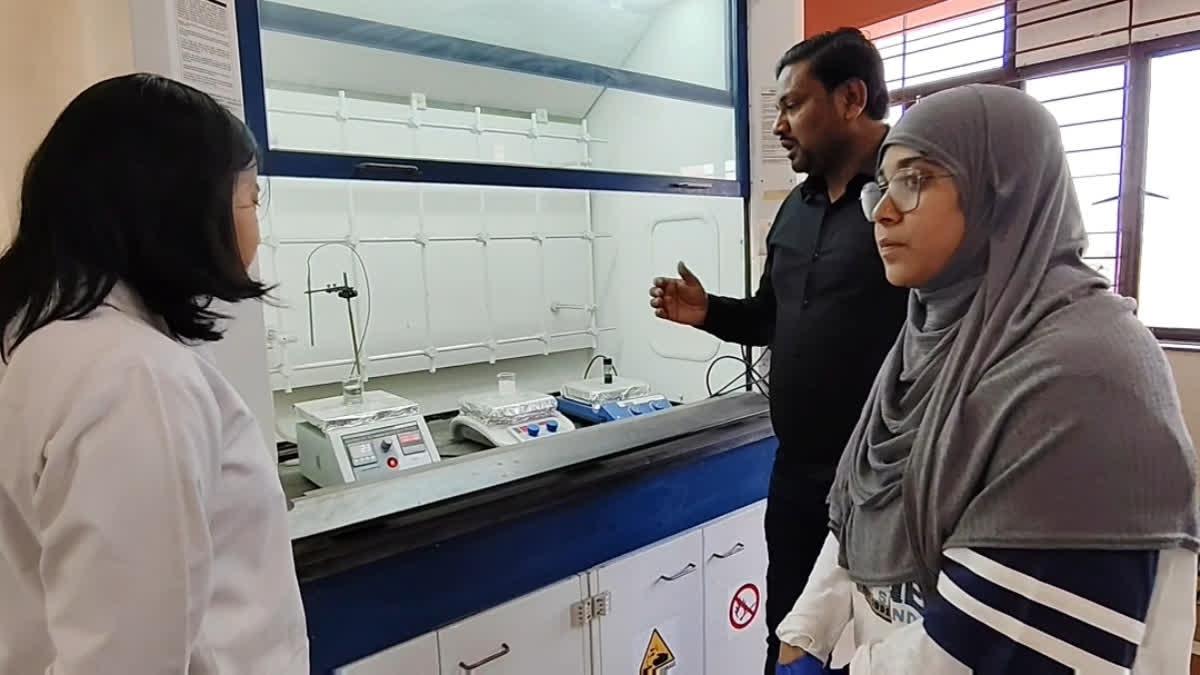
Scientists At IIT Dhanbad Develop Low Cost And Effective Electrode Material For Producing Green Hydrogen (ETV Bharat)
Dhanbad: In a move towards strengthening the country’s energy security, scientists from the Department of Physics at Indian Institute of Technology (Indian School of Mines) at Dhanbad have developed a low-cost and effective electrode material for producing green hydrogen.
The team led by Sheikh Riazuddin claims that this will significantly reduce the cost of green hydrogen, making it accessible to both the public and industry.
Riazuddin explained that the Indian government launched the National Green Hydrogen Mission in 2023 with the primary objective of reducing the cost of green hydrogen production and making the country self-reliant.
He added that the material used to produce green hydrogen is the most expensive component and if its price is reduced, green hydrogen could become affordable. His team has succeeded in developing the electrode material after a sustained research of a year and a half.
Priyadarshini Tamang and Omar Sultana, students pursuing doctorate at the Department of Physics, also played a key role in this research. The team developed a new catalyst using low-cost and readily available elements, including molybdenum, vanadium, sulfur and carbon.
Carbon, which includes graphene and graphite, is quite inexpensive, costing around Rs 60 rupees per kg. The scientists disclosed that this new material accelerates the process of splitting water into hydrogen and oxygen while providing better results with less energy.
Currently, expensive metals like platinum, palladium and ruthenium are used to produce green hydrogen. These metals are not available in sufficient quantities in India and have to be imported from countries like China and South Africa. This is why the price of green hydrogen currently hovers around Rs 500 per litre or more.
Riazuddin claims that the green hydrogen produced using the material developed by his team could cost less than Rs 50 per litre. “If this is possible, it would prove to be a major revolution in the energy sector,” he said.
The Government of India has set a target of producing 5o lakh tonnes of green hydrogen annually by 2030. The budget for 2026 also includes a separate funding provision to promote this sector. This project is being implemented in collaboration with the Department of Science and Technology along with the Innovation in Science Pursuit for Inspired Research (INSPIRE) programme.
Green hydrogen is considered to be a clean fuel. While the use of petrol and diesel emits harmful gases like carbon dioxide and carbon monoxide, which harm the environment and contribute to global warming, the use of green hydrogen does not emit these toxic gases. When it burns, it produces only water which protects the environment.
Scientists believe that in the future, the use of green hydrogen will increase in vehicles and machinery. It will also provide better mileage.
The research on the new material developed has been published in the international journal Small (Wiley, 2026). Efforts are underway to secure a collaboration with an industrial company to implement this technology on a larger scale. Scientists say that with industry support, large-scale production is possible.
Riazuddin believes that in the next 10 to 15 years, green hydrogen pumps will be seen on the roadsides just as petrol and diesel pumps are today. If this technology is successfully implemented on a large scale, India could become self-reliant in green hydrogen.


