

SPAIN’S prime minister has visited the site of a new €1 billion green hydrogen plant in Andalucia as construction formally begins.
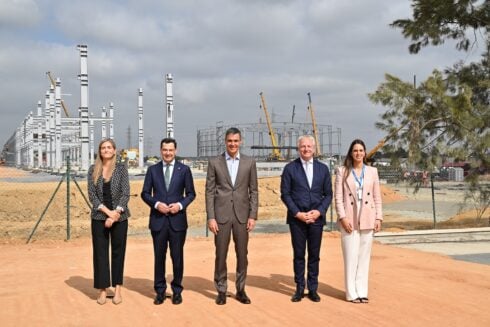
Pedro Sanchez toured the site in Palos de la Frontera, a port town on Huelva’s Costa de la Luz coast between Seville and the Portuguese border, where Spanish energy company Moeve held a ceremony on September 17 to mark the start of building work.
Also present were Sara Aagesen, Spain’s deputy prime minister for the ecological transition, and Juanma Moreno, president of Andalucia’s regional government.
The plant, named Onuba, is only the first phase of a far larger scheme called the Andalucian Green Hydrogen Valley, which the government says could become Europe’s biggest renewable hydrogen project.
READ MORE: WATCH: Spain’s PM Pedro Sanchez tells VOX leader ‘I may be a dog but, unlike you I have no master’ during Ceuta row
Green hydrogen is made by using renewable electricity to split water into hydrogen and oxygen, a process called electrolysis, producing a fuel that carries no carbon emissions when it’s burned or used in industry.
Moeve’s Energy Park in Palos de la Frontera, built on the site of its former Cepsa oil refinery, will house 300 megawatts of electrolysis capacity in this first phase, expandable to 405 megawatts, at a total cost of more than €1 billion.
German manufacturer Thyssenkrupp is supplying the electrolysis equipment, and the plant is expected to produce around 45,000 tonnes of green hydrogen a year once complete.
READ MORE: Spanish PM Pedro Sanchez to meet left-wing New York mayor Zohran Mamdani for debate on building an economy ‘for the majority’
That output is expected to cut roughly 250,000 tonnes of CO2 emissions a year – more than the combined car emissions of the Spanish provinces of Huelva, Cadiz and Jaen, according to Moeve, based on official emissions data from Spain’s environment ministry and traffic authority.
Sanchez said the project would create more than 3,700 direct jobs during construction and involve more than 400 small and medium-sized businesses.
Moeve, the rebranded former Cepsa, holds a 51% majority stake in the project.

Two hydrogen investors, Hy24 and Spain’s state-owned investment body COFIDES, each hold 14.5% after buying out the Emirati fund Masdar earlier this year, while Spanish gas grid operator Enagas Renovable and renewable power firm Alter Enersun share the remaining 20%.
The scheme has secured €304 million in European Union recovery funding, channelled through Spain’s post-pandemic recovery plan and a specific scheme for renewable hydrogen sites known as the Hydrogen Valleys programme.
But Onuba is only the opening step in something far more ambitious.
READ MORE: Political round-up: PM Pedro Sanchez battles growing Ceuta backlash as opposition turns up the heat
The government says the completed Valle Andaluz could eventually reach 2,000 megawatts of capacity, produce around 300,000 tonnes of hydrogen a year – roughly half of Spain’s entire 2030 national target – and cost as much as €3 billion in total.
That fuller vision has quietly narrowed since it was first announced in 2022, when Moeve’s plan also included a second hydrogen plant in Cadiz and a total investment of €5 billion, with the company’s efforts now concentrated solely on the Huelva site, according to newspaper El Mundo.
Sanchez opened his remarks by referring to Huelva’s worst wildfire in recent memory, which tore through the province this summer.
“A few weeks ago we looked at this province and saw fire and pain; today we look at this same land and see investment, jobs, innovation, and therefore hope,” he said.
He went on to frame renewable hydrogen as a matter of national strategy rather than just climate policy, tying Spain’s energy supply directly to the wars and crises reshaping global oil and gas markets.
“We cannot leave our supply at the mercy of unjustified wars, of tensions that are not our own, or of the legitimate geopolitical interests of other powers – nor, of course, pay the price for those who turn energy into another piece in their power games,” he said.
READ MORE: Spain will be the only major country in the EU not to shrink this century — and Pedro Sanchez says immigration is the reason why
“For decades, Spain and Europe have depended too much on energy that came from elsewhere.
“We still do. Unfortunately, every international crisis reminds us of the enormous price we’re paying for that dependence.”
His remarks hark directly to the war between the United States and Iran, which has pushed oil prices back over $100 (around €92) a barrel and revived a hydrogen sector that had cooled since a first wave of announcements followed Russia’s invasion of Ukraine in 2022.
The scheme also carries an EU ‘Project of Common Interest’ label, a status reserved for energy infrastructure Brussels considers strategically important, which fast-tracks planning permission and access to EU funding.
Pierre Etienne Franc, co-founder of Hy24, said the project ‘strengthens Europe’s energy diversification and Spain’s strategic autonomy, while paving the way for a southwestern European hydrogen network.’
A separate report commissioned by Moeve from PwC argues that green hydrogen and similar clean fuels could cut Europe’s dependence on imported energy by as much as half by 2040, and eventually supply around a third of the EU’s entire energy mix by 2050.
Sanchez also said his government would shortly begin processing the first sections of a national hydrogen pipeline network, and said Spain has already committed more than €3 billion to more than 120 renewable hydrogen projects nationally.
The Huelva plant itself is not expected to be up and running until 2029 – three years later than Moeve originally planned – and for now its only confirmed customer is Moeve itself, which will use the hydrogen to decarbonise its own refinery next door in San Roque, Campo de Gibraltar.
Click here to read more Environment News from The Olive Press.


