

PEM Hydrogen Production Bipolar Plate Market Size
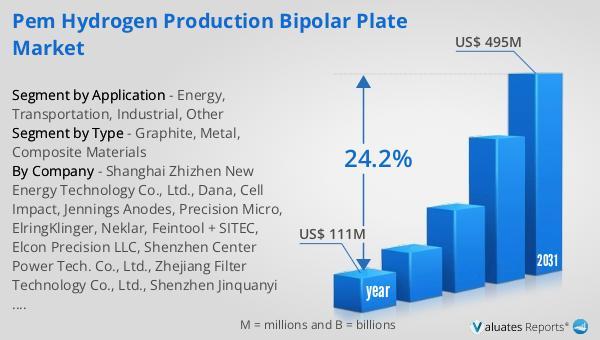
The global market for PEM Hydrogen Production Bipolar Plate was valued at US$ 111 million in the year 2024 and is projected to reach a revised size of US$ 495 million by 2031, growing at a CAGR of 24.2% during the forecast period.
View sample report
https://reports.valuates.com/request/sample/QYRE-Auto-12K19776/Global_PEM_Hydrogen_Production_Bipolar_Plate_Market_Research_Report_2025
The global PEM Hydrogen Production Bipolar Plate market is witnessing strong market growth as green hydrogen production, fuel cell deployment, and clean energy transition initiatives accelerate across industrial and transportation sectors. Bipolar plates are critical components in proton exchange membrane (PEM) electrolyzers, enabling efficient current conduction, gas separation, thermal management, and structural support within hydrogen production stacks. Increasing global investments in decarbonization, renewable energy integration, and hydrogen-based energy systems are significantly influencing market size and long-term market forecast trends. One of the most important market trends shaping the industry is the rapid expansion of green hydrogen infrastructure supported by government-backed hydrogen strategies, carbon neutrality targets, and large-scale electrolyzer installations. Manufacturers are increasingly focusing on improving material conductivity, corrosion resistance, sealing performance, and manufacturing precision to enhance PEM electrolyzer efficiency and durability. The growing adoption of hydrogen in transportation, industrial decarbonization, and energy storage applications is further strengthening market growth globally. In addition, rising demand for high-efficiency electrolyzers, cost reduction in hydrogen production, and scaling of renewable-powered hydrogen facilities are accelerating adoption of advanced bipolar plate technologies worldwide. Companies are focusing on material innovation, precision forming processes, and scalable manufacturing technologies to strengthen their market share and support the global hydrogen economy transition.
Based on type segmentation, the Metal segment currently holds a significant market share due to its high electrical conductivity, strong mechanical strength, and suitability for high-efficiency PEM electrolyzer systems. Metal bipolar plates are widely used in modern hydrogen production systems because they enable compact stack design, improved power density, and high durability under operating conditions involving acidic environments and variable loads. Ongoing advancements in coating technologies, corrosion-resistant materials, and precision stamping techniques continue to enhance metal bipolar plate performance, making this segment increasingly dominant in next-generation PEM systems. The Graphite segment also maintains a strong market presence due to its excellent corrosion resistance, chemical stability, and long operational lifespan in electrochemical environments. However, its relatively higher brittleness and machining limitations have encouraged gradual transition toward metallic alternatives in high-performance systems. The Composite Materials segment is witnessing growing market attention as manufacturers seek to combine the advantages of both metal and graphite materials, offering improved corrosion resistance, reduced weight, and enhanced manufacturability. Continuous innovation in material science, surface treatment technologies, and high-precision manufacturing processes is significantly influencing broader market trends across all type categories. As PEM electrolyzer deployment expands globally, the overall market forecast for bipolar plate materials remains highly positive.
From an application perspective, the Energy segment currently accounts for the largest market share due to the widespread adoption of PEM electrolyzers in renewable energy storage, grid balancing, and green hydrogen production facilities. Bipolar plates play a critical role in enabling efficient hydrogen generation from renewable power sources such as wind and solar energy, supporting large-scale energy transition initiatives. Increasing investment in hydrogen hubs, renewable energy integration projects, and national hydrogen strategies is significantly contributing to market growth within this segment. The Transportation segment is also witnessing strong market growth as hydrogen fuel cell vehicles, including buses, trucks, and passenger vehicles, gain traction as zero-emission mobility solutions. PEM electrolyzers and associated bipolar plate technologies are essential for supporting hydrogen refueling infrastructure and large-scale hydrogen production for transportation applications. The Industrial segment continues to maintain steady demand as industries such as steel manufacturing, chemical processing, and refining increasingly adopt hydrogen as a decarbonization fuel source. The Others category includes emerging applications such as backup power systems, distributed energy solutions, and research-based hydrogen production systems. As hydrogen adoption accelerates globally, the market forecast for PEM bipolar plate applications remains highly favorable.
The competitive landscape of the PEM Hydrogen Production Bipolar Plate market is characterized by strong material engineering expertise, precision manufacturing capabilities, and increasing investment in hydrogen energy technologies. Dana remains one of the companies with the largest market share due to its advanced expertise in thermal management, automotive systems, and hydrogen technology components supporting fuel cell and electrolyzer systems. Cell Impact is also a key market leader recognized for its high-speed forming technology for flow plates and bipolar plate production, enabling scalable manufacturing for hydrogen applications. ElringKlinger holds a significant position in the market through its strong focus on fuel cell components, lightweight materials, and hydrogen mobility solutions. Feintool + SITEC contributes through precision forming technologies and advanced manufacturing processes for high-performance metal components used in energy systems. Precision Micro and Elcon Precision LLC are important contributors in precision engineering and micro-manufacturing for electrochemical systems. Shanghai Zhizhen New Energy Technology, Shenzhen Center Power Tech, Zhejiang Filter Technology, Shenzhen Jinquanyi Technology, Suzhou Yunfan Hydrogen Energy Technology, and Jiangsu Yiantong Special Electrode New Material Technology are strengthening their market presence through expanding hydrogen technology manufacturing capabilities and increasing participation in the global green hydrogen supply chain. Jennings Anodes and Neklar are also contributing through specialized electrochemical component development and advanced materials expertise. Industry competition is expected to intensify further as companies focus on improving corrosion resistance, reducing production costs, enhancing mass manufacturing scalability, and developing next-generation bipolar plate materials optimized for large-scale PEM hydrogen production systems.
Regionally, Asia-Pacific currently dominates the PEM Hydrogen Production Bipolar Plate market in terms of market share due to rapid hydrogen infrastructure development, strong manufacturing capabilities, and large-scale renewable energy integration projects across China, Japan, South Korea, and Taiwan. China plays a particularly significant role due to aggressive investments in green hydrogen production, electrolyzer manufacturing, and clean energy transition initiatives. Japan continues to lead in hydrogen technology adoption and fuel cell development, while South Korea is expanding hydrogen infrastructure through government-backed clean energy programs. Europe is also a major market driven by strong hydrogen strategies, decarbonization policies, and large-scale electrolyzer deployment across Germany, France, the United Kingdom, Italy, and Russia. North America is witnessing strong market growth supported by federal clean energy initiatives, renewable hydrogen projects, and increasing investment in hydrogen production infrastructure across the United States and Canada. Southeast Asia, including India, is emerging as a growth region due to rising renewable energy adoption and early-stage hydrogen development initiatives. Latin America is gradually increasing participation through renewable energy projects and hydrogen pilot programs across Mexico and Brazil. The Middle East & Africa region is also showing growing potential due to large-scale green hydrogen export projects and renewable energy investments in countries such as Saudi Arabia and the UAE. The overall market forecast for the PEM Hydrogen Production Bipolar Plate market remains highly positive as global energy systems transition toward hydrogen-based economies, with continued advancements in electrolyzer technology, material innovation, and large-scale production scaling expected to drive long-term industry expansion worldwide.
Segment by Type
• Graphite
• Metal
• Composite Materials
Segment by Application
• Energy
• Transportation
• Industrial
• Other
By Company
Shanghai Zhizhen New Energy Technology Co., Ltd., Dana, Cell Impact, Jennings Anodes, Precision Micro, ElringKlinger, Neklar, Feintool + SITEC, Elcon Precision LLC, Shenzhen Center Power Tech. Co., Ltd., Zhejiang Filter Technology Co., Ltd., Shenzhen Jinquanyi Technology Co., Ltd., Suzhou Yunfan Hydrogen Energy Technology Co., Ltd., Jiangsu Yiantong Special Electrode New Material Technology Co., Ltd.
View full report
https://reports.valuates.com/market-reports/QYRE-Auto-12K19776/global-pem-hydrogen-production-bipolar-plate
Valuates,
4th Floor,
Balaraj’s Arcade,
Whitefield Main road,
Bangalore 560066,
Valuates offers an extensive collection of market research reports that helps companies to take intelligent strategical decisions based on current and forecasted Market trends.
This release was published on openPR.


