

Researchers in Germany have just unveiled a solar module that can convert up to 31.3 percent of sunlight into hydrogen, thus bringing clean fuel production closer to commercial reality.
For the project, scientists at the Fraunhofer Institute for Solar Energy Systems (ISE) in Freiburg, Baden-Württemberg, directly coupled concentrating photovoltaic cells with proton exchange membrane (PEM) electrolyzer cells.
The research team discovered that the integrated design eliminated the need for intermediate power conversion. It moreover enabled direct water splitting using electricity generated by the solar cells.
“Our new record shows that hydrogen can be produced very efficiently directly from sunlight,” Frank Dimroth, PhD, a physicist renowned for developing some of the most efficient solar cells in the world, and head of the III-V Photovoltaics and Concentrator Technology Department at Fraunhofer ISE, said.
Direct solar hydrogen
Juan Francisco Martínez Sánchez, PhD, project manager at the institute, which is one of the world’s largest facilities for solar research, stated the system relies on concentrating photovoltaics (PVs) rather than conventional solar panels. “For the photovoltaic/electrolysis modules we have developed, we use what is known as concentrating photovoltaics,” Sánchez, said.
Direct sunlight is concentrated by a Fresnel lens array, an optical part made up of multiple tiny Fresnel lenslets into a 1D or 2D grid. The light is then focused onto highly efficient III-V multi-junction solar cells that produce an open-circuit voltage of more than four volts.
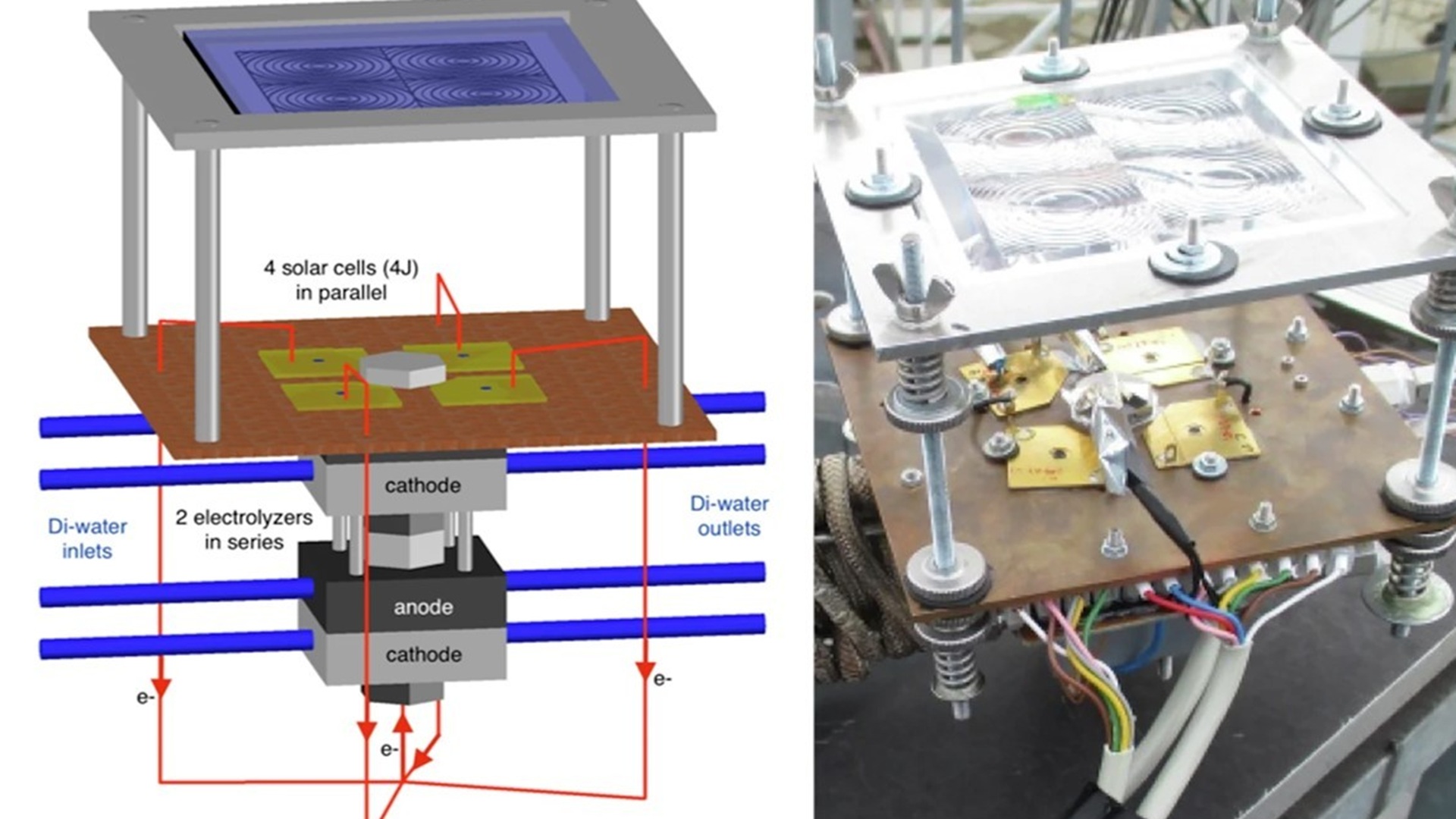
The researchers connected these solar cells directly to the cathode and anode of two Proton Exchange Membrane (PEM) electrolyzer cells arranged in series. They then carefully matched the electrical characteristics of the two technologies. As a result the system transferred electricity straight into hydrogen production without intermediate conversion stages or energy losses.
“For hydrogen production, we connected these solar cells directly to the cathode and anode of two PEM electrolysis cells connected in series, thereby achieving a perfect match between the two electrical characteristics,” Tom Smolinka, PhD, head of the membrane electrolysis department at the institute, noted.
No energy losses
According to the team, the proof-of-concept demonstrator features a lens area of roughly 9.92 square inches (64 square centimeters) but successfully demonstrated the feasibility of the integrated approach under real outdoor conditions.
In field tests, the outdoor demonstrator converted approximately 31.3 percent of incoming solar energy into chemical energy stored in hydrogen. The efficiency was calculated using the fuel’s higher heating value.
The technology uses III-V solar cells, which are currently regarded as the world’s most efficient photovoltaic devices. These cells have long been used in spacecraft because of their high performance and durability.
The researchers believe that concentrating photovoltaic systems could also make them economically viable for terrestrial applications. They said the results showed the potential of integrated photovoltaic-electrolysis systems for efficient green hydrogen production.
However, although the prototype reached record efficiency, the technology is still at an early stage of development. “Development is still in its early stages, and it’s hard to say how quickly we’ll be able to achieve competitive systems,” Dimroth said in a press release.
They are now looking for investors to commercialize the technology. “To further develop the concept, we are seeking investors for our planned spin-off, Clearsun Energy,” Dimroth concluded.


