

Middle East Green Hydrogen Market Summary
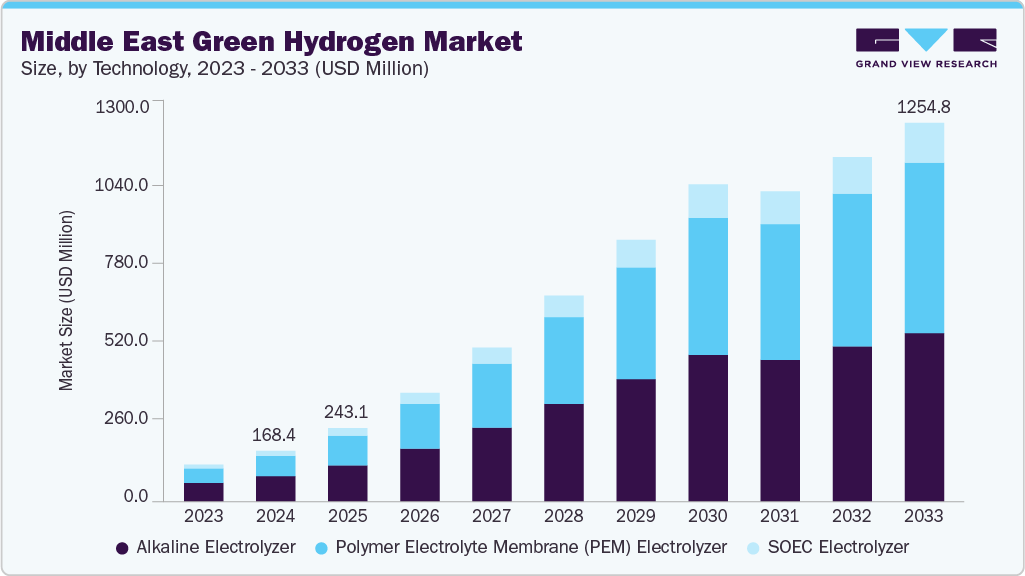
The Middle East green hydrogen market size was estimated at USD 168.4 million in 2024 and is projected to reach USD 1,254.8 million by 2033, growing at a CAGR of 22.8% from 2025 to 2033. Green hydrogen development in the region is anchored by large-scale renewable-powered electrolysis projects, hybrid renewable storage systems, and integrated hydrogen-to-ammonia facilities targeting domestic consumption and exports.
Key Market Trends & Insights
- Saudi Arabia green hydrogen market held the largest share of 60% of the Middle East market in 2024.
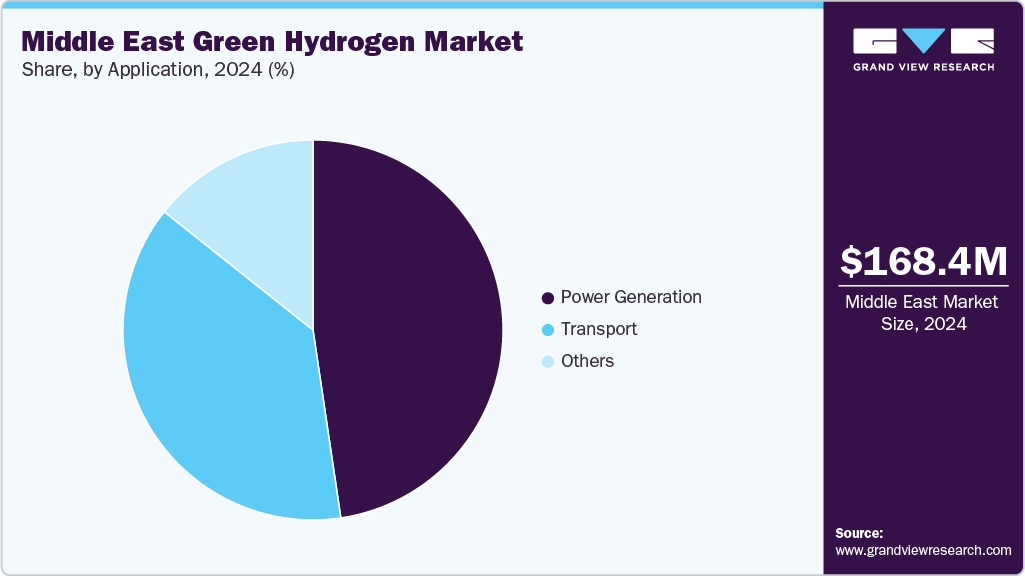
- By application, power generation held the largest market share of 47.66% in 2024.
- Based on technology, alkaline electrolyzer segment held the largest market share in 2024.
Market Size & Forecast
- 2024 Market Size: USD 168.4 Million
- 2033 Projected Market Size: USD 1,254.8 Million
- CAGR (2025-2033): 22.8%
National decarbonization strategies such as Saudi Arabia’s Hydrogen Strategy under Vision 2030, the UAE’s Hydrogen Roadmap, and Oman’s Hydrogen Strategy 2040 are accelerating investments in production hubs, port infrastructure, and hydrogen-ready industrial clusters. Countries across the Gulf Cooperation Council (GCC), Egypt, and Morocco leverage their abundant solar and wind resources to position themselves as global exporters while meeting local demand in mobility, power generation, and heavy industries such as steel and fertilizers.
Market growth is driven by declining renewable power costs, rapid scaling of electrolyzer manufacturing, and strong policy support through long-term offtake agreements, public-private partnerships (PPPs), and green financing mechanisms. Technological advancements such as high-efficiency PEM and alkaline electrolyzers, ammonia cracking systems, and AI-optimized hydrogen production enhance project viability. Integrated hydrogen corridors connecting production zones to export terminals, as seen in NEOM’s $8.4 billion hydrogen project in Saudi Arabia and Oman’s Duqm Green Hydrogen Hub, enable global supply chain integration. Cross-border collaborations with Europe and Asia through agreements for clean fuel imports are expanding market opportunities. With leading companies such as Masdar, ACWA Power, Engie, Siemens Energy, and Fortescue Future Industries driving large-scale deployments, the Middle East green hydrogen market is poised for rapid expansion, cementing the region’s role as a cornerstone of the global hydrogen economy.
Drivers, Opportunities & Restraints
Ambitious national decarbonization strategies, abundant renewable energy resources, and a growing global demand for clean fuels drive the Middle East green hydrogen market. Countries such as Saudi Arabia, the UAE, and Oman are leveraging their strategic location, high solar irradiation, and strong wind corridors to develop large-scale electrolysis facilities capable of producing competitively priced green hydrogen for domestic use and export. Government-backed initiatives such as the Saudi National Hydrogen Strategy, the UAE’s Hydrogen Roadmap, and Oman Hydrogen Strategy 2040 provide clear policy direction and attract significant foreign direct investment. The falling costs of renewable electricity and the scaling up of electrolyzer manufacturing capacity are accelerating the transition from pilot projects to commercial-scale operations.
Opportunities in the market include the development of green hydrogen export hubs linked to Europe and Asia, integrating hydrogen into heavy industries such as steel, fertilizers, and petrochemicals, and deployment in emerging sectors such as shipping and aviation. Cross-border collaborations, such as EU-GCC clean hydrogen agreements, and investments in ammonia conversion and cracking technologies, enhance market reach and flexibility. The rise of green hydrogen-powered mobility solutions and AI-driven optimization of hydrogen production and storage further expands commercial potential. However, restraints remain in the form of high capital costs for electrolyzers and hydrogen transport infrastructure, limited availability of specialized hydrogen-ready logistics, and the absence of harmonized certification standards across export markets. In addition, water scarcity in some parts of the region necessitates significant investment in desalination facilities, which can increase project complexity and cost. However, fluctuating global demand patterns may impact long-term offtake certainty.
Technology Insights
The Alkaline Electrolyzer segment emerged as the dominant technology category in the Middle East green hydrogen market, accounting for a revenue share of 50.03% in 2024. Its strong foothold is driven by the technology’s proven operational reliability, cost-effectiveness, and suitability for large-scale hydrogen production in industrial and utility-scale applications. Key deployments in Saudi Arabia, the UAE, and Oman have accelerated capacity growth, particularly in sectors such as ammonia production, steel manufacturing, and petrochemical refining. Notable projects leveraging alkaline technology highlight its capability to deliver consistent hydrogen output while maintaining lower capital and operational costs than alternative electrolyzer technologies. While PEM and SOEC electrolyzers are gaining ground due to their flexibility and efficiency in variable renewable integration, alkaline technology continues to dominate for bulk hydrogen production, where grid stability and lower electricity costs are available.
Favorable policy frameworks, strategic partnerships with international electrolyzer manufacturers, and large-scale government-backed hydrogen hubs further reinforce the region’s sustained adoption of alkaline electrolyzers. Technological advancements, such as improved membrane durability, modular plant designs, and hybrid system integration with renewable power sources, enhance performance and scalability. Moreover, expanding dedicated green hydrogen clusters in industrial zones, port facilities, and export-oriented projects underscores the technology’s adaptability to regional demand patterns. Water consumption and space requirements are being addressed through process optimization and integration with desalination systems, cementing the alkaline electrolyzer’s position as the preferred choice for large-scale green hydrogen projects in the Middle East over the forecast period.
Application Insights
The Power Generation segment accounted for the largest revenue share of 47.66% in the Middle East green hydrogen market in 2024 and is expected to maintain its dominance over the forecast period. This application segment is witnessing strong growth due to the region’s strategic push toward decarbonizing electricity supply, integrating large-scale renewable projects, and enhancing grid stability through clean fuel alternatives. Countries such as Saudi Arabia, the UAE, and Oman are leading initiatives to blend green hydrogen with natural gas in existing power plants, develop hydrogen-fueled turbines, and construct dedicated hydrogen-to-power facilities. Flagship projects, including integrated renewable-hydrogen power hubs, are being deployed to supply low-carbon electricity for industrial complexes, urban centers, and export markets. The ability of green hydrogen to store excess renewable energy and provide dispatchable power positions it as a key enabler of the region’s clean energy transition.
The expansion of power generation applications is further driven by growing investments in hydrogen-fired turbines, fuel cells for stationary power, and hybrid power plants combining solar, wind, and hydrogen storage systems. Integration with advanced control technologies, energy management platforms, and high-efficiency generation units allows operators to optimize fuel utilization while ensuring round-the-clock energy availability. Supportive government policies, long-term offtake agreements, and international partnerships for technology transfer are fostering large-scale adoption. As Middle Eastern nations advance toward net-zero targets and smart grid modernization, green hydrogen-powered generation likely to play a central role in meeting peak demand, ensuring energy security, and delivering sustainable electricity to domestic and export markets.
Distribution Channel Insights
The Pipeline segment accounted for the largest revenue share of 63.15% in the Middle East green hydrogen market in 2024 and is expected to maintain its leading position over the forecast period. The segment is witnessing strong growth due to the region’s focus on building large-scale hydrogen transport infrastructure to connect production hubs with industrial zones, power generation sites, and export terminals. Countries such as Saudi Arabia, the UAE, and Oman are developing dedicated hydrogen pipeline networks integrated with renewable energy-powered electrolysis plants to ensure cost-efficient, high-volume delivery. Projects such as the NEOM green hydrogen pipeline and the UAE’s hydrogen corridor are setting benchmarks for regional connectivity, enabling seamless supply to domestic users while preparing for large-scale international exports to Europe and Asia. The ability of pipelines to deliver hydrogen with minimal energy losses and at competitive transport costs positions them as the backbone of the region’s green hydrogen logistics.
The need for long-term supply security for industries such as refining, chemicals, steelmaking, and power generation further drives the expansion of hydrogen pipelines. Integration with underground storage, compressor stations, and advanced monitoring systems enhances operational efficiency and safety, while cross-border pipeline projects foster regional trade and strategic energy partnerships. Supportive regulatory frameworks, investment incentives, and government-backed hydrogen strategies accelerate infrastructure deployment. As the Middle East advances its vision of becoming a global green hydrogen export hub, pipeline networks likely to remain central to unlocking scale, ensuring consistent delivery, and reducing supply chain bottlenecks for domestic consumption and international trade.
Country Insights
Saudi Arabia Green Hydrogen Market Trends
Saudi Arabia dominates the Middle East green hydrogen market in 2024 with a 60.0% share, driven by its strategic push under Vision 2030 to become a global leader in renewable energy and hydrogen exports. The Kingdom is spearheading mega-projects such as the USD 8.4 billion NEOM green hydrogen plant, which is expected to be one of the largest in the world upon completion, producing up to 600 tonnes of hydrogen per day. These initiatives are backed by the Renewable Energy Project Development Office (REPDO), which ensures transparent tendering processes and attracts top-tier global developers. Complementary renewable energy capacity, including large-scale solar and wind projects in Sakaka, Dumat Al Jandal, and the Red Sea region, is being expanded to power green hydrogen production.
Saudi Arabia’s exceptional solar irradiance and robust wind corridors give it unmatched production potential, enabling it to target domestic decarbonization and large-scale export markets in Europe and Asia. Sovereign-backed financing mechanisms, clear regulatory frameworks, and active partnerships with firms from the U.S., Japan, Germany, and South Korea are accelerating deployment. With active construction, secured offtake agreements, and an ambitious pipeline exceeding 60 GW of renewable capacity dedicated to hydrogen production, Saudi Arabia is positioned to retain its leadership well into the next decade.
UAE Green Hydrogen Market Trends
The UAE holds a significant share of the Middle East green hydrogen market in 2024, supported by its well-established renewable energy sector and proactive hydrogen strategy under the UAE Energy Strategy 2050. The country is leveraging its solar dominance, particularly through projects such as the 5 GW Mohammed bin Rashid Al Maktoum Solar Park, to feed large-scale hydrogen electrolyzers. Abu Dhabi’s Masdar and ADNOC jointly lead multiple green and blue hydrogen initiatives aimed at domestic industrial decarbonization and export opportunities, especially to Europe and East Asia. Dubai’s Hydrogen Pilot Project at the Mohammed bin Rashid Solar Park is a flagship example of integrating renewables with hydrogen production for mobility and energy storage applications.
The UAE benefits from low-cost financing, world-class infrastructure, and strong international partnerships with companies such as Siemens Energy, ENGIE, and BP. Export-oriented projects and port infrastructure at Khalifa Port and Jebel Ali position the UAE as a regional hydrogen trade hub. The government’s focus on regulatory clarity, incentives for technology adoption, and readiness to scale electrolyzer capacity beyond 2 GW by 2030 ensures its competitive positioning in the Middle East hydrogen race.
Egypt Green Hydrogen Market Trends
Egypt green hydrogen market is gaining momentum, driven by strategic geographic positioning and strong renewable energy resources. The government is leveraging its Integrated Sustainable Energy Strategy (ISES) and abundant solar and wind capacity-such as Benban Solar Park and Gulf of Suez wind farms-to develop large-scale hydrogen production. Key projects include green hydrogen pilot plants in the Suez Canal Economic Zone, developed in partnership with European and Gulf investors, aimed at producing green ammonia for global export. Egypt’s cross-border grid connectivity with Libya and Sudan and planned links to Greece and Cyprus provide a logistical advantage for energy trade.
Policy support, competitive feed-in tariffs, and financial backing from the European Investment Bank and the African Development Bank attract Independent Power Producers (IPPs) to the hydrogen sector. The Suez Canal’s position as a global shipping artery makes Egypt a bunkering hub for green fuels. With multiple MoUs signed for projects exceeding 10 GW of electrolyzer capacity, Egypt is solidifying its role as a bridge between Middle East hydrogen production and European demand.
Oman Green Hydrogen Market Trends
Green hydrogen market in Oman is rapidly emerging as a green hydrogen powerhouse in the Middle East, underpinned by its Oman Vision 2040 target to diversify the economy and derive 30% of its energy from renewables by 2030. The country’s Hydrom initiative is central to this push, having allocated prime land in the Al Wusta and Dhofar regions for large-scale hydrogen and ammonia projects. Multiple international consortia, including Shell, BP, and ACWA Power, are developing integrated solar and wind generation projects to supply electrolyzers. Oman’s strategic location with direct access to deep-water ports such as Duqm and Salalah gives it a competitive edge in green hydrogen exports to Asia and Europe.
Government-backed incentives, streamlined permitting processes, and long-term offtake agreements bolster investor confidence. The first wave of projects, targeting over 1 million tonnes per year of green hydrogen production by the early 2030s, is already underway. With vast land availability, high renewable energy yields, and growing policy maturity, Oman is positioning itself as a major exporter of green fuels in the global energy transition.
Qatar Green Hydrogen Market Trends
Qatar green hydrogen market is at an early but promising stage, complementing its long-term diversification strategy beyond natural gas under the Qatar National Vision 2030. Building on its strong energy infrastructure, Qatar is developing pilot hydrogen projects such as the Al Kharsaah solar-powered hydrogen production facility, integrated with the 800 MW Al Kharsaah Solar PV Plant. The country is exploring solid oxide electrolyzer technology to enhance efficiency and scale, aiming to serve domestic industrial needs and future export markets.
The government is aligning hydrogen development with its carbon neutrality goals and is actively engaging with global technology providers to accelerate project readiness. While fossil fuels remain dominant, Qatar’s robust LNG export network and port infrastructure can be adapted to handle hydrogen and ammonia shipments. Continued investment in R&D, technology partnerships, and regulatory frameworks expected to determine Qatar’s trajectory as it seeks to position itself as a competitive hydrogen supplier by the early 2030s.
Key Middle East Green Hydrogen Company Insights
Some of the key players operating in the Middle East green hydrogen market include ACWA Power, Masdar, Air Products and Chemicals, Inc., ADNOC/Fertiglobe, Siemens Energy, ENGIE, Thyssenkrupp, BP, TotalEnergies, and Linde. These companies are actively engaged in developing large-scale green hydrogen production facilities, advancing electrolysis technologies, and forging strategic partnerships to accelerate hydrogen adoption across the region.
Key Middle East Green Hydrogen Companies:
- ACWA Power
- Masdar
- Air Products and Chemicals, Inc.
- ADNOC / Fertiglobe
- Siemens Energy
- ENGIE
- Thyssenkrupp
- BP
- TotalEnergies
- Linde
Recent Developments
-
In January 2025, ACWA Power announced the commencement of construction on a 1.2 GW green hydrogen production facility in Saudi Arabia’s NEOM region. The project, powered entirely by solar and wind energy, is designed to produce green hydrogen for both domestic industrial use and international export, reducing carbon emissions by an estimated 3 million tons annually. This development supports Saudi Arabia’s National Hydrogen Strategy and underscores ACWA Power’s pivotal role in scaling green hydrogen infrastructure across the Middle East through large-scale, sustainable, and technologically advanced clean energy projects.
Middle East Green Hydrogen Market Report Scope
|
Report Attribute
|
Details
|
|
Market size value in 2025
|
USD 243.1 million
|
|
Revenue forecast in 2033
|
USD 1,254.8 million
|
|
Growth rate
|
CAGR of 22.8% from 2025 to 2033
|
|
Base year for estimation
|
2024
|
|
Historical data
|
2021 – 2023
|
|
Forecast period
|
2025 – 2033
|
|
Quantitative units
|
Volume in Kilotons, Revenue in USD million, and CAGR from 2025 to 2033
|
|
Report coverage
|
Volume & revenue forecast, competitive landscape, growth factors, and trends
|
|
Segments covered
|
Technology, application, distribution channel, country
|
|
Country scope
|
UAE; Saudi Arabia; Egypt; Oman; Qatar
|
|
Key companies profiled
|
ACWA Power; Masdar; Air Products and Chemicals, Inc.; ADNOC / Fertiglobe; Siemens Energy; ENGIE; Thyssenkrupp; BP; TotalEnergies; Linde
|
|
Customization scope
|
Free report customization (equivalent up to 8 analysts working days) with purchase. Addition or alteration to country, regional & segment scope.
|
|
Pricing and purchase options
|
Avail customized purchase options to meet your exact research needs. Explore purchase options
|
Middle East Green Hydrogen Market Report Segmentation
This report forecasts revenue growth at country levels and provides an analysis of the latest industry trends in each of the sub-segments from 2021 to 2033. For this study, Grand View Research has segmented the Middle East Green Hydrogen market report based on technology, application, distribution channel, and country:
-
Technology Outlook (Volume, Kilotons; Revenue, USD Million, 2021 – 2033)
-
Application Outlook (Volume, Kilotons; Revenue, USD Million, 2021 – 2033)
-
Power Generation
-
Transport
-
Others
-
-
Distribution Channel Outlook (Volume, Kilotons; Revenue, USD Million, 2021 – 2033)
-
Country Outlook (Volume, Kilotons; Revenue, USD Million, 2021 – 2033)
-
Middle East
-
UAE
-
Saudi Arabia
-
Egypt
-
Oman
-
Qatar
-
-


