

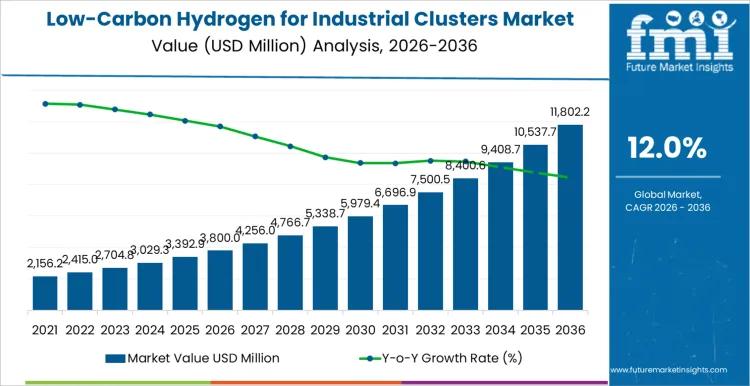
The Low-Carbon Hydrogen for Industrial Clusters Market is projected to expand from USD 3,800.0 million in 2026 to USD 11,802.2 million by 2036, advancing at a robust 12.0% CAGR during the forecast period. Growth reflects the accelerating shift toward coordinated industrial cluster development, where shared hydrogen infrastructure enables economies of scale, optimized resource allocation, and collective decarbonization outcomes.
The Low-Carbon Hydrogen for Industrial Clusters Market is becoming central to regional energy transition strategies as co-located facilities integrate production, storage, and distribution into synchronized hydrogen ecosystems that enhance supply reliability, operational flexibility, and investment efficiency.
Read Full Report:https://www.futuremarketinsights.com/reports/low-carbon-hydrogen-for-industrial-clusters-market
Direct Answers
Market size in 2026: USD 3,800.0 million
Market size in 2036: USD 11,802.2 million
Forecast CAGR (2026-2036): 12.0%
Leading production route: Green Hydrogen (Electrolysis) – 44%
Leading business model: Shared backbone infrastructure – 38.0%
Leading end-use segment: Refining and chemical applications – 30.0%
Largest development stage: Under-construction clusters – 42.0%
Key growth countries: China, Germany, USA, UK, South Korea, Japan
Top companies: Air Liquide, Linde, Air Products, Shell, BP, Equinor, RWE, ENGIE, Iberdrola, Ørsted
Market Momentum (2026-2036 Trajectory)
The Low-Carbon Hydrogen for Industrial Clusters Market begins its forecast cycle at USD 3,800.0 million in 2026, supported by committed under-construction cluster projects and expanding renewable integration. By 2028, scaling electrolysis capacity and shared infrastructure investments strengthen deployment momentum. Entering 2030, coordinated policy support and cost improvements in renewable electricity enhance green hydrogen competitiveness.
From 2031 onward, increased operational maturity and backbone infrastructure optimization accelerate adoption across refining and chemical complexes. By 2033, international hydrogen trade opportunities and cross-border cooperation reinforce large-scale cluster economics. The market ultimately reaches USD 11,802.2 million by 2036, reflecting sustained 12.0% CAGR growth anchored in integrated industrial decarbonization strategies.
Why the Market is Growing
The Low-Carbon Hydrogen for Industrial Clusters Market is expanding as regional decarbonization mandates increasingly favor coordinated industrial action over standalone facility transitions. Shared electrolysis facilities, integrated storage systems, and smart distribution networks reduce individual capital burdens while improving operational reliability.
Declining renewable electricity costs are improving green hydrogen economics, supporting full lifecycle carbon neutrality and access to green financing. At the same time, industrial competitiveness pressures encourage cluster-based approaches that optimize cost structures, enhance supply security, and meet regulatory compliance expectations.
Policy frameworks supporting just transition initiatives, workforce development, and regional industrial modernization further strengthen the investment case for large-scale cluster development.
Segment Spotlight
1) Production Route: Green Hydrogen Leads (44%)
Green hydrogen produced via renewable-powered electrolysis commands 44% of the Low-Carbon Hydrogen for Industrial Clusters Market. Its leadership reflects strong alignment with net-zero targets and green financing requirements. Declining solar and wind costs, combined with improving electrolysis efficiency, reinforce long-term cost stability and energy independence.
Blue hydrogen remains significant for immediate large-scale deployment and cost optimization while supporting gradual green transition pathways.
2) Business Model: Shared Backbone Infrastructure (38.0%)
Shared backbone infrastructure systems account for 38.0% adoption, highlighting coordinated development as the preferred configuration. These models enable infrastructure sharing, distributed risk, and optimized resource allocation across multiple industrial users. Participants gain access to large-scale production and storage capacity without assuming standalone project risks.
3) End Use: Refining and Chemical Applications (30.0%)
Refining and chemical applications represent 30.0% of demand, positioning petrochemical complexes and refineries as anchor customers. Their substantial hydrogen consumption and existing infrastructure provide predictable volumes that support cluster economics while enabling expansion into adjacent industrial applications.
Drivers, Opportunities, Trends, Challenges
Drivers: Regional decarbonization mandates and industrial policy frameworks increasingly prioritize cluster-based hydrogen deployment. Shared infrastructure reduces system-wide costs and simplifies regulatory compliance.
Opportunities: International hydrogen trade and cross-border cooperation create export pathways and technology leadership potential. Integrated renewable-hydrogen projects offer diversified revenue streams and improved economics.
Trends: Green hydrogen adoption is accelerating as renewable energy costs decline. Under-construction clusters (42.0%) dominate near-term deployment, while announced projects (30.0%) signal strong pipeline expansion.
Challenges: High capital requirements for production, storage, and distribution infrastructure remain a barrier. Grid connection constraints and electricity supply limitations may restrict large-scale electrolysis deployment in certain industrial regions.
Country Growth Outlook (CAGR)
China leads growth at 13.2% CAGR, driven by industrial scale and coordinated hydrogen policies. Germany advances at 11.6% through structured hydrogen strategy implementation. The USA grows at 11.8%, supported by regional hub initiatives. Japan (10.5%) emphasizes precision and reliability. South Korea (11.2%) and the UK (11.7%) strengthen cluster integration within advanced industrial ecosystems.
Subscribe for Year-Round Insights → Stay ahead with quarterly and annual data updates: https://www.futuremarketinsights.com/reports/brochure/rep-gb-31645
Request for Sample Report | Customize Report |purchase Full Report –https://www.futuremarketinsights.com/reports/sample/rep-gb-31645
Competitive Landscape
The Low-Carbon Hydrogen for Industrial Clusters Market features global industrial gas leaders and energy majors driving large-scale cluster development. Key participants include Air Liquide, Linde, Air Products, Shell, BP, Equinor, RWE, ENGIE, Iberdrola, and Ørsted. Competitive positioning centers on integrated project execution, infrastructure coordination, operational optimization, and stakeholder collaboration.
Scope of the Report
Market Value (2026): USD 3,800.0 million
Forecast Value (2036): USD 11,802.2 million
CAGR (2026-2036): 12.0%
Segmentation: Production Route, Business Model, End Use, Development Stage
Regions Covered: Global
Countries Analyzed: China, Germany, USA, Japan, South Korea, UK
Key Companies Profiled: Air Liquide, Linde, Air Products, Shell, BP, Equinor, RWE, ENGIE, Iberdrola, Ørsted
Explore More Related Studies Published by FMI Research:
Energy Storage High Voltage Connector Market:https://www.futuremarketinsights.com/reports/energy-storage-high-voltage-connector-market
Compressor Anti Surge Control Valve Market:https://www.futuremarketinsights.com/reports/compressor-anti-surge-control-valve-market
Decoking Control System Market:https://www.futuremarketinsights.com/reports/decoking-control-system-market
Surfactants for Enhanced Oil Recovery (EOR) Market:https://www.futuremarketinsights.com/reports/surfactants-for-enhanced-oil-recovery-eor-market
Why FMI: Decisions that Change Outcomes- https://www.futuremarketinsights.com/why-fmi
Have a specific Requirements and Need Assistant on Report Pricing or Limited Budget please contact us – sales@futuremarketinsights.com
Contact Us:
Future Market Insights Inc.
Christiana Corporate, 200 Continental Drive,
Suite 401, Newark, Delaware – 19713, USA
T: +1-347-918-3531
Website: https://www.futuremarketinsights.com
LinkedIn| Twitter| Blogs | YouTube
About Future Market Insights (FMI)
Future Market Insights, Inc. (FMI) is an ESOMAR-certified, ISO 9001:2015 market research and consulting organization, trusted by Fortune 500 clients and global enterprises. With operations in the U.S., UK, India, and Dubai, FMI provides data-backed insights and strategic intelligence across 30+ industries and 1200 markets worldwide.
This release was published on openPR.


