

System architecture and operational design
Rather than adopting a single deterministic feasibility-based sizing outcome, the Solar–Green Hydrogen Hybrid System (SGHHS) in this study is designed using a bounded design-envelope and scenario-based sizing framework. This approach reflects realistic engineering practice and enables generalization beyond a single site or configuration, while avoiding over-specification tied to a particular feasibility outcome. (Fig. 1) represents Component capacities are therefore treated as decision variables constrained by physical, operational, and resource limits, rather than fixed design constants.

Design envelope definition
The design envelope defines the allowable lower and upper bounds for each major SGHHS component based on industrial load requirements, solar resource availability, hydrogen storage autonomy, wastewater availability, and safety constraints. These bounds ensure that all evaluated configurations remain technically viable while preserving flexibility for scenario analysis and replication at other industrial sites.
Component sizing rationale
Within the defined envelope, individual component sizes are governed by distinct primary and secondary drivers, reflecting the coupled nature of energy, hydrogen, and water subsystems. The sizing logic emphasizes trade-offs rather than optimization, acknowledging that multiple technically valid configurations may exist for the same industrial context (Table 2).
This rationale-driven framing ensures that component sizing is decision-oriented, rather than a repetition of feasibility-stage capacity selection.
Scenario-based capacity configurations
To capture operational diversity and support scalability analysis, three representative sizing scenarios were evaluated within the design envelope: conservative, base-case, and resilience-oriented configurations. These scenarios reflect differing priorities in capital investment, grid independence, and operational robustness(Table 3).
All quantitative results reported in this study correspond to the base-case configuration, which was selected as a balanced solution offering continuous firm power delivery, efficient hydrogen utilization, and full integration of wastewater-derived electrolysis feedwater without excessive capital escalation. Importantly, no single result in this study depends critically on a specific capacity value; instead, conclusions are drawn from trends observed across uncertainty-bounded scenarios. The conservative, base-case, and resilience-oriented scenarios may be interpreted as system responses to increasing degrees of resource and demand uncertainty, rather than discrete design choices(Table 4).
Implications for replication and scalability
By decoupling system performance evaluation from a single fixed sizing outcome, the proposed framework enables replication across industrial clusters with varying load profiles, effluent volumes, and solar resources. The design-envelope and scenario-based approach further supports policy analysis by allowing sensitivity of techno-economic outcomes to be interpreted as ranges rather than point estimates, enhancing robustness for decision-makers and investors.
Simulation of the entire integrated system was carried out using HOMER Pro software to assess performance under variable solar and load conditions. Validation exercises ensured that simulated system behavior closely aligned with empirical performance data from analogous global case studies and manufacturer specifications. Deviation margins across energy and water outputs were kept within a 5–10% range, reinforcing the technical credibility of the model. This methodological construct provides a high-resolution, context-sensitive evaluation of a hybrid SGHHS system with water reuse, tailored specifically for industrial zones in water-stressed, solar-rich environments such as Pakistan53.
Water treatment integration and resource looping
A cornerstone of the proposed SGHHS framework is its water integration design, which transforms an environmental liability—industrial wastewater—into a valuable resource for clean energy production. Given that the electrolytic process central to hydrogen generation demands high-purity water, the ability to source this water sustainably is paramount, particularly in regions facing acute freshwater scarcity. To address this, the system is co-located with Gul Ahmed Textiles in Karachi, a facility that produces a consistent and quantifiable stream of textile effluent, estimated at over 400,000 L per day.
From this volume, a dedicated draw of approximately 4,050 L per day is routed into a multi-stage treatment process engineered to meet the stringent purity requirements of Proton Exchange Membrane (PEM) electrolyzers. The treatment train begins with primary filtration to remove suspended solids and proceeds through a Membrane Bioreactor (MBR) for biological treatment and clarification. Subsequently, the water passes through Reverse Osmosis (RO) units, effectively eliminating dissolved salts, heavy metals, and organic contaminants. A final polishing stage employing Deionization (DI) ensures the water meets ASTM Type II standards—specifically low total dissolved solids (TDS), minimal conductivity, and the absence of microbial impurities. Textile effluent from Gul Ahmed, typically characterized by COD levels between 1,000 and 2,000 mg/L and TDS of 1,500–2,500 mg/L, can be reliably treated using the proposed MBR–RO–DI configuration, as validated in similar industrial setups across South Asia. The technical feasibility of this treatment approach is summarized in Table 5, which outlines the functional role, energy intensity, and water output quality of each treatment stage(Table 5).
The PEM electrolyzer deployed in this study consumes approximately 9 L of ultrapure water per kilogram of hydrogen produced, which is consistent with vendor specifications and literature reports on PEM systems. At the modeled production rate of 45 kg H₂ per hour, this translates to an hourly water demand of ~ 405 L, equivalent to ~ 4,050 L per day under standard operating conditions. This value aligns with the wastewater draw specified in the system design, ensuring that the treated effluent volume is appropriately matched to the electrolyzer’s operational requirements.
Following purification, the ASTM Type II water is supplied to the PEM electrolyzer, ensuring optimal operating conditions for hydrogen production. Once treated, the ultrapure water is directed to the electrolyzer unit for hydrogen generation. The high efficiency of PEM electrolysis under these conditions not only ensures consistent hydrogen output but also prolongs the operational lifespan of the system’s electrochemical membranes. During the regeneration of electricity via fuel cells, approximately 90% of the water consumed in electrolysis is recovered as condensate. This high-purity water, captured from the fuel cell exhaust, is further filtered and returned to the industrial facility for reuse in non-potable applications such as dye bath preparation, cooling systems, or boiler feedwater. This establishes a closed-loop water cycle that minimizes freshwater intake while maximizing internal reuse potential.
Integrating wastewater reuse with energy generation creates a dual-function sustainability loop. This enhances both the operational resilience of the SGHHS and the environmental performance of the host industrial facility. This water-energy feedback mechanism not only reduces dependency on municipal water infrastructure but also contributes to wastewater load reduction in local water bodies. By transforming effluent into an energy-enabling input and returning clean water to the industrial ecosystem, the system redefines traditional resource boundaries through circular economy principles.
The careful sizing and calibration of the water treatment units ensure minimal energy overhead, making the integration energetically and economically viable. Furthermore, the reuse of condensate from the fuel cell process offsets a substantial portion of the water demand, reducing net withdrawal from external sources. These design efficiencies culminate in a system that is not only technically sound but also contextually adapted to Pakistan’s dual challenges of water stress and energy insecurity.
Coupling of Hourly Simulation, LCA, and DCF Frameworks
The analytical framework integrates three sequential components: (i) hourly techno-operational simulation, (ii) life-cycle assessment (LCA), and (iii) discounted cash-flow (DCF) analysis. Hourly simulations (8,760 time steps per year) are first performed to resolve solar power generation, electrolyzer operation, hydrogen storage dynamics, fuel-cell dispatch, and wastewater treatment energy demand under site-specific conditions.
The LCA is conducted using a cradle-to-operation system boundary, including upstream manufacturing of solar PV modules, PEM electrolyzers, PEM fuel cells, hydrogen storage systems, and wastewater treatment units, as well as the operational phase of electricity generation and water treatment. End-of-life processes are excluded and treated as a limitation. The functional unit is defined as 1 kWh of firm electricity delivered to the industrial load, enabling direct consistency between the environmental and economic analyses.
Hourly simulation outputs are aggregated to annual quantities of electricity delivered (kWh·yr⁻¹), hydrogen produced and consumed (kg·yr⁻¹), and wastewater treated (m³·yr⁻¹). Embodied emissions associated with system components are amortized over their respective lifetimes, while operational emissions are calculated annually by multiplying aggregated energy and material flows by literature-based emission factors. These annualized flows form the basis for total CO₂-equivalent emissions.
The same annualized outputs are used as inputs to the DCF model, where capital costs, replacement schedules, degradation effects, and operating expenditures are evaluated over a 25-year project lifetime using a constant discount rate. This coupling ensures internal consistency across the hourly simulation, environmental assessment, and economic evaluation while retaining sufficient temporal resolution to capture renewable intermittency and dispatch behavior.
Analytical modelling, simulation, and validation
The development of a robust modelling framework for the SGHHS system began with the identification and definition of key performance parameters. These parameters, along with their associated calculations and dependencies, are summarized in Table 6. This table serves as a comprehensive reference, ensuring clarity and consistency across the simulation and economic evaluation phases.
To ensure clarity and reproducibility of the modelling framework, this section first outlines the governing equations used to represent the coupled energy–water–hydrogen processes prior to their consolidated presentation in Table 6. The formulation is based on first-principles energy and mass balance relationships for solar photovoltaic generation, PEM electrolysis, hydrogen storage, and fuel-cell reconversion. Solar power output is computed as a function of installed capacity, solar irradiance, and performance ratio losses, while hydrogen production is derived from electrolyser electrical input, system efficiency, and the lower heating value of hydrogen. Hydrogen storage dynamics are governed by inventory balance equations accounting for production, consumption, and reserve constraints. Fuel-cell electricity generation is expressed as a function of hydrogen throughput and conversion efficiency. In parallel, the water subsystem is modelled using specific energy consumption and recovery ratios for the membrane bioreactor (MBR), reverse osmosis (RO), and deionization (DI) units to quantify electrolysis-grade water availability. All variables, parameters, and efficiency terms referenced in these formulations are defined explicitly to facilitate transparency, and the complete set of equations and corresponding symbols is subsequently summarized in Table 2 for ease of reference.
The performance and economic evaluation of the proposed system is governed by a set of energy, hydrogen, cost, and environmental metrics. The daily solar energy output of the photovoltaic subsystem is estimated as a function of the installed PV area, site-specific global horizontal irradiance, module efficiency, and the overall performance ratio, as expressed in Eq. (1).
$${E_{PV\;\;\;\; = }}\;\;\;{A_{pv}}x{\text{ }}GHI{\text{ }}x{\text{ }}{\eta _{pv}}xPR$$
(1)
This formulation captures the combined influence of solar resource availability and system-level derating effects. The electrolyzer capacity is determined based on the targeted daily hydrogen production requirement and the effective conversion efficiency of the electrolysis process, as represented in Eq. (2).
$${P_{elec{\text{ }} = }}\frac{{m}_{H2}\times{HHV}_{H2}}{{\eta}_{elec}}$$
(2)
This sizing relation ensures that hydrogen output is sufficient to meet downstream storage and reconversion demands while accounting for electrochemical conversion losses.
Hydrogen storage requirements are quantified using a real-gas formulation derived from the ideal gas law with compressibility correction, as shown in Eq. (3).
$${V_{storage}}=\frac{{m}_{H2}\times{R}\times{T}}{{P}_{storage}\times{Z}}$$
(3)
The storage volume depends on the mass of hydrogen produced, operating temperature, storage pressure, and the compressibility factor, enabling accurate estimation of pressurized storage capacity under non-ideal conditions. The levelized cost of electricity (LCOE) is computed over the project lifetime using a discounted cash-flow approach, as defined in Eq. (4).
$$LCOE=\frac{\sum_{t=1}^{25}(CAPEX+OPEX+R1)}{\sum_{t=1}^{25}{E}_{total}\left(t\right)}$$
(4)
This metric incorporates cumulative capital expenditures, operating and maintenance costs, and component replacement costs, normalized by the total electricity supplied over the system lifetime. The LCOE formulation allows consistent comparison with conventional grid and diesel-based electricity alternatives.
The carbon mitigation potential of the system is evaluated by estimating the cumulative emissions avoided through displacement of fossil-based electricity generation, as expressed in Eq. (5).
$$\Delta C{O_{2{\text{ }} = }}\sum_{t=1}^{25}\varDelta\text{t}\times{P}_{fossil}\times{EF}_{fossil}\times{EF}_{hybrid}$$
(5)
This calculation accounts for the baseline fossil power output, corresponding emission factors, and the net electricity supplied by the hybrid renewable system over the analysis horizon.
The governing formulations summarized in Table 2 follow standard energy-system modeling practice and are consistent with approaches used in earlier feasibility studies by the authors13. In the present work, these equations are applied within an expanded comparative, uncertainty-aware, and policy-oriented evaluation framework. To effectively evaluate the performance of the integrated SGHHS, a combination of system-level metrics and simulation tools was employed. Table 2 provides an overview of the key operational parameters, mathematical formulations, and interdependencies that underpin the system’s energy balance, hydrogen production dynamics, storage capacity, and overall economic performance. These metrics served as foundational inputs for system sizing, modelling assumptions, and subsequent calibration of simulation tools.
Key performance indicators, such as daily energy demand (ETotal), hydrogen production energy (EH2−pro), electrolyser sizing (Pelec), and hydrogen storage volume (Vstorage), were directly extracted from this table and translated into operational configurations within the modelling environment. Particular attention was given to fuel cell polarization loss (PLFC), system degradation factor (DFsystem), and cumulative system efficiency, as these parameters substantially influenced the round-trip energy conversion and lifecycle cost assessment. Additionally, environmental and economic metrics such as carbon mitigation potential (∆CO2) and Levelized Cost of Electricity (LCOE) were derived using these interlinked system components, serving as essential outputs for sustainability evaluation.
Following the parameter mapping, a comprehensive suite of simulation methodologies was deployed to assess the SGHHS system’s technical, economic, and environmental viability. HOMER Pro software served as the primary simulation platform, enabling detailed hourly performance analysis over a one-year operational cycle. The platform incorporated high-resolution solar irradiance and temperature data, along with site-specific load profiles corresponding to the textile facility.
The techno-economic analysis was conducted using a discounted cash flow model over a 25-year project horizon. This model accounted for all capital and operational expenditures across the SGHHS subsystems, including photovoltaic arrays, PEM electrolyzers, hydrogen storage infrastructure, PEM fuel cells, and water treatment units. Inflation trends, component degradation rates, and maintenance cycles were also included. Critically, operational cost savings from wastewater reuse were factored into the model, reducing LCOE by eliminating costs related to freshwater procurement and effluent discharge.
Environmental performance was evaluated using lifecycle assessment (LCA) metrics. Carbon offset potential was calculated based on the volume of hydrogen used to displace fossil-fuel-based electricity, benchmarked against Pakistan’s average grid emission factor. Furthermore, the integration of wastewater reuse and 90% water recovery from fuel cell operation translated into substantial reductions in freshwater withdrawal, enhancing both ecological and economic resilience.
Sensitivity analyses were performed to test the system’s robustness under variable operating conditions. Parameters such as solar irradiance, electrolyzer efficiency, hydrogen compression energy, and fuel cell degradation were adjusted within realistic bounds to generate a range of performance scenarios. This enabled risk-adjusted decision-making for potential scale-up and deployment.
This structured, parameter-informed approach ensures that the analytical modelling and simulation of the SGHHS system are grounded in empirical rigor and practical feasibility. The use of Table 6 not only enhances transparency in assumptions but also reinforces the coherence between system design, simulation logic, and real-world implementation potential.
In addition to component sizing and energy balance calculations, electrolyzer performance is highly sensitive to operating conditions such as stack temperature, pressure, and water flow rate. Elevated temperatures (50–80 °C) can enhance electrochemical kinetics and reduce overpotentials, thereby improving hydrogen yield and energy efficiency, though they may also accelerate membrane degradation. Similarly, operating at elevated pressures (10–30 bar) reduces the need for downstream compression, lowering balance-of-plant energy demand, while water flow rate directly influences membrane hydration, heat removal, and impurity flushing. Insufficient or excessive flow can lead to performance losses through membrane dry-out or unnecessary pumping loads. To account for these dynamics, sensitivity analysis was conducted around vendor-specified baseline conditions, consistent with recent studies that report 5–10% efficiency improvements when these parameters are optimized. The detailed implications of these operating conditions are further discussed later.
To ensure statistical robustness, all multivariate analyses were performed while controlling for potential confounders, including solar irradiance variability, electrolyzer efficiency, and component degradation. For hypothesis testing involving multiple comparisons, a Bonferroni correction was applied, and adjusted p-values are reported to mitigate Type I error risk. This approach ensures that the observed relationships between system parameters (e.g., water reuse, hydrogen output, and LCOE reduction) remain statistically reliable after correction for multiple testing.
Operational control strategies and hydrogen logistics were not explicitly simulated in this study. Instead, the modelling assumes idealized dispatch of hydrogen production and storage based on solar availability and wastewater throughput. These assumptions provide a baseline techno-economic assessment, while real-world control and logistics considerations are addressed in the Discussion section.
System degradation factor: definition and validation
The system degradation factor (DFsystem) was introduced to account for annual performance decline across all major components, namely PV modules, PEM electrolyzers, and PEM fuel cells. For PV modules, an average degradation rate of 0.7% per year was assumed, consistent with long-term field studies in similar climatic zones. Electrolyzer efficiency was assumed to decline by 0.25% per year, reflecting catalyst and membrane aging as reported in recent durability studies. Fuel cell stacks were assigned an annual degradation of 0.5%, corresponding to manufacturer specifications and empirical pilot-scale data. These component-level degradation rates as mentioned in Fig. 2 were aggregated into a weighted average, normalized by their contribution to overall system efficiency, yielding a composite DFsystem of ~ 0.5% per year.

Component degradation trajectories used in the model: PV (0.7%/yr), PEM electrolyzer (0.25%/yr), PEM fuel cell (0.5%/yr); dashed line shows composite DF_system (~ 0.5%/yr) over 25 years.
Validation was performed by cross-referencing with empirical performance data from global SGHHS case studies and adjusting model assumptions until simulated long-term efficiency trajectories aligned within ± 5–10% of reported benchmarks. This operational definition ensures that DFsystem reflects a realistic, evidence-based estimate of cumulative efficiency decline over the 25-year project horizon.
Model validation was performed by benchmarking simulated subsystem performance against empirical literature values. Annual PV performance ratios were compared with field-measured ranges reported for utility-scale installations, PEM electrolyzer efficiencies were calibrated using reported LHV-based conversion efficiencies, and PEM fuel-cell electrical efficiencies were cross-checked against commercial system performance reported in the literature. Across all subsystems, deviations remained within ± 5–10% of reported benchmark ranges53,54,55.
Water-energy integration with gul ahmed textiles
The integration of the SGHHS with Gul Ahmed Textiles is rooted in the strategic alignment between the facility’s industrial characteristics and the system’s operational requirements. Gul Ahmed Textiles, located in Karachi, Pakistan, represents one of the largest vertically integrated textile manufacturing units in the country. Its operations span spinning, weaving, dyeing, finishing, and garment manufacturing—each of which is highly water- and energy-intensive. Daily effluent discharge from the facility is estimated at approximately 400,000 L, constituting a reliable and underutilized resource that can be repurposed through advanced water treatment for green hydrogen production.
By co-locating the SGHHS with this facility, the study leverages a consistent, high-volume wastewater stream to feed the electrolytic hydrogen production process. From a technical standpoint, this approach eliminates the need to extract fresh groundwater or rely on municipal water infrastructure—both of which are under significant stress in Karachi’s urban context. Economically, the use of industrial effluent as a resource reduces input costs for hydrogen production, while simultaneously mitigating the textile unit’s effluent discharge burden. Environmentally, the closed-loop reuse of treated water and recovery of fuel cell condensate provides an avenue to reduce the facility’s overall water footprint.
In terms of infrastructure, Gul Ahmed Textiles offers adequate rooftop and adjacent land space for PV array installation, facilitating the deployment of the 22.75 MW solar generation system without necessitating off-site land acquisition. The proximity of the SGHHS to the factory floor also minimizes energy transmission losses and enables real-time load balancing, especially during peak operational periods. Additionally, the integration with existing wastewater treatment infrastructure—already in place for partial compliance with national effluent discharge standards—provides a ready foundation for upgrading to the ultrapure water specifications required by PEM electrolyzers.
Moreover, the facility’s alignment with international sustainability certifications (e.g., ISO 14001, OEKO-TEX, Higg Index) and its engagement with global apparel brands make it a suitable candidate for piloting such an innovative and high-impact model. The incorporation of SGHHS can further augment its Environmental, Social, and Governance (ESG) profile, creating new pathways for climate financing, green branding, and regulatory incentives.
This integration thus exemplifies the principles of industrial symbiosis, where the by-products of one process become valuable inputs for another, closing resource loops and enhancing systemic efficiency. It also positions Gul Ahmed Textiles not merely as a beneficiary but as an active contributor to a broader sustainability transformation. Through this partnership, the study demonstrates the feasibility of scaling SGHHS deployments in other industrial clusters across Pakistan and similar resource-constrained geographies.
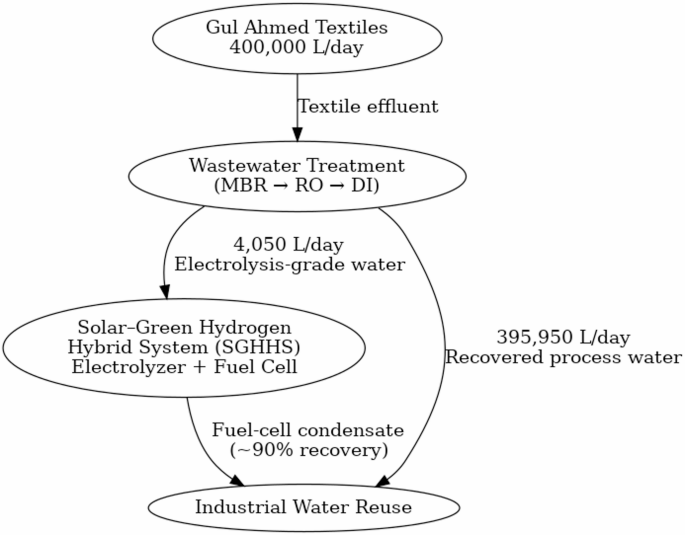
Circular water-energy resource loop.
The resource flow diagram in Fig. 3 provides a high-level overview of the SGHHS’s closed-loop operation. To complement this, Fig. 4 disaggregates the water flows across system components, detailing input-output ratios, recovery percentages, and reuse pathways essential for system-level optimization. It quantifies water use within the SGHHS, showing proportions of wastewater treated, water fed to the electrolyzer, condensate recovered, and minor evaporative losses—demonstrating high efficiency in water recycling.

Of the total 7,695 L/day processed, 3,645 L/day (47.4%) is consumed in hydrogen production, approximately 3,280 L/day (42.6%) is recovered as fuel-cell condensate and reused within the facility, while the remaining ~ 770 L/day (10.0%) represents net losses due to evaporation and system inefficiencies.
Uncertainty and model validation
Model validation was performed by benchmarking simulated system performance against empirical literature values and manufacturer-reported operational data. Annual PV energy yields and performance ratios were compared with field-reported values for utility-scale PV installations in high-irradiance regions, while PEM electrolyzer efficiency and hydrogen production rates were calibrated against OEM specifications and peer-reviewed pilot-scale studies. PEM fuel-cell electrical efficiencies were similarly cross-checked against reported commercial performance ranges. Across these comparisons, simulated outputs remained within ± 5–10% of reported benchmarks, consistent with accepted practice in techno-economic energy system modeling.
Quantitatively, validation accuracy was assessed using relative percentage error and normalized root-mean-square error (NRMSE) computed on annualized energy and hydrogen production metrics. The use of literature-derived benchmarks, rather than site-synchronous field measurements, precludes time-domain residual analysis; this limitation is explicitly acknowledged.
Uncertainty analysis was extended beyond economic parameters to environmental and water-related indicators. For climate impacts, uncertainty in CO₂-equivalent emissions was evaluated by propagating variability in grid emission factors and system performance degradation, yielding an estimated CO₂ avoidance range of approximately ± 8–12% around the reported central value over the 25-year horizon. This range reflects plausible variation in baseline electricity carbon intensity and long-term system efficiency.
Water recovery performance is sensitive to industrial effluent quality, particularly chemical oxygen demand (COD) and total dissolved solids (TDS). Sensitivity analysis was conducted using reported operating envelopes for textile wastewater treatment systems, indicating that overall water recovery remains robust (> 85%) across moderate influent variability, with marginal increases in specific energy consumption under higher contaminant loading. These effects do not alter the qualitative conclusions regarding freshwater displacement but are discussed as operational considerations.
While the Monte Carlo analysis focuses on techno-economic uncertainty to preserve analytical tractability, the combined validation and sensitivity assessments indicate that the study’s environmental and water-related conclusions are and Uncertainty under realistic variability in system performance and input conditions.


