

Imperial researchers have gained new insights into a catalyst involved in green hydrogen production that could ultimately help efforts to scale up the use of green hydrogen.
Green hydrogen is produced by splitting water using renewable electricity and is central to cutting industrial emissions. It offers one of the few viable pathways to decarbonise sectors such as steel production and heavy transport.
Proton exchange membrane (PEM) electrolysers are among the leading technologies for producing green hydrogen. At the centre of these systems is the oxygen-forming reaction, which must take place under strongly acidic conditions.
Iridium oxide is one of the very few materials that remains both active and stable in this environment. However, iridium is one of the rarest elements on Earth, and its limited global supply is considered a significant barrier to scaling hydrogen production.
No single technique tells the whole story. By combining complementary experimental methods, we were able to unlock a far clearer picture of this complex catalytic interface in action. Dr Reshma Rao Lecturer (Royal Academy of Engineering Research Fellow)
To scale green hydrogen production to the terawatt level, iridium must be used more efficiently or ultimately replaced altogether. Achieving this requires an understanding of how the current state-of-the-art catalysts function at the atomic scale during operation, something that has previously been unclear.
In a study published in Nature Materials, researchers from Imperial, University of Manchester, University of Oxford, University of Copenhagen and Diamond Light Source, observed the catalyst in real time under working conditions, revealing what happens at its surface as oxygen is formed.
By identifying which chemical states are truly responsible for driving the process, the research lays the groundwork for designing more efficient and longer-lasting materials that use iridium more efficiently or potentially replace it.
Dr Reshma Rao from the Department of Materials, study, said “No single technique tells the whole story. By combining complementar”
Watching the catalyst in action
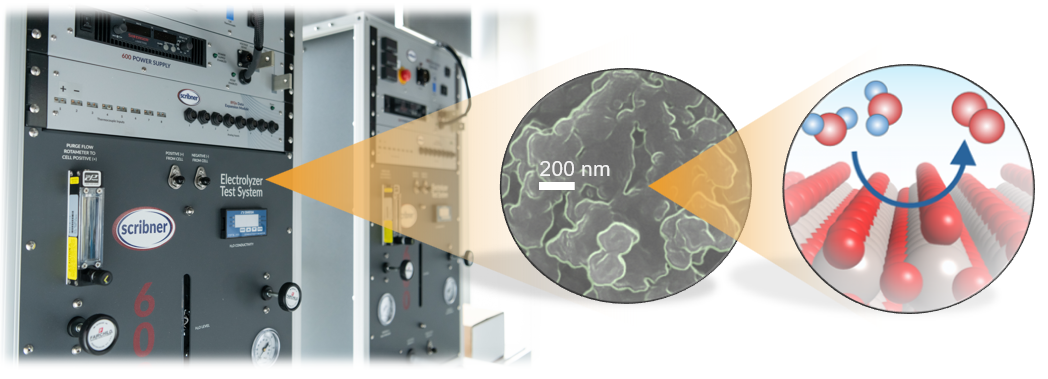
Schematic showing catalytic interfaces that drive proton exchange membrane electrolysers
The team lecombined optical spectroscopy, X-ray techniques and electrochemical mass spectrometry carried out at the Royce facility at Imperial to track changes in the catalyst as the reaction occurred. This allowed them to connect shifts in the material’s chemical state directly to the production of oxygen.
The researchers discovered that it is not only the iridium metal centres that matter. Oxygen atoms within the catalyst surface form reactive species that play a direct role in driving the reaction. By linking the lifetime of these species to the reaction rate, the team were able to pinpoint what is truly responsible for oxygen formation.
The work done by the ICAM92 team has been able to combine operando characterisation techniques to study the activity of catalysts such as iridium oxide in PEM electrolysis. Insights from this project can help optimise their operational performance. Dr Mandar Thakare Associate Director at the bp-International Centre for Advanced Materials
Professor Ifan Stephens, Professor in Electrochemistry in the Department of Materials, added: “While Caiwu and Reshma led the work, it was a great team effort between Imperial, Diamond and Manchester through our bp-ICAM funded project on the catalysis of green hydrogen production. The insight we gain on this model catalyst is extremely useful for understanding industrial iridium oxide-based catalysts.”
The study was largely funded by the bp-International Centre for Advanced Materials (bp-ICAM), which supports collaborative research between academia and industry.
Dr Mandar Thakare, Associate Director at the bp-International Centre for Advanced Materials, added: “The work done by the ICAM92 team has been able to combine operando characterisation techniques to study the activity of catalysts such as iridium oxide in PEM electrolysis. Insights from this project can help optimise their operational performance.”
Guiding the next generation of catalysts
By clarifying how iridium oxide behaves under real operating conditions, the research moves the field beyond trial-and-error development. A clearer understanding of the active surface states could help scientists design principles for developing improved materials for green hydrogen production.
“Working at the cutting edge of electrochemistry, spectroscopy and theory, across world-class facilities at the Department and Diamond Light Source, has been the most inspiring and rewarding part of my research at Imperial.”, said Dr Caiwu Liang, Research Associate in the Department of Materials, Imperial.
As demand for green hydrogen grows, understanding how critical materials behave during operation will be essential. The team hope their findings will support the development of next-generation electrolysers capable of producing hydrogen more sustainably and at scale.
–
Liang, C., Garcia Verga, L., Moss, B. et al. Key role of oxidizing species driving water oxidation revealed by time-resolved optical and X-ray spectroscopies. Nat. Mater.(2026)


