

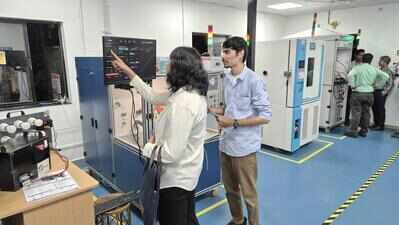
Pune: A new ‘centre of excellence’ (CoE), designed to develop an entire ecosystem around hydrogen fuel, was inaugurated in the city on Thursday.The CoE, officials said, will offer testing facilities, seed funding, incubation support and capability-building programmes to clean-energy innovators and startups.CSIR-NCL director Ashish Lele, who attended the inauguration, said Maharashtra’s early adoption of Green Hydrogen policy, the first state to do so, has helped it produce probably the most number of startups working in the sector. “And within that space Pune has emerged as a key hub to build an end-to-end hydrogen ecosystem,” he said.Some experts believe hydrogen is set to emerge as an important clean fuel for sectors that cannot be immediately electrified. In an ideal ecosystem, “green” hydrogen will be produced by splitting water with renewable electricity, producing little or no greenhouse-gas emissions at the point of production. India already has a hydrogen-powered train. Hopes are to have commercial vehicles too relying on this fuel.Lele said: “Startups cannot afford all the testing facilities required for electrolyzers, fuel cells and batteries. This common facility available at an affordable price will provide the infrastructure for prototype testing, which otherwise would be prohibitively expensive.”Currently India doesn’t have a single certification agency for such products but is working towards following international protocols while adapting them to Indian conditions. “For instance, an electrolyzer to be used in India must be tested at higher ambient temperatures, maybe even 50°C, which may not be needed in Canada,” said Lele. An electrolyzer is what splits water into hydrogen and oxygen gas.The centre for excellence was set up at the incubator Venture Centre, in association with Maharashtra State Innovation Society (MSInS), CSIR-NCL and Rao Family Trust (RAFT).V Premnath, director of Venture Center, said new sectors like green hydrogen are “future industries” that take considerable time to build. “Startups have started creating products, but the entire market for them and supply chains take time to pick up,” he said.Citing the example of a hydrogen-powered vehicle that was showcased at the event, Premnath said: “This vehicle itself exists, but it cannot be widely used or purchased without a logistics network and refueling supply points. The government’s policy is designed as an ‘enabler’ to help build this ecosystem.”Lele said current state policy provides incentives for electricity-related concessions and stamp-duty waivers, but several of the incentives were currently more suited to commercial-scale projects than early-stage startups, which require support during the research, prototyping and testing stages.He added that countries like Japan and China have been investing heavily in hydrogen fuel so it was a ripe time for India too to be ready, to grab the opportunity when it arises. “The hydrogen start-ups are not restricted to Pune. We also see activity in Kolhapur, Nagpur etc. In the future, we can set up an entire value chain for hydrogen, from production and storage to compression and utilization,” Lele said, adding that companies such as KPIT are also increasingly investing in green hydrogen engineering.One of the major challenges with hydrogen fuel is storage. “Hydrogen has extremely low density. At normal pressure, storing a kilo of hydrogen would require about 11,000 litres of volume, making compression essential for practical storage and transportation. Compressing hydrogen, however, itself consumes significant energy and adds to the cost of the technology. All these need to be worked on to come up with a viable solution,” Lele added.Maharashtra State Innovation Society CEO, Shrikant Patil, said a chief minister’s fund will soon be launched to support companies involved in hydrogen development. “The proposed Rs 500-crore fund aims to support 25,000 entrepreneurs over the five years,” he said.


