

Support CleanTechnica’s work through a Substack subscription or on Stripe.
My comparative review of eight Polish municipal projects purchasing hydrogen buses under the EU-funded Green Public Transport program reveals a systemic failure to apply the Energy Efficiency First (EE1st) principle.
Seven out of eight cities skipped any energy or cost-efficiency comparison with battery-electric buses (BEVs), even though EU law explicitly requires it.
The result: public money flows into the least efficient “zero-emission” technology — hydrogen fuel-cell buses (FCEVs) — which consume 4–5× more electricity at the source and cost 4–6× more to operate than BEVs.
1. Background: when subsidies override logic
Since 2021, Poland’s Zielony Transport Publiczny (Green Public Transport, or ZTP) program has been offering EU-backed grants for zero-emission buses.
However, the subsidy rules make FCEV projects more lucrative on paper:
- up to 90% funding for hydrogen buses,
- vs 80% for battery-electric ones.
That small difference turned into a major distortion. Instead of rewarding efficiency, the system encouraged cities to choose the most expensive and energy-wasteful option available.
Yet under EU law, every project must follow the Energy Efficiency First rule — comparing total lifecycle energy use and costs before making a decision.
In reality, almost none did.
2. What the studies didn’t do
I reviewed nine feasibility studies from cities including Kraków, Konin, Lublin, Piła, Płock, Poznań, Rybnik, Rzeszów, Wejherowo.
Here’s what I found:
- 9 studies had no BEV vs. FCEV energy or cost comparison.
- None contained TCO or primary-energy analyses.
- Justifications were often limited to generic statements like “hydrogen offers greater range and faster refueling” — with no route-level modeling to support it.
- In most cases, the choice of hydrogen was made first, and the “analysis” written afterward to justify it.
The result: projects that directly contradict EU funding principles — but still get approved.
3. Real data from Polish operators
To verify the numbers, I requested operational data from cities already running BEV and FCEV fleets. The results are stark.
Białystok (BEV – Yutong U12)
Based on a full year of data from 2024:
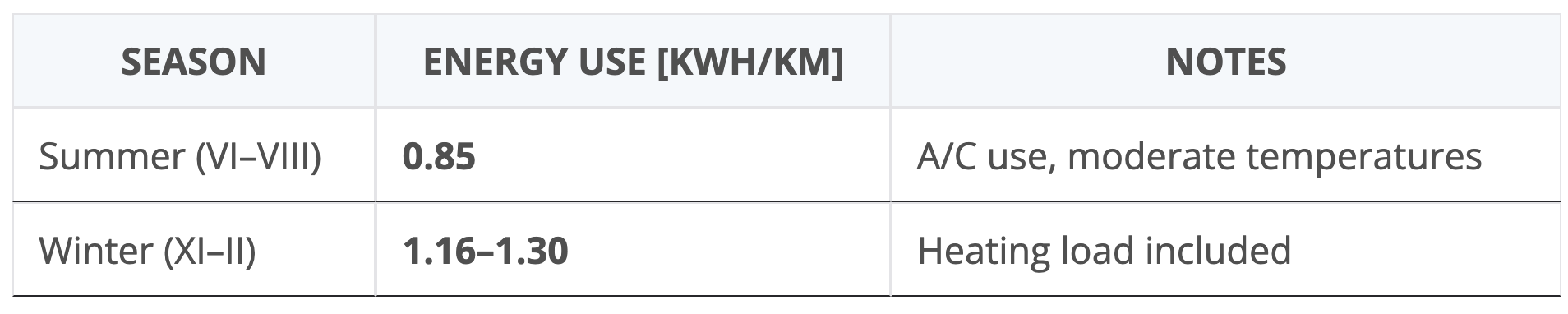
That’s 85–130 kWh per 100 km, plug-to-wheel — excellent efficiency for a 12-meter bus operating in a continental climate.
Hydrogen (FCEV) comparison
Typical FCEV use in Poland: 7.5 kg H₂ / 100 km
Given the full hydrogen chain (electrolysis ~60% efficient + compression + fuel cell losses):
7.5 kg × 65 kWh/kg = ~490 kWh of electricity per 100 km
Even allowing for logistics and optimization, hydrogen buses still consume 4–5× more primary electricity per kilometer than BEVs.
They’re “zero-emission” only in the tailpipe sense — not in real energy terms.
4. Case study: Płock — when numbers speak louder than slogans
KM Płock, a municipal operator, signed a 5-year contract with Orlen S.A. for hydrogen supply to 18 Solaris Urbino 12 Hydrogen buses.
The hydrogen is marketed as “low-emission,” but it’s not green — produced mainly from natural gas.
I analyzed the city’s actual contract and energy data to estimate 15-year total costs (TCO) for four drivetrain scenarios:
- FCEV (hydrogen contract),
- BEV (grid electricity),
- BEV (grid + PV + storage, 40% autarky),
- Diesel.
Key assumptions (based on official data)
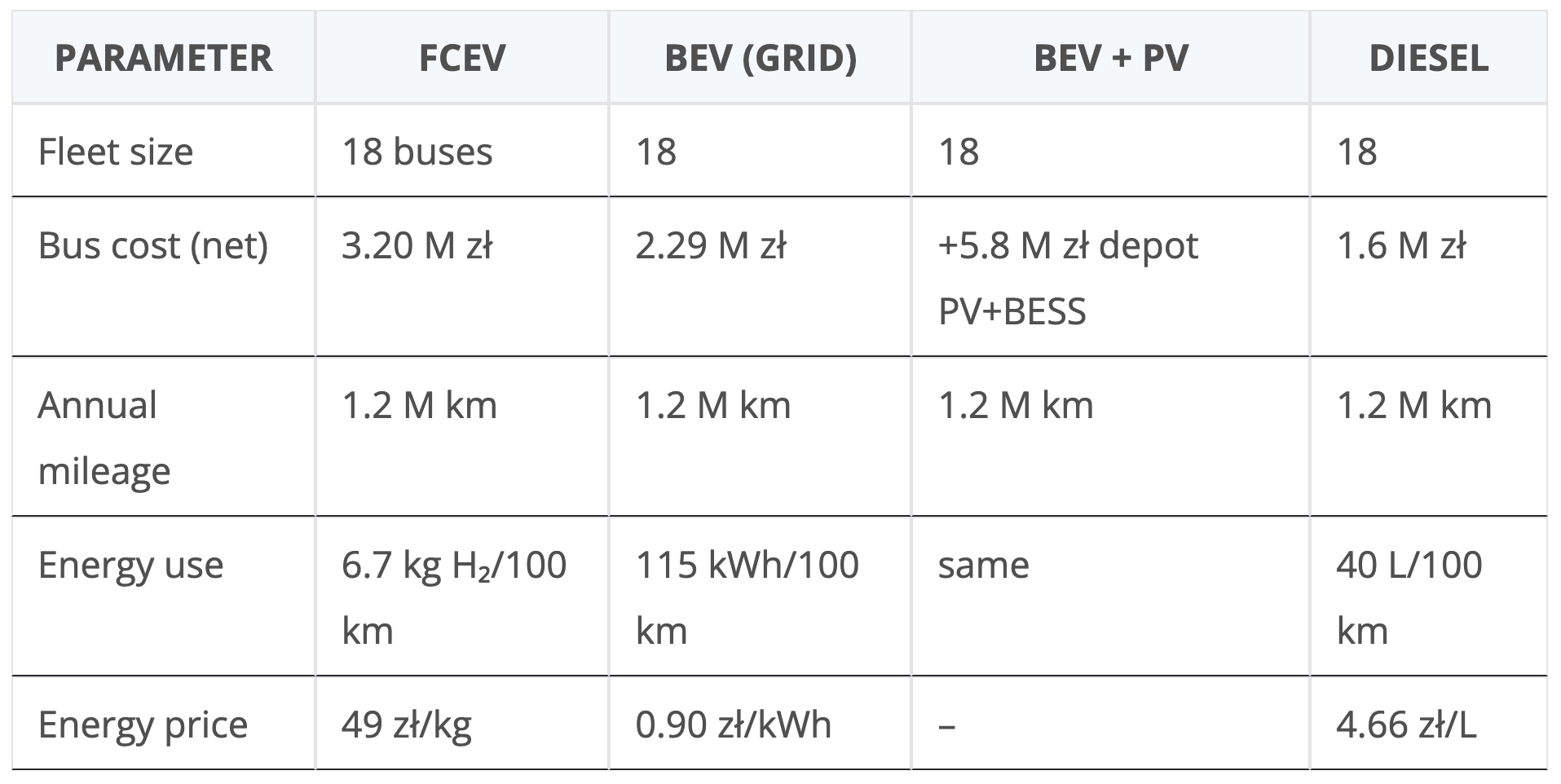
Results:
- Hydrogen (orange line) stays consistently above all others — even diesel.
- Over 15 years, Płock will lose ≈ 40 million zł compared to BEVs, just on fuel.
- That’s about 2.7 million zł per year in avoidable operating costs.
- Even assuming 100% capital subsidy for FCEVs, the fuel alone makes them uneconomic.
- Meanwhile, BEVs are already cheaper than diesel in lifetime cost — and can be 30% cheaper still with partial solar and battery storage.
5. The bigger picture
Hydrogen buses might have limited roles — e.g. long-range or intercity routes — but they are a thermodynamic and fiscal failure in city transport.
Approving such projects without EE1st verification effectively rewards energy waste.
The Energy Efficiency First principle exists to prevent exactly this: spending public funds on options that deliver fewer clean kilometers per euro.
6. Why it matters beyond Poland
- Energy waste = more generation required.
Every kilometer on hydrogen requires four times more renewable capacity than on batteries. - Budget waste = fewer buses on the road.
Cities buy fewer vehicles for the same subsidy, limiting decarbonization speed. - Public trust.
When citizens learn that “clean” projects waste 80% of their input energy, confidence in the transition erodes.
As one engineer in Lublin told me off record:
“We were told hydrogen was the future. Then we saw the bills.”
7. I’m happy to share
I can provide:
- Full datasets from BEV and FCEV operators (Lublin, Białystok, Rzeszów, Konin, etc.),
- Comparative tables of all 8 feasibility studies,
- TCO spreadsheets for BEV vs FCEV vs Diesel (+PV scenarios),
- Original contracts and price formulas,
- Verified data from public-record requests (UDIP) and operator responses.
8. The lesson
The cleanest kilowatt-hour is the one we don’t waste. Yet EU funds are now subsidizing a technology that needs five of them to do the work of one.
Hydrogen may have a future — but not inside city buses.
By Jacek Werder, independent energy & transport analyst
Sign up for CleanTechnica’s Weekly Substack for Zach and Scott’s in-depth analyses and high level summaries, sign up for our daily newsletter, and follow us on Google News!
Have a tip for CleanTechnica? Want to advertise? Want to suggest a guest for our CleanTech Talk podcast? Contact us here.
Sign up for our daily newsletter for 15 new cleantech stories a day. Or sign up for our weekly one on top stories of the week if daily is too frequent.
CleanTechnica uses affiliate links. See our policy here.
CleanTechnica’s Comment Policy


