

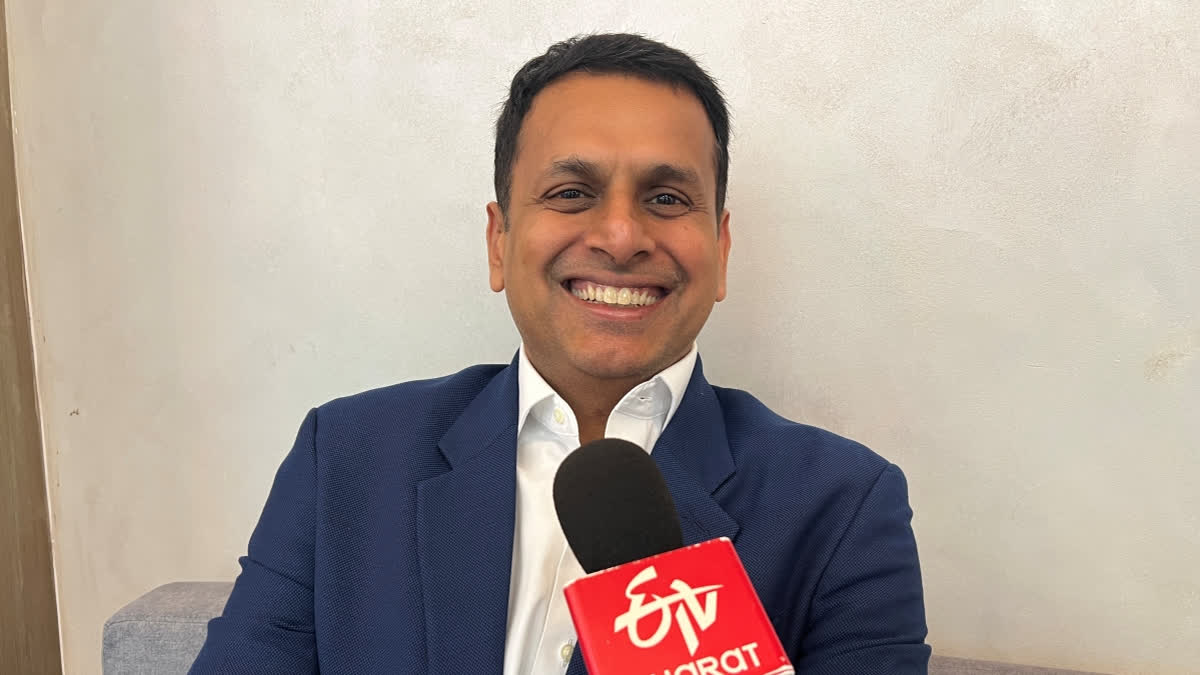
Vineet Mittal, Chairman and Managing Director of Avaada Group, in conversation with ETV Bharat. (ETV Bharat)
By Surabhi Gupta
Goa: Avaada Group Chairman and Managing Director Vineet Mittal has said that India’s clean energy transition is entering a phase where solar power combined with energy storage will play a defining role, as the country works to balance rapid renewable capacity addition with grid stability, rising electricity demand and energy security concerns.
Speaking to ETV Bharat at the India Energy Week 2026, Mittal said Avaada plans to invest nearly ₹1 lakh crore over the next five years, with the bulk of the capital flowing into large-scale renewable power projects, energy storage and green manufacturing.
According to Mittal, most of the investment will go into Avaada’s independent power producer (IPP) business, which includes utility-scale solar parks, wind projects, pumped storage and battery energy storage systems. He said the company has already secured several thousand megawatts of renewable projects through central utilities.
“Many of these projects have already translated into power purchase agreements, and we are now implementing them across states such as Gujarat, Rajasthan, Maharashtra and Uttar Pradesh,” he said.
Investment Deployment Linked To PPA Execution
Mittal said Avaada already has strong project visibility and that the pace of capital deployment will depend on how quickly awarded projects are converted into signed power purchase agreements.
“Based on current visibility, if all the projects translate into power purchase agreements, we should be able to deploy this fund flow by 2031,” he said.
Apart from generating assets, Avaada is also expanding into green manufacturing to build an integrated renewable energy value chain in India. Mittal said the company is targeting manufacturing capabilities from polysilicon to ingots, wafers, cells and modules, which will then be used to generate electricity.
He added that Avaada is actively exploring solar glass manufacturing in India, a segment where the country remains heavily import-dependent. “We will be investing in that sector as well,” he said.
In addition, the company is looking at opportunities in green ammonia and green methanol, which are expected to play an important role in decarbonising the industry and reducing fossil fuel imports. “All these sectors combined will help us make this large investment,” Mittal said.
Storage Critical For Grid Stability And Peak Demand
Mittal reiterated that solar-plus-storage will increasingly dominate India’s energy mix as renewable penetration rises. He explained that while solar and wind capacity has grown rapidly, their intermittent nature makes energy storage essential for grid stability. “Solar and wind are intermittent by nature, and storage helps provide grid stability,” he said.
India also faces a significant peaking power challenge, with some states experiencing both morning and evening demand peaks. During these hours, state utilities often buy electricity at high prices from the market.
“For those peak hours, storage is a great solution,” Mittal said.
Looking ahead, he said India will need to add storage capacity at scale. “In the next five years, India could add at least 250 gigawatt-hours of storage,” he said, noting that many firm and dispatchable renewable energy projects currently being awarded already involve extensive use of storage.
Policy Bottlenecks And PPA Delays Remain A Concern
Mittal acknowledged that delays in signing renewable power purchase agreements across states remain a key concern for the industry, largely due to pricing issues and the financial health of state distribution companies. “That is a real concern for the industry,” he said.
He added that Avaada has recently engaged with the Ministry of Power and the Ministry of New and Renewable Energy (MNRE), which have assured developers that pending PPAs will be addressed under the existing regulatory framework.
“They have assured that they will work to ensure that all pending power purchase agreements are signed,” Mittal said.
He also pointed to proposed legislative changes in the current Budget session, particularly amendments to the Electricity Act, aimed at making Renewable Consumption Obligations (RCOs) more stringent.
“These changes are meant to ensure that states do not skip their responsibilities,” he said, adding that the company is convinced the government is working sincerely to convert pending letters of award into PPAs.
‘Sand To Molecule’ Transition Key To Energy Security
Mittal stressed that India’s clean energy mission must be viewed through the lens of energy security and import dependence. India currently produces only about 12–13% of its oil requirements domestically, while nearly half of its gas consumption is imported. “This creates a huge current account deficit,” he said.
According to Mittal, addressing this challenge requires a fundamental shift in how energy is consumed in the country. Currently, only around 20% of India’s total energy consumption is electrified.
“We need to move that from 20% to 50% in the near future,” he said.
Such a transition, he said, is possible only if India significantly scales up renewable power generation along with storage and batteries, while also producing green fuels such as green hydrogen and green ammonia domestically.
“If we start making green ammonia locally, green hydrogen locally, and do more solar, wind, pumped storage and batteries, then it is possible to achieve this,” he said.
India Among Top Clean Energy Markets Globally
Mittal said India is already among the top three clean energy markets globally, supported by strong policy frameworks. However, he acknowledged that challenges remain in areas such as transmission infrastructure and delays in PPA signing.
“The government is proactively addressing these issues, and hopefully all of these challenges should be behind us by this year,” he said.
Avaada’s Role In India’s 500 GW Target
On Avaada’s contribution to India’s renewable ambitions, Mittal said the company is targeting around 30 GW of DC renewable power capacity to be operational by 2030, subject to the timely signing of PPAs.
Green power, he said, will also be critical for meeting rising demand from electric vehicle charging and industrial consumers.
“For EV charging and industry, green power is the best solution,” Mittal said.
If projects progress as planned, Avaada’s capacity additions would significantly support the government’s vision of Viksit Bharat and a greener economy.
Transmission Planning Needs Overhaul
Mittal flagged transmission infrastructure as one of the biggest bottlenecks slowing down renewable projects. He said transmission planning needs to be done much earlier than is currently the case.
“We need to start building transmission lines five years ahead of time,” he said, noting that transmission is often taken up only after projects are awarded.
He also stressed the need for quicker execution of PPAs with states, ideally within weeks of winning a bid.
On the revised Renewable Consumption Obligation norms, Mittal said directions have already been issued by the power ministry, and dedicated groups are following up with states.
“They are hopeful that a part of the PPAs will be signed by March, and the rest by June this year,” he said.


