

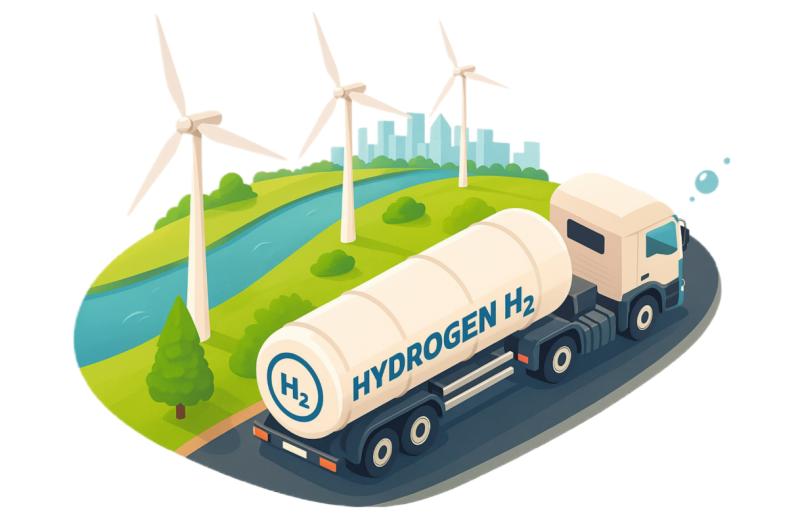
Green Hydrogen Market
The green hydrogen domain is characterized by highly specialized recovery processes and electrolyser is the major cost component, complex utility, environmental, integration, heavy dependence on clean energy sources. Given these dynamics, the success of clients’ entry into this space hinges on a rigorous, data-backed Go/No-Go evaluation, supported by credible cost-expense-margin modelling, technology benchmarking, and a clear understanding of the commercial viability.
One of the important aspects of producing green hydrogen are electrolyser technologies. Below are the critical aspects for the same, i.e. Alkaline electrolyser and PEM electrolyser are mainly used. Alkaline Electrolyser: The main components of an alkaline water electrolysis electrolyser for hydrogen production include the anode, cathode, and diaphragm. Its working principle refers to the process of producing hydrogen by electrolyzing water in an alkaline electrolyte environment.
PEM Electrolyser: The main internal components of a PEM water electrolyser, from the inside out, are a proton exchange membrane, anode and cathode catalyst layers, anode and cathode gas diffusion layers, and anode and cathode end plates. The proton exchange membrane, catalyst layer, and diffusion layer constitute the membrane electrode assembly (MEA), which is the main site for material transport and electrochemical reactions in the entire water electrolyser.
From a technical perspective, PEM water electrolysis technology has unique advantages, leading many new projects to choose it, and it has gained a significant market share in recent years.
Our company has been engaged to conduct a comprehensive two-phase feasibility assessment to help clients make a confident, risk-adjusted investment decision before committing capital.
1. Market Analysis and Market Entry Strategies
o Assess market size, growth potential, and competitive dynamics to identify strategic opportunities.
o Provide actionable market entry strategies for seamless expansion into target regions
2. Go-To-Market (GTM) Strategic Roadmap
o Develop phased, actionable GTM roadmaps tailored to your business objectives.
o Provide a structured plan that includes milestones, performance metrics, and risk mitigation strategies to achieve seamless market entry.
3. Competitive Intelligence and Positioning:
o Deliver in-depth analysis of competitors’ strengths, weaknesses, and market positioning to highlight differentiation opportunities.
o Develop strategies for building a robust competitive advantage.
4. Business Planning and Feasibility Studies
o Develop comprehensive business plans to guide strategic decision-making, funding, and resource allocation.
o Conduct feasibility studies to validate new market opportunities, product launches, or investment decisions.
5. Product and Pricing Research
o Conduct research to optimize pricing strategies and understand product performance.
o Analyze competitor pricing models to maximize market competitiveness.
6. Industry Reports and Whitepapers
o Produce high-quality whitepapers and thought leadership materials tailored to client needs.
o Offer detailed industry insights to enhance brand authority and market positioning.
7. Tailored Intelligence Solutions
o Provide bespoke databases and mapping, including target customers, competitors, investors, and suppliers.
o Design tailored intelligence solutions such as newsletters (daily/weekly/monthly) for ongoing market monitoring.
8. Peer Review and Benchmarking
o Evaluate performance metrics against industry benchmarks and best practices.
o Identify areas for improvement and strategic realignment.
9. Performance Management and Cost Optimization
o Implement balanced scorecards, MIS frameworks, and cost optimization strategies.
o Enable organizations to track performance and drive efficiency effectively.
The scope of this engagement is divided into two comprehensive phases-Phase 1 (Go/No-Go Feasibility Strategy) and Phase 2 (Detailed ROI Analysis). Each phase consists of multiple technical, commercial, and financial workstreams designed to evaluate Client’s potential entry into green hydrogen plant with complete clarity and confidence.
Request for Sample & Brochure @
https://www.supplydemandmarketresearch.com/home/contact/1702693?ref=Sample-and-Brochure&toccode=SDMREL1702693
Table Of Content
Phase 1 focuses on determining whether green hydrogen plant is a viable and strategically sound business opportunity for the client. This includes a full examination of technical processes, raw material supply, market demand, cost structures, margin outlook, and location suitability.
A. Product & Market Assessment
1. Green Hydrogen Product Understanding
• Technical characteristics
• Energy sources
• Electrolyser characteristics
• Composition benchmarking (e.g., metal %, carbon %, moisture %, inorganic residues)
2. Market Demand Assessment
• Demand for Green Hydrogen across:
– Petrochemicals
– Fertilizers
– Methanol
– Specialty applications
• India-specific consumption patterns
• Global price cycles and volatility analysis
• Demand-supply outlook (2025-2031)
3. Customer Analysis
• Identification of top 15-20 relevant customers
• Indicative annual consumption
• Pricing patterns for green hydrogen (levelized cost of Hydrogen, LCOH)
• Typical procurement criteria and qualification parameters
B. Input Availability & Sourcing Economics
1. Supplier Identification & Mapping
• Mapping of suppliers of green energy
• Supplier categories (level of integration)
• Industrial clusters where green hydrogen are consumed and discarded
2. Availability & Volume Potential
• Indicative monthly volumes available in India
• Grade/quality variations
• Competitive intensity for green hydrogen plant with hydrogen carrier details
3. Sourcing Economics (green energy & electrolyser)
• Benchmark purchase prices
• Transportation & handling costs
• Pre-treatment requirements
• Alternate sourcing possibilities (imports, long-term contracts)
C. Technology & Process Feasibility Assessment
1. Technology Benchmarking
• Evaluation of global process routes for electrolyser
• Recovery yields and yield-stability factors
• Number of unit operations and complexity index
• Integrated vs semi-integrated vs standalone configurations
2. Detailed Process Assessment (per metal)
• Process flow description
• Key operating conditions
• Chemical reactions involved
• Utility requirements (power, steam, water, nitrogen, natural gas, inert gases)
• Hazardous handling and waste treatment needs
The scope of this engagement is divided into two comprehensive phases-Phase 1 (Go/No-Go Feasibility Strategy) and Phase 2 (Detailed ROI Analysis). Each phase consists of multiple technical, commercial, and financial workstreams designed to evaluate Client’s potential entry into green hydrogen plant with complete clarity and confidence.
The report focuses on determining whether green hydrogen plant is a viable and strategically sound business opportunity for clients. This includes a full examination of technical processes, raw material supply, market demand, cost structures, margin outlook, and location suitability.
Green Hydrogen Product Understanding
• Technical characteristics
• Energy sources
• Electrolyser characteristics
• Composition benchmarking (e.g., metal %, carbon %, moisture %, inorganic residues)
Market Demand Assessment
• Demand for Green Hydrogen across:
– Petrochemicals
– Fertilizers
– Methanol
– Specialty applications
• India-specific consumption patterns
• Global price cycles and volatility analysis
• Demand-supply outlook (2025-2031)
Customer Analysis
• Identification of top 15-20 relevant customers
• Indicative annual consumption
• Pricing patterns for green hydrogen (levelized cost of Hydrogen, LCOH)
• Typical procurement criteria and qualification parameters
Input Availability & Sourcing Economics
Supplier Identification & Mapping
• Mapping of suppliers of green energy
• Supplier categories (level of integration)
• Industrial clusters where green hydrogen are consumed and discarded
Availability & Volume Potential
• Indicative monthly volumes available in India
• Grade/quality variations
• Competitive intensity for green hydrogen plant with hydrogen carrier details
Sourcing Economics (green energy & electrolyser)
• Benchmark purchase prices
• Transportation & handling costs
• Pre-treatment requirements
• Alternate sourcing possibilities (imports, long-term contracts)
Technology & Process Feasibility Assessment
Technology Benchmarking
• Evaluation of global process routes for electrolyser
• Recovery yields and yield-stability factors
• Number of unit operations and complexity index
• Integrated vs semi-integrated vs standalone configurations
Detailed Process Assessment (per metal)
• Process flow description
• Key operating conditions
• Chemical reactions involved
• Utility requirements (power, steam, water, nitrogen, natural gas, inert gases)
• Hazardous handling and waste treatment needs
Request for Discount @ https://www.supplydemandmarketresearch.com/home/contact/1702693?ref=Discount&toccode=SDMREL1702693#
3. Equipment Benchmarking: Based on illustrative global facilities:
• Electrolyser
• Allied equipments
4. Technology Provider Landscape
• Licensor/supplier ecosystem
• Indian vs global technology options
• Upgrade potential and IP constraints
D. Cost, Expense & Margin Modelling
A complete techno-economic evaluation covering:
1. Variable Cost Modelling
• Raw materials and auxiliary chemicals
• Utility breakdown:
– Power
– Process water
– Steam (LP/MP/HP)
– Nitrogen
– Natural gas
– Other utilities
• Waste treatment costs
• By-product credits
2. Fixed Cost Modelling
• Operating manpower (operators, supervisors, maintenance, quality)
• Maintenance materials
• Direct overheads
• Plant-level overhead allocation
• Insurance, taxes
3. Cash Cost & Margin Analysis
• Cost per kg of recovered metal
• Benchmark margin analysis
• Sensitivity to raw material cost, utility inflation, and yield changes
E. Location Suitability Assessment
• Comparison of potential feasible clusters
• Proximity to customer’s facilities
• Raw material sourcing routes
• Utility cost benchmarking
• Waste management ecosystem
• Environmental and hazardous storage compliance landscape
• Logistics cost structure
The above will be followed by a detailed “Go / No-Go Recommendation”, including:
• Process wise feasibility outcome
• Recommended capacity
• Preferred process route
• Expected capex range
• Economic attractiveness index
• Key risks and mitigations
• Go / No-Go verdict for each metal and for the integrated business model
Buy Now the report @ https://www.supplydemandmarketresearch.com/home/purchase?code=SDMREL1702693
SDMR International
302-20 Misssisauga Valley,
Missisauga, L5A 3S1, Toronto
Global +1-778-686-7521
Email- info@supplydemandmarketresearch.com
We have a strong network of high powered and experienced global consultants who have about 10+ years of experience in the specific industry to deliver quality research and analysis. Having such an experienced network, our services not only cater to the client who wants the basic reference of market numbers and related high growth areas in the demand side, but also we provide detailed and granular information using which the client can definitely plan the strategies with respect to both supply and demand side.
This release was published on openPR.


