

Marrakech – Morocco positioned itself as a future green hydrogen supplier to Europe at the fifth Power-to-X Summit in Marrakech on October 1-2, drawing delegations from Germany, the Netherlands, and the Czech Republic.
The summit brought together government officials, private investors, and industry leaders to advance Morocco’s National Hydrogen Strategy. The country aims to meet more than four percent of global hydrogen demand by 2030, leveraging its solar and wind resources and proximity to European markets.
Morocco launched its “Morocco Offer” investment program in March 2024 to operationalize the strategy. The program allocated more than MAD 319 billion ($31.9 billion) and reserved up to one million hectares of land for green hydrogen projects. Phase one covered 300,000 hectares.
In March 2025, the steering committee pre-selected five investor consortia for six green hydrogen projects across three southern regions. The projects focus on green ammonia, e-fuels, and green steel production. Land reservation contracts are now being executed.
The EU-Morocco Green Partnership, signed in October 2022, created a policy dialogue on climate, energy, and the green economy. The partnership explicitly includes hydrogen economy development. It marked the EU’s first such agreement with a non-EU country.
The European Union aims to use 20 million tons of renewable hydrogen annually by 2030. Ten million tons would come from domestic production and ten million from imports. Morocco targets this import demand, though the European Court of Auditors called the 2030 targets unrealistic under current timelines.
Morocco’s anchor use-case is green ammonia for OCP’s fertilizer value chain. The Jorf Hydrogen Platform targets 100,000 tons per year of green ammonia initially in 2026. The project secured a €30 million grant from KfW’s PtX Development Fund in February 2025.
Germany sees Morocco as key hydrogen partner
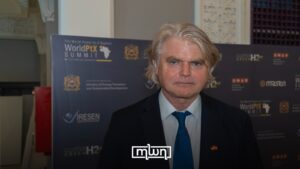
Christoph Rauh leads the Directorate Africa at Germany’s Federal Ministry for Economic Cooperation and Development. He described Morocco as Germany’s main partner for hydrogen cooperation on the African continent.
“We have a lot of private actors here who are interested in investing in Morocco, and we also have a large delegation of government officials,” Rauh told Morocco World News (MWN).
“Our philosophy is, of course, to accompany from the public sector what is happening and what will happen in the area of private investments. We work hand in hand, and Morocco is our main partner on the African continent.”
Germany and Morocco signed a Climate and Energy Alliance in June 2024. The alliance explicitly named hydrogen production and exports as priorities. Germany expects to import 50% to 70% of its hydrogen needs and views Morocco as a priority supplier.
The German Development Agency GIZ works closely with Moroccan authorities like MASEN to establish framework conditions and develop standards. Rauh noted that learning exchanges extend beyond bilateral cooperation to include other African countries building hydrogen industries.
“The goals are ambitious,” Rauh explained. “We want to work on the level of climate neutrality until 2045. That looks like a long period from now, but in reality, it’s a huge task.”
He stressed that climate neutrality within 20 years requires substituting fossil energy supplies with alternatives like hydrogen. Germany’s high dependence on imports makes cooperation with countries like Morocco essential.
“It must be a win-win solution for Morocco and for Germany to go into such a direction,” Rauh said.
Morocco’s energy cooperation with Berlin extends beyond hydrogen to direct electricity supply. Xlinks, through its German subsidiary, is developing the Sila Atlantik project with backing from German utilities E.ON and Uniper.
The venture aims to deliver 26 terawatt-hours of Moroccan solar and wind energy annually to Germany via twin 3.6 gigawatt cables across 4,800 kilometers of seabed by 2034. The project requires €30 to €40 billion in investment and government backing to move forward.
Netherlands targets 300 to 500 petajoules by 2050
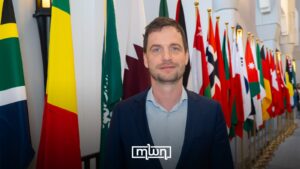
The Netherlands Enterprise Agency released a study projecting Dutch renewable hydrogen needs at 300 to 500 petajoules by 2050. Tomas Olejniczak serves as Project Lead Climate and Energy at the agency.
“The role of Morocco is going to be very significant,” Olejniczak told MWN. “We are looking for suppliers all over the world who can supply us with those kinds of amounts of hydrogen.”
Hydrogen will play a critical role in Dutch industry. Steel production, chemicals, and other sectors will depend on it. “So Morocco will be a very important partner for us,” he stated, noting the bilateral MOU between the Dutch Ministry of Economic Affairs and Morocco’s Ministry of Energy Transition running for three years and due for renewal.
Indeed, Amsterdam and Rabat signed a dedicated hydrogen memorandum of understanding in June 2023.
A detailed bilateral Action Plan followed in Rotterdam in May 2024. The plan covers renewable rollout, hydrogen applications, port infrastructure, and green shipping corridors through 2025. An MOU between the Dutch Ministry of Economic Affairs and Morocco’s Ministry of Energy Transition and Sustainable Development has been running for three years.
“We’ve been focusing a lot on creating the circumstances that are necessary to develop this new sector,” Olejniczak said. The focus includes certification, capacity building on the governmental level, and strategic environmental assessment.
The Dutch government recently signed a deal with Tata Steel to green Dutch steel plants. The multi-billion euro investment will rely heavily on hydrogen. Olejniczak expressed hope that Moroccan hydrogen could support this transition.
Proton Ventures, a Dutch firm, is building a Green Ammonia Pilot at Jorf Lasfar with UM6P, OCP, and IRESEN. The pilot uses 4 tons per 4-ton-per-day capacity with two 2 MW electrolyzers to test intermittency, operations, and training. Invest International financed the pilot equipment.
The Port of Rotterdam is preparing hydrogen carrier entry points and backbone connections. The Hydrogen Network Netherlands and the Delta-Rhine Corridor will enable future Moroccan imports to reach Dutch and German industrial clusters. Rotterdam’s terminal upgrades on the Maasvlakte will handle green ammonia imports from mid-decade.
Czech Republic brings water-from-air technology to Morocco
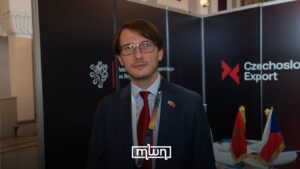
The Czech Republic became the first country to supply Morocco with innovative water-from-air technology. Ilja Mazánek serves as Senior Business Development Manager at Czechoslovak Export.
“We will be supplying two units of our unique technology that generates water from air to our esteemed client, IRESEN, here in Morocco,” Mazánek told MWN.
The project falls under Czech Development Agency funding through a government-to-government arrangement. The water-from-air prototype reached a total value of MAD 1.6 million, equivalent to $160,000, financed by CzechAid at CZK 3.9 million.
The technology delivery includes a collaboration component. Czech suppliers will gain data on machine performance from IRESEN’s expertise and Morocco’s unique climatic conditions. Discussions may explore how to exploit and improve the machines based on field data.
“We really hope to have the machines installed in Morocco to obtain all the data from the field, and also evaluate them as such, and profit from IRESEN’s expertise, and we will see how we can move from there,” Mazánek said.
The patent-protected technology has won numerous awards, highlighting its significance. Previous testing in Australia and the United Arab Emirates demonstrated success in harsh climatic conditions, and Czech officials believe Morocco’s results will lead to additional projects.
Summit focuses on bankability and export readiness
The Ministry of Energy Transition organized the summit with IRESEN, Green H2 Cluster, UM6P, and MASEN. The event focused on bankability, offtake, certification, ports, export readiness, and transport decarbonization.
A high-level plenary on October 1 addressed securing and de-risking offtake. Participants included H2Global, MASEN, TAQA Morocco, CIP, and MED-GEM. Offtake contracts unlock financing for large-scale projects.
A side event on October 2 covered advancing green hydrogen readiness in the Southern Mediterranean. Sessions included EIB financing, certification pilots with INNOVX and Hinicio, and port and export readiness assessments.
A panel on transport decarbonization featured the Port of Rotterdam, Maersk, and FEV. Morocco seeks to tie Power-to-X production to maritime and aviation corridors to Europe.
MED-GEM, an EU-funded initiative, co-ran key sessions throughout the summit. The program supports certification and traceability work critical for accessing EU incentives and sustainable aviation fuel mandates.
Major projects advance across Morocco’s regions
TotalEnergies is studying a 200,000 tons per year green ammonia export project near Guelmim-Oued Noun. The project involves TE H2, CIP, and AP Møller Capital. Morocco has reserved land and advanced permitting steps.
OCP signed a memorandum of understanding with ENGIE for a multi-billion-euro renewables, green molecules, and desalination platform. The partnership aligns with OCP’s decarbonization and green fertilizer ambitions.
The Chbika project near Guelmim-Oued Noun is in the pre-FEED phase. It aims to produce green ammonia for European markets. Large project pipelines are forming across Morocco’s southern regions.
Morocco’s National Hydrogen Strategy dates to 2021 and builds on a National Hydrogen Commission established in 2019. The phased approach prioritizes decarbonizing local ammonia and fertilizer production before scaling exports in the 2030s.
A PtX Hub Power-to-Liquid pilot will train engineers on e-kerosene and e-methanol production. The pilot complements the Jorf Lasfar Green Ammonia facility in developing skilled workforce capacity.
Green steel production represents an early signal in Morocco’s hydrogen strategy. One selected investor consortium targets green steel manufacturing, leveraging Morocco’s industrial base and EU Carbon Border Adjustment Mechanism (CBAM) dynamics.


