

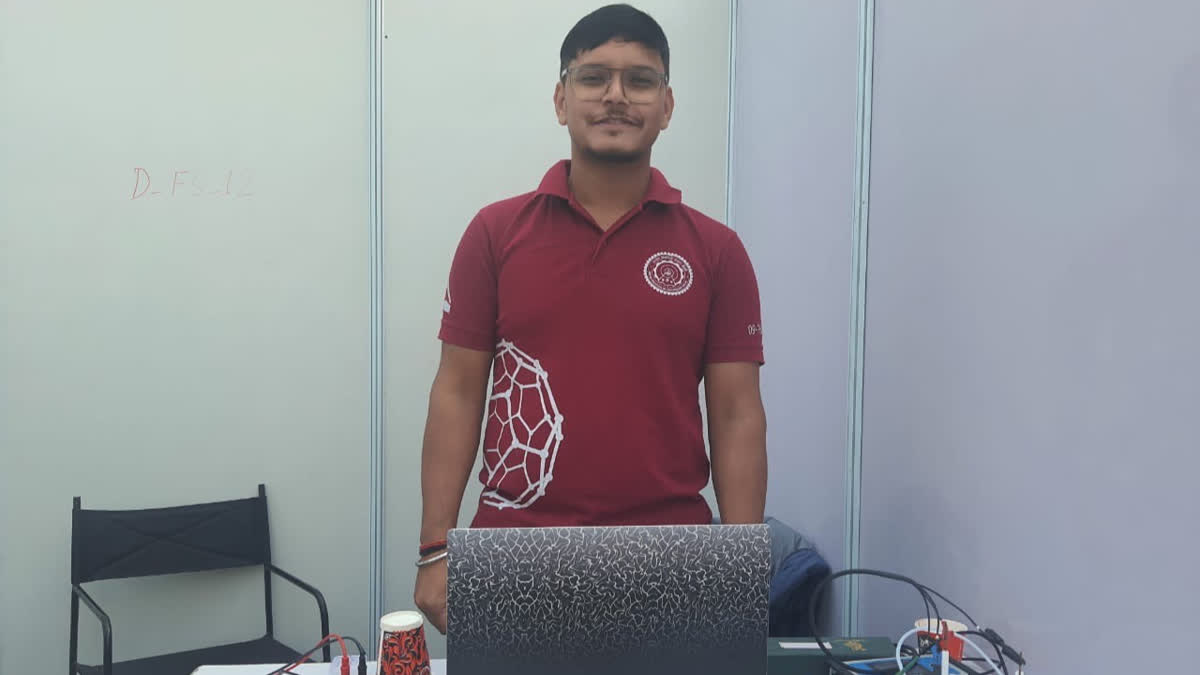
An IIT Delhi PhD student Sagar, showing one of his projects. (ETV Bharat)
By Surabhi Gupta
New Delhi: The Indian Institute of Technology (IIT) Delhi opened its gates for a unique exhibition to demonstrate some outstanding examples of certain kinds of research innovations that suggest areas of the next generation of scientific and engineering capabilities in India. The exhibition included groundbreaking research in a variety of fields, including healthcare and biotechnology, artificial intelligence, data science, quantum technologies, sustainable infrastructure, and Industry 4.0.
While visitors and experts in many fields were impressed by all of the exhibits displayed, two exhibitions garnered considerable interest: one examining the neuroscience of depression and brain functioning, and the other innovating sustainable hydrogen generation using advanced materials. Together, these two initiatives involved the intersection of technology, robotics, innovation, and human-centred research – exemplifying IIT Delhi’s approach to addressing some of society’s urgent challenges.
Decoding Depression: Understanding How The Brain Mirrors While Processing Emotion And Thought
Professor Varsha is leading a small team of PhD researchers in the Department of Cognitive Science at IIT Delhi, and has embarked upon an ambitious trajectory toward examining the neurological basis for mental health, with a particular focus on depression, emotional awareness, and variability in thoughts.
Speaking to ETV Bharat, Professor Varsha emphasized the social urgency behind her work. “We’ve seen students, including undergraduates, facing depression and, tragically, even suicide and that too on our own campus. This reality is our broader motivation. We want to understand how depression arises in the brain, how thoughts occur, and how neuronal activity maps onto thinking processes,” she said.
The purpose of her team’s research is to connect subjective mental states with objective biological markers. Psychology, for a long time, has focused on self-reported questionnaires or interviews, which are subject to many biases, including social desirability or the individual’s own uncertainty. The IIT Delhi group is taking a different approach: using non-invasive brain imaging to study how brain activity varies across individuals and conditions.
“We measure brain activity in a non-invasive manner and try to differentiate between depressed and non-depressed participants,” Professor Varsha explained. “We also study how brain activity changes from morning to evening and how it differs between men and women.”
One of her PhD students, who demonstrated the system at the exhibition, explained how the technology works. “Basically, the system uses light to assess brain activity. We send LED light into the scalp through sources placed on a wearable cap, and detectors measure the light that returns. Based on how much light is absorbed in different brain regions, we can infer neural activity during various tasks,” the student said.
The technique, known as functional near-infrared spectroscopy (fNIRS), allows real-time observation of changes in brain oxygenation, an indirect marker of neural activity. There are many potential applications in everyday life for the system because it is both portable and safe for use, including monitoring mental states outside of clinical settings.
During the live demonstration, the participant was asked to perform a balanced mental arithmetic task while the system tracked changes in oxygen levels across regions of the brain. As the cognitive load increased, the brain’s oxygen delivery changed, which was clearly visible in the big fluctuations on the screen in real-time and with colour.
“If we ask the participant to count backwards or solve problems, you’ll see a rise in blood flow in active regions of the brain. The more demanding the task, the stronger the activity pattern,” the researcher noted.
This capability allows researchers to compare how healthy individuals and those experiencing depression respond to emotional or cognitive challenges. For example, participants may be shown positive or negative images while their brain responses are recorded. Such experiments can reveal how emotional sensitivity or cognitive processing differs between groups.
Professor Varsha’s earlier studies have already hinted at significant sex-specific differences in how men and women process emotional information. According to her, women are twice more to experience depression as men.
“Our previous paper showed that when women look at positive and negative emotions, their brain activity patterns differ compared to men,” she said. “This sensitivity to emotional information may partly explain why depression manifests differently across sexes. Women are more likely to experience depression, but when men do, they’re more likely to attempt suicide.”
While the work is still ongoing, the implications are profound. Understanding these differences could lead to personalized diagnostic tools and targeted therapies for mental health conditions. The group is also exploring how factors such as hunger, stress, and epilepsy influence brain activity and thought processes.
“We’re trying to connect the dots. from individual brain cells to neural networks, and from there to behaviours and health risks,” Professor Varsha summarized. “The variability in how our brains work is what makes each of us unique, but also what makes us vulnerable in different ways.”
Green Hydrogen And Clean Energy: A Path To Sustainable Power
Just a few booths away, another crowd gathered around a very different yet equally transformative project. Under the guidance of Professor Samir Sapra, PhD student Sagar demonstrated a setup for water splitting and CO₂ electrochemical reactions, an effort aimed at producing clean hydrogen fuel at a lower cost and energy input.
“We synthesize materials that can generate hydrogen at lower potential but with a good current density,” Sagar explained. “Our goal is to make hydrogen production more efficient and sustainable.”
The setup, neatly divided into two compartments, represents a complete electrochemical cell. In the cathodic compartment, hydrogen gas is generated, while in the anodic compartment, oxygen evolves, together mimicking a miniature version of a renewable energy reactor.
Hydrogen fuel is often hailed as the future of clean energy because its only by-product is water. However, current hydrogen production technologies remain expensive and energy-intensive. The IIT Delhi team is working to change that by developing novel catalysts and photoactive materials that reduce the energy required for water splitting.
“Right now, most of the fuel we use comes from fossil sources, which emit pollutants and CO₂. Hydrogen, on the other hand, burns to form only water. The challenge is making it cost-effective,” Sagar said. “We’re improving catalyst materials so that hydrogen can be generated at a lower potential, meaning less electricity input for the same output.”
Beyond electrolysis, Sagar’s research also explores semiconductor materials that convert sunlight directly into electrical or chemical energy. He demonstrated a small prototype of a photoelectrode that generates voltage when exposed to light.
“These are semiconductor materials we synthesize in the lab. When light shines on them, they generate potential energy that can be stored in batteries. In the dark, the potential drops to zero, but in light, you can see the voltage rise instantly,” he explained, showing how the potential changed as he blocked and unblocked a light source.
While the materials are still in the research phase, these materials could eventually be made on a larger scale to power a solar panel or be integrated into a photoelectrochemical system that directly produces hydrogen from sunlight and water, essentially uniting those two technologies together: solar and fuels.
Details of the work are part of IIT Delhi’s larger effort to enhance sustainable infrastructure and the research of renewable energy, coinciding with India’s national goals to reach carbon neutrality and independence of energy.
For Professor Sapra’s team, it is about dissolving the world’s energy systems and replacing carbon-based fuels that have been damaging the planet with clean, renewable hydrogen to fuel industries, electricity in homes, and vehicles without forever damaging the planet.
As IIT Delhi continues to push the boundaries of research across fields, from quantum computing and artificial intelligence to biotechnology and sustainable energy, it reaffirms its place at the forefront of India’s technological future. The exhibition was not just a showcase of inventions; it was a window into the next era of scientific discovery, driven by young minds determined to make a difference.


