

Europe’s ‘green battery’ is running on empty
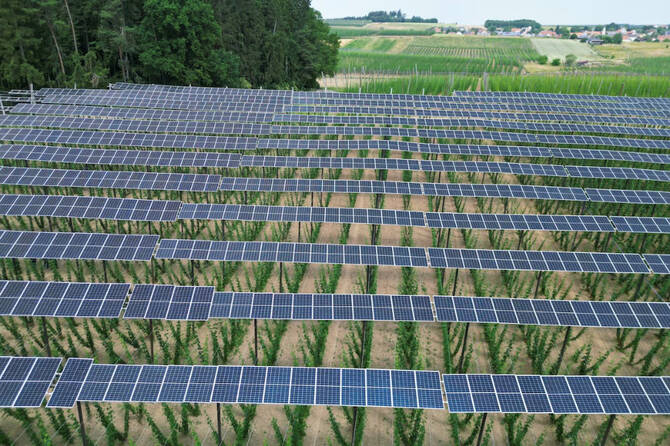
Europe’s decarbonization strategy has for years rested on a deceptively simple proposition: outsource the most energy-intensive parts of the green transition to regions blessed with superior natural endowments.
North Africa, with its vast solar irradiation and consistent wind corridors, emerged as the ideal partner. A vision took hold in Brussels, Berlin and The Hague, one in which electrons generated in the Sahara would be transformed into green hydrogen and shipped north to power European industry. Geography, in that narrative, would solve the problems of politics, economics and physics in a single stroke.
Events so far this year have strained that assumption. A fragile ceasefire agreement in the US-Israeli war with Iran might have temporarily lowered the temperature, but underlying risks remain unresolved. For instance, insurance premiums for Red Sea shipping have not fully normalized. Freight costs, while down from their peak, remain elevated. Supply chains continue to price in possible disruptions.
Energy systems built on thin margins cannot easily absorb such volatility. Europe’s externalized energy model now faces a deeper question: whether its “green battery” was ever structurally capable of delivering stable power in the first place.
At the heart of the problem lies a mismatch between ambition and material reality. About 350 gigawatts of prospective wind and solar capacity are tracked across Africa, a tenfold increase over the current installed capacity. Yet nearly two-thirds of that pipeline, about 216 gigawatts, is earmarked for green hydrogen production, much of it intended for export to Europe rather than domestic consumption. Such an allocation reflects a strategic choice: to prioritize future export revenues over immediate energy access.
However, grid instability and dependency on fuel imports remain defining features of North Africa’s energy systems. Morocco imports 90–95 percent of its petroleum needs, exposing its fiscal balance to every fluctuation in global shipping costs and oil-refining margins. Tunisia continues to struggle with energy vulnerability tied to external supply. Egypt, despite relatively stronger infrastructure, faces rising pressures on demand that strain generation capacity.
A region positioned as Europe’s energy savior remains, in many respects, energy insecure itself.
Moreover, the scale of the plans amplifies the contradiction. Proposed hydrogen projects often dwarf the existing energy systems of their host countries. Mauritania, for example, which has less than 0.3 gigawatts of operational wind and solar capacity, has announced projects approaching 80 gigawatts in capacity. Djibouti could achieve European-level per capita electricity consumption with just a fraction of the renewable capacity currently slated for export-oriented hydrogen. Such figures suggest speculative overreach rather than incremental expansion.
On the infrastructure side, hydrogen is not a plug-and-play commodity. Transport requires either dedicated pipelines, many of which do not yet exist, or conversion into derivatives such as ammonia, which introduces additional costs and inefficiencies.
Existing gas pipelines are often unsuitable without extensive retrofitting. Port infrastructure capable of handling large-scale hydrogen or ammonia exports remains largely conceptual. Studies indicate that only a small percentage of potential export sites can compete economically once transport and conversion costs are included.
Water scarcity introduces yet another layer of complexity. Producing a kilogram of green hydrogen requires up to 30 liters of water. In already arid North Africa, large-scale hydrogen production would necessitate desalination, at significant financial and energy costs.
In addition, trade-offs become unavoidable. Water allocated to hydrogen exports is water unavailable for agriculture, urban consumption or industrial diversification. Such trade-offs risk embedding structural imbalances into already stressed resource systems.
Until strategy aligns with material conditions on the ground, the battery will remain undercharged.
Hafed Al-Ghwell
Besides all of this, consider the following: Energy investment per capita in Europe exceeds that of Sub-Saharan Africa by a factor of more than 40. The annual funding requirement for universal electrification across Africa is estimated at between $60 billion and $90 billion, yet actual mobilization so far remains far below that.
Large hydrogen projects, often backed by foreign developers, risk reinforcing patterns of external dependency. In turn, revenue is accrued primarily at the point of consumption, meaning that export-oriented models capture limited value locally. Without strong domestic industrial integration, for example green steel or fertilizer production, North Africa risks repeating old extractive patterns under a new “low-carbon” label.
Current geopolitical developments have exacerbated these vulnerabilities. Even with a temporary ceasefire in place in the US-Israeli conflict with Iran, the strategic choke points that underpin global energy flows remain exposed. As a result, insurance premiums can triple within days and shipping delays ripple through supply chains.
For North African economies reliant on imported refined fuels, such disruptions translate into immediate fiscal stress. For Europe, dependence on distant hydrogen supply chains introduces a new layer of exposure, one that mirrors, rather than replaces, the previous reliance on Russian gas.
A deeper issue concerns strategic sequencing. Europe’s external hydrogen strategy assumes that large-scale production, transport infrastructure and end-use demand will develop in parallel. The historical experience in energy markets suggests otherwise.
Oil, gas and electricity systems evolved through decades of coordinated investment, regulatory alignment, and formation of demand. Hydrogen, in contrast, is being advanced through simultaneous bets across the entire value chain. Failure at any single node could stall the entire system.
Meanwhile, smaller-scale alternatives continue to demonstrate immediate impacts. Distributed solar installations, minigrids and hybrid systems have delivered measurable gains in energy access and local income in Africa. Projects as small as 50 kilowatts have been shown to increase household income by up to two-thirds in some contexts.
Hundreds of such systems have already been deployed across the continent, reaching millions of people. The economics of such projects are straightforward, the timelines short and the benefits locally retained. Yet capital allocation remains skewed toward large, export-oriented ventures with uncertain returns.
A rebalancing of priorities is unavoidable. Europe’s decarbonization goals are legitimate and urgent. North Africa’s renewable potential is real and substantial. Alignment between the two requires a shift away from extraction toward integration.
Local grids must be strengthened before export corridors are expanded. Industrial value chains should be developed in situ, capturing more economic value within producing countries. Risk-sharing mechanisms need to reflect asymmetries in financial capacity and exposure. Technology transfers must move beyond rhetoric into tangible capability building.
Energy partnerships built on such principles would still allow for hydrogen exports, but as a byproduct of domestic resilience rather than a substitute for it. A region capable of reliably powering its own economies would, by definition, be a more credible supplier to external markets. Conversely, a region struggling with energy access and infrastructure deficits cannot sustainably underpin another continent’s transition.
Europe’s “green battery” has not failed for lack of sunlight or wind. Failure has emerged from a misreading of systems: economic, political and physical.
The potential of renewables does not automatically translate into exportable energy security. Infrastructure cannot be willed into existence through policy targets alone. Markets do not materialize without credible demand.
Until strategy aligns with material conditions on the ground, the battery will remain undercharged, capable of generating headlines but not of delivering the dependable power that Europe’s transition ultimately requires.
• Hafed Al-Ghwell is senior fellow and program director at the Stimson Center in Washington and senior fellow at the Center for Conflict and Humanitarian Studies.
X: @HafedAlGhwell
Disclaimer: Views expressed by writers in this section are their own and do not necessarily reflect Arab News’ point-of-view


