

Producing clean energy using seawater, without consuming fresh water or polluting the ocean: this is what Hychor promises, a company derived from the University of Aberdeen, in the United Kingdom. The company has developed a low-cost technology that generates green hydrogen directly from seawater, without the expensive desalination step.
The innovation addresses a significant bottleneck in the energy transition. Traditional hydrogen production by electrolysis is expensive and consumes a lot of fresh water: generating just two kilograms of fuel requires more than 32 liters of potable water. Using seawater directly, therefore, could unlock the large-scale use of hydrogen.
Why green hydrogen is still a challenge
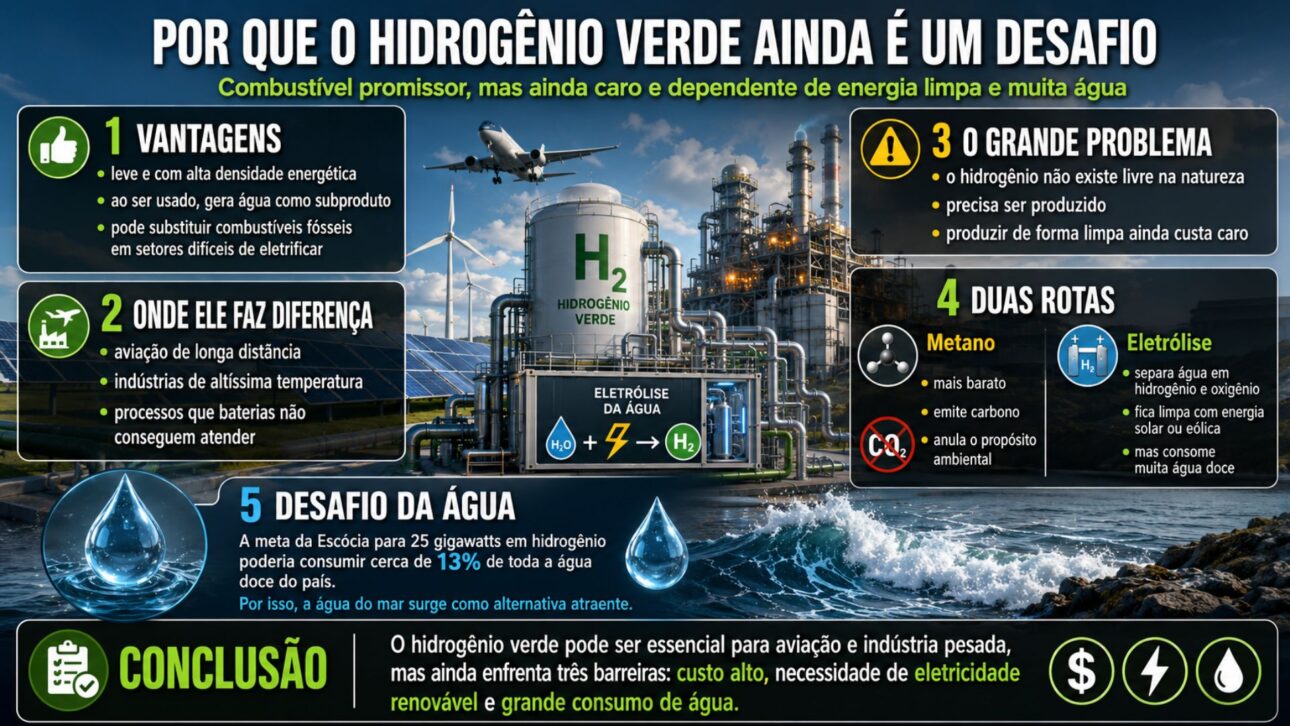
Hydrogen is quite a fuel: light, with an energy density superior to fossil fuels, and when burned, it releases only water as a byproduct.
The problem is that it does not exist freely in nature and needs to be produced. Batteries can handle household appliances and electric cars, but not make an airplane cross continents or drive high-temperature industrial processes, precisely where green hydrogen would come in as an alternative.
The issue is that producing it cleanly is expensive. A cheap route, methane dehydrogenation, emits carbon and defeats the purpose.
The other, electrolysis, separates water into hydrogen and oxygen using electricity and remains clean when powered by solar or wind energy, but it strains fresh water reserves.
To give an idea, Scotland’s goal of producing 25 gigawatts in hydrogen would consume about 13% of the country’s entire freshwater, an unsustainable volume that makes seawater an attractive alternative.
How Hychor produces hydrogen from seawater
The major obstacle to using seawater has always been chlorine. During electrolysis, this highly corrosive gas is generated and destroys the electrolyzer, and avoiding it usually makes the process more expensive.
Instead of trying to solve the problem by changing materials, the founder and CEO of Hychor, Dr. Jani Shibuya, decided to rethink the entire electrolysis system.
The turning point was to stop fighting the salts in seawater and start using them to advantage, leveraging them to facilitate conductivity.
Graduated from the University of Aberdeen, where he researched electrocatalysts, flow batteries, and desalination during his doctorate, Shibuya named the technology HySET.
The exact details of the electrolyzer are being kept secret, as the patent application is still pending, but the company assures that the system does not require additives nor generates unnecessary by-products. This approach supports the promise of cheaper green hydrogen.
Less freshwater and a more protected ocean
Besides the cost, there is an important environmental gain. Other attempts to generate hydrogen with seawater depend on desalination, which produces a polluting brine that needs to be carefully disposed of.
According to Hychor, their process increases the concentration of seawater by less than 1%, making it safe to return the treated water directly to the source without harming the marine environment.
The system was also designed to operate on-site and off-grid, combining electrolysis with an embedded seawater flow battery capable of stabilizing the intermittent generation of renewable sources.
For Shibuya, the technology tackles two of the planet’s biggest challenges at the same time, energy security and water scarcity, by dispensing with an increasingly contested resource, freshwater.
When it arrives and what still needs to be proven
The company is advancing quickly, but there is still a way to go. After a round of investment, Hychor formalized the spin-out and opened a research and development center in Aberdeen at the beginning of May 2026.
Founded in 2024 by Shibuya, it now includes co-founder and COO Alex Colledge and a small team, with plans to start industrial pilot projects in 2027, aimed at coastal communities and off-grid industries.
Caution is always advisable. The direct electrolysis of seawater is a notoriously difficult field, marked by corrosion, scaling, and the chlorine issue, and many of the announced advantages are promises from Hychor itself, still transitioning from the laboratory to pilot scale.
If the technology from the University of Aberdeen delivers on its promises, it could make green hydrogen more accessible and save potable water. But, like all recent innovations, only real-world operation will tell if it holds up beyond theory.
Transforming seawater into clean fuel, without using fresh water, seems to solve two problems at once, if it gets out of the laboratory.
Tell us in the comments if you believe that green hydrogen made from seawater will take off or if you still bet on other sources of clean energy.
Source link


