

Green hydrogen takes centre stage in global energy transition
As energy transition policies shift focus from the power sector to hard-to-abate end-use sectors, green hydrogen and green ammonia are increasingly emerging as essential decarbonisation vectors rather than optional alternatives.
The hard-to-abate sectors—steel, chemicals, refining, shipping and long-distance transport—together account for around 40 per cent of global greenhouse gas emissions and have limited electrification potential.
The shift, embedded in binding policy frameworks across major consuming economies, presents a significant opportunity for exporters.
The European Union, under REPowerEU and the RFNBO (Renewable Fuel of Non-Biological Origin) regime, aims for 20 MTPA of renewable hydrogen consumption by calendar year 2030, of which 10 MTPA is to be met through imports. Japan’s Basic Hydrogen Strategy targets combined hydrogen and ammonia demand of ~3 MTPA by calendar year 2030 and ~12 MTPA by calendar year 2040, with imports forming the dominant share. South Korea’s Clean Hydrogen Portfolio Standard under its Carbon Neutrality Act mandates progressive uptake of clean hydrogen in power generation and industry through the 2030s.
Hydrogen targets anchoring decarbonisation pathways
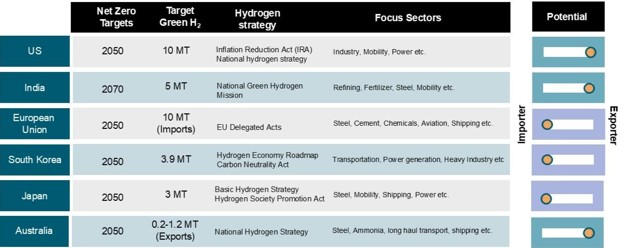
Note: Hydrogen targets mentioned are till calendar year 2030. Potential indicates whether a region’s hydrogen volumes would be import- or export-driven (e.g., much of Japan’s ~3 MT is expected to be import-driven).
Source: Government reports, Crisil Intelligence
However, domestic supply is structurally constrained in Europe and north-east Asia, since lower and variable renewable capacity factors, land & grid limitations, and persistently high power costs restrict the development of large-scale, low-cost, high-utilisation renewable-to-hydrogen systems. Even with accelerated policy support, producing certification-compliant green hydrogen is expected to be costlier in these regions than in renewable-rich geographies in the medium term.
This demand–supply asymmetry points to an import-oriented structure for the hydrogen and ammonia market, similar to the early phase of the liquefied natural gas market development—where a small group of low-cost, infrastructure-ready countries accounted for the bulk of the global exports. Delivered cost, access to port-linked infrastructure, shipping distance to major demand centres and compliance with evolving certification regimes (such as RFNBO) are expected to result in supply being concentrated in a limited set of geographies that can combine scale, competitiveness and execution readiness.
India’s positioning as a serious hydrogen market player
India is among the few geographies where the core elements required for participation in this emerging market are coming together at scale. By 2025, renewable energy accounted for over 50 per cent of installed power capacity. International benchmarks consistently place Indian utility-scale solar and onshore wind in the lower global cost quartile, comparable to the Middle East and below the US and most European markets. Given that electricity contributes more than half of the levelised cost of green hydrogen, India has a durable structural advantage on the production cost curve.
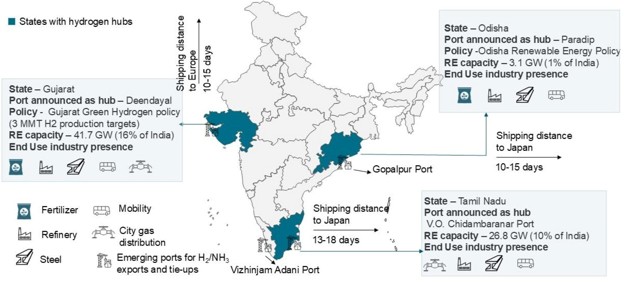
Hydrogen hubs can act as integrated centres for production, consumption and export
Source: Ministry of New and Renewable Energy, industry reports, Crisil Intelligence
Resource quality strengthens this positioning. Solar and wind capacity factors in states such as Gujarat, Rajasthan, Tamil Nadu and Karnataka support high electrolyser utilisation, particularly in hybrid systems with storage. Several of these high-capacity utilisation factor (CUF) zones are located close to deep-water ports and are positioned to become hydrogen export clusters through state policies providing capital subsidies, land facilitation, transmission and duty waivers. Co-location of renewable power generation, electrolysis and ammonia synthesis with export terminals reduces transmission bottlenecks, lowers balance-of-plant costs and shortens inland logistics, directly improving delivered economics.
Geography further reinforces competitiveness. Sailing time from India’s west coast to north-west Europe (10-15 days) and from the east coast to Japan and South Korea (8-12 days) is comparable to that from the Middle East and shorter than that from Australia or Chile. For ammonia-led trade, where shipping and storage can account for a meaningful share of cost, insurance and freight, shorter routes translate into lower freight, faster inventory turns and higher supply reliability.
This is also reflected in emerging bilateral and commercial corridors, including the India–Japan clean hydrogen and ammonia partnership, initial green ammonia offtake agreements with Japanese and European utilities, and port-linked agreements with Singapore and east Asian players, which provide early demand signals, standards alignment and port-to-port logistics pathways for future trade flows.
Exports can anchor early scale for India
India’s hydrogen ecosystem is characterised by a large prospective domestic market and a developing export opportunity. The country is the world’s third-largest hydrogen consumer, with over 8 MTPA used in refining and fertiliser production—priority targets under the National Green Hydrogen Mission with initial tenders and policy instruments already underway. Capacity additions in steel, expansion of the city gas distribution network and early pilots in mobility and industrial heating are expected to broaden the domestic demand base for low-carbon hydrogen and derivatives in the medium term.
In the near term, stringent decarbonisation mandates, import targets and higher willingness to pay in overseas markets—Europe, Japan and South Korea—are expected to provide the initial anchor for large, export-oriented projects. Export-linked offtake enables early scale-up of renewable and electrolyser capacity, supports higher utilisation and accelerates learning-curve effects in equipment and project execution. Over time, these scale effects and technology cost reductions are expected to lower the delivered cost of green hydrogen and ammonia to levels that allow wider adoption across domestic refining, fertilisers, steel and gas networks.
This interaction creates a complementary dynamic rather than a trade-off: export markets facilitate early scale and price discovery, while the domestic market provides long-term volume depth and demand stability. Few competing export hubs combine both attributes at comparable scale, giving India an inherent option value and resilience in the evolution of its hydrogen economy.
Regulatory alignment and offtake maturation will shape export realisation
The pace at which India’s export ambitions translate into sustained volumes will be governed by regulatory and commercial alignment in importing regions and the availability of scalable resources. These aspirations face the following bottlenecks:
Evolving definitions and certification frameworks: There is no harmonised global definition of green hydrogen and its derivatives. India’s Green Hydrogen Certification Scheme is anchored in an emissions-intensity threshold, whereas key importing regions—notably the European Union under the RFNBO framework—define eligibility through production-pathway and power-sourcing rules, including additionality, system boundaries and traceability. This divergence creates uncertainty around cross-recognition of certificates and the eligibility of source-country molecules under legally binding import mandates and support schemes.
Scale of renewable capacity and availability: Export-oriented green hydrogen & ammonia production and domestic consumption at scale will require large and time-bound additions of renewable capacity of ~125 GW, aligned with the National Green Hydrogen Mission’s production targets, against the current installed base of ~254* GW. Mobilising such capacity will depend on the availability of suitable land, timely development of transmission and evacuation infrastructure, depth of domestic manufacturing in solar, wind and electrolyser supply chains and development of port-linked renewable corridors in coastal states. The ability to ensure stable availability of renewable power, through hybridisation, grid balancing and storage, will also be important to sustain electrolyser utilisation and competitive export economics.
Long-term offtake and bankability: While import targets and policy mandates have been articulated, binding, long-tenure offtake has been slower, reflecting the phased roll-out and slippage of sectoral decarbonisation milestones, such as in maritime fuels and renewable deployment. A large share of engagements remain at the level of memorandums of understanding or pilot-scale procurement rather than long-term contracts. The availability of anchor buyers providing volume and price visibility over the asset life will be a key determinant of when large export-oriented projects move from development to financial closure.
Price discovery and contract standardisation: Global green hydrogen and green ammonia trade is still in the early stages of price formation and contract structuring. While domestic tenders and overseas support mechanisms have indicated production and delivered cost ranges, there is no widely accepted benchmark price or standard contract format covering conversion, shipping, storage, carbon attributes and risk allocation. India’s recent green ammonia tender provides a price signal, but the absence of large-scale, long-tenure and internationally benchmarked contracts limits price discovery and trade continues to be structured on a bespoke rather than liquid, standardised basis.
The coming years will determine how policy initiatives and project pipelines translate into sustained participation in global trade. Early progress through bilateral partnerships, industry collaborations and emerging corridors with demand centres provides a constructive foundation. How these evolve into scaled infrastructure, long-term offtake and stable trade frameworks will shape India’s role in the global low-carbon molecule flows.


