

RESEARCH METHODOLOGY
The study involved four major activities in estimating the current size of the hydrogen truck market. Exhaustive secondary research was done to collect information on the market, the peer market, and the child markets. The next step was to validate these findings, assumptions, and sizing with the industry experts across value chains through primary research. The top-down and bottom-up approaches were employed to estimate the complete market size. Thereafter, market breakdown and data triangulation processes were used to estimate the market size of segments and subsegments.
Secondary Research
In the secondary research process, various secondary sources such as company annual reports/presentations, press releases, industry association publications [for example, International Organization of Motor Vehicle Manufacturers (OICA), National Highway Traffic Safety Administration (NHTSA), International Energy Association (IEA)], articles, directories, technical handbooks, trade websites, technical articles, and databases (for example, Marklines, and Factiva) have been used to identify and collect information useful for an extensive commercial study of the global hydrogen truck market.
Primary Research
Extensive primary research was conducted after understanding the scenario of the hydrogen truck market through secondary research. Several primary interviews were conducted with market experts from both the demand (OEMs) and supply (fuel cell component providers, hydrogen integrators, and other component manufacturers) across three major regions: North America, Europe and Asia Pacific. Approximately 52% and 48% of primary interviews were conducted from the demand and supply sides. Primary data was collected through questionnaires, emails, and telephonic interviews.
In the canvassing of primaries, various departments within organizations, such as sales, operations, and administration, were covered to provide a holistic viewpoint in this report. After interacting with industry experts, brief sessions with highly experienced independent consultants were also conducted to reinforce the findings from primaries. This and the in-house subject-matter experts’ opinions led to the findings described in the remainder of this report.
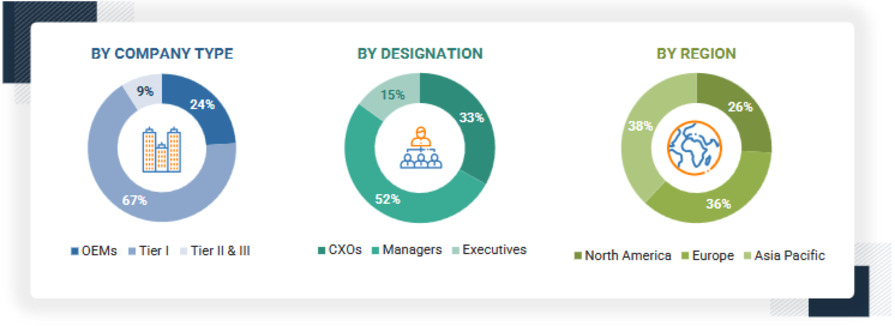
To know about the assumptions considered for the study, download the pdf brochure
Market Size Estimation
Both top-down and bottom-up approaches were used to estimate and validate the total size of the hydrogen truck market. These methods were also used extensively to estimate the size of various subsegments in the market. The research methodology used to estimate the market size includes the following:
BOTTOM-UP APPROACH
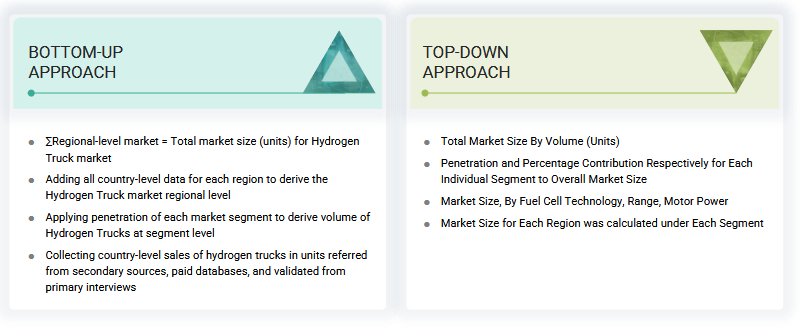
To know about the assumptions considered for the study, Request for Free Sample Report
Data Triangulation
After arriving at the overall market size of the global market through the above-mentioned methodology, this market was split into several segments and subsegments. The data triangulation and market breakdown procedure were employed to complete the overall market engineering process and arrive at the exact market value data for the key segments and subsegments, wherever applicable. The extrapolated market data was triangulated by studying various macro indicators and regional trends from both the demand- and supply-side participants.
Market Definition
Hydrogen Bus and Truck refers to heavy-duty vehicles powered by hydrogen fuel cells. A hydrogen fuel cell generates electricity through a chemical reaction between hydrogen and oxygen, which then powers the vehicle’s electric motor. Hydrogen buses offer zero-emission transportation, helping to reduce air pollution in urban areas. They can be quickly refueled and provide a range comparable to or better than traditional diesel buses. Hydrogen trucks are designed for various applications, such as long-haul transportation, construction, and delivery services. They provide the benefits of zero emissions and can be refueled quickly, making them an effective alternative to diesel and CNG trucks.
List of Key Stakeholders
-
Automotive Blogs -
Automotive Component Manufacturers Association (ACMA) -
Automotive Electronics Council (AEC) -
Automotive Fuel Cell Providers -
Automotive Magazines -
Automotive Original Equipment Manufacturers (OEMs) -
Company Websites -
Corporate Filings (such as Annual Reports, Investor Presentations, and Financial Statements) -
Country-level Automotive Associations -
Databases such as Factiva, Marklines and Bloomberg -
Department of Transportation (DoT) -
EAFO (European Alternative Fuels Observatory) -
Electric Vehicle Association of Asia Pacific (EVAAP) -
Environmental Protection Agency (EPA) -
European Automobile Manufacturers Association (ACEA) -
Freight Transport Association -
Fuel Cell and Hydrogen Energy Association (FCHEA) -
German Association of the Automotive Industry (VDA) -
Government & Research Organizations -
Hydrogen Council -
International Council on Clean Transportation (ICCT) -
International Electrotechnical Commission (IEC) -
International Energy Agency (IEA) -
International Energy Agency (IEA) -
International Organization of Motor Vehicle Manufacturers (OICA) -
National Electrical Manufacturers Association (NEMA) -
National Highway Traffic Safety Administration (NHTSA) -
National Institute of Standards and Technology (NIST) -
Navigation Data Standard Association -
Organisation for Economic Co-Operation and Development (OECD) -
Organisation Internationale des Constructeurs d’Automobiles (OICA) -
Other Automotive-related Paid and Free Databases -
System Integrators -
The Alternative Fuels Data Center (AFDC) -
Trade, Business, and Related Associations -
Webinars
Report Objectives
-
To analyze and forecast the Hydrogen truck market in terms of value (USD million) and volume (thousand units) from 2024 to 2035 -
To segment the market by vehicle type, by motor power, by range, by fuel cell technology, tank size, type of tank, and region-
To segment and forecast the market size by volume based on Vehicle Type (Hydrogen Bus, Hydrogen Truck) -
To segment and forecast the market size by volume based on Motor Power (Less than 200 KW, 200-400 KW, More than 400 KW) -
To segment and forecast the market size by volume based on Type of Tank (Tank 3, Tank 4) -
To segment and forecast the market size by volume based on Range (Upto 300 Miles, Between 300-500 Miles, Above 500 Miles) -
To segment and forecast the market size by volume based on Hydrogen tank size (<30 Kg, 30–60 Kg, >60 Kg) -
To segment and forecast the market size by volume based on Fuel Cell Technology (Proton Exchange Membrane Fuel Cell (PEMFC), Solid Oxide Fuel Cell (SOFC)) -
To segment and forecast the market by volume based on region (Asia Pacific, Europe, and North America)
-
-
To provide detailed information about the factors influencing the market growth (drivers, challenges, restraints, and opportunities) -
To strategically analyze the market for individual growth trends, prospects, and contributions to the total market -
To study the following with respect to the market-
Value Chain Analysis -
Ecosystem Analysis -
Technology Analysis -
Trade Analysis -
Pricing Analysis -
Case Study Analysis -
Patent Analysis -
Tariff and Regulatory Landscape -
Key Stakeholders and Buying Criteria -
OEM vs. Existing and upcoming hydrogen vehicle models -
Country-level targets of electric & hydrogen bus/truck and stations -
Investment and funding scenario -
Funding by use case application
-
-
To strategically profile the key players and comprehensively analyze their market share and core competencies -
To analyze the opportunities for stakeholders and the competitive landscape for market leaders -
To track and analyze competitive developments such as deals, product launches/developments, expansions, and other activities undertaken by the key industry participants
AVAILABLE CUSTOMIZATIONS
With the given market data, MarketsandMarkets offers customizations in line with company-specific needs.
-
Hydrogen truck Market, By Vehicle Class at Regional Level -
Hydrogen truck Market, Additional Countries (Up to 3) -
Profiling of additional market players (Up to 3)


