The EIC is a trade associations for companies that supply goods and services to the energy industries worldwide. In its new report it noted that “Europe is aiming to become a leader in renewable hydrogen production as well a major importer to increase hydrogen’s role in the future energy mix and aid in reaching net zero”. But while the European Union (EU), its member states and the UK have all established hydrogen targets, it is “very unlikely that any of these 2030 targets will be met, based on current market conditions which have impacted progress”.
EIC’s own data found that of 624 projects announced since 2020 to produce and transport hydrogen, just 59 have entered operation and 74 have been cancelled. Overall, 47 per cent of projects remain in the feasibility stage with just 19 per cent pending and under construction and 15 per cent of projects on hold.
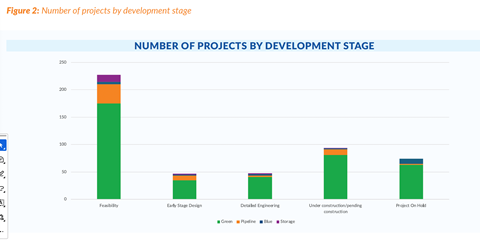
Germany has the most ambitious plans and aims to install a 9,000km hydrogen network which would link with proposed pipelines in Denmark, the Czech Republic, France, the Netherlands, and Poland. Other pipelines are proposed to link European hydrogen production in North Africa with users in Europe. But EIC says its data show most pipeline projects are still in the feasibility stage. It says, “This highlights the infrastructure challenge in getting projects online at the same time as production projects” so hydrogen can be transported to end-users.
On the availability of green hydrogen, EIC considered electrolyser projects expected to come online in 2026-2035. It said: “In reality, the capacity will not reach the projected levels with more projects being paused or even cancelled” because the market is moving too slowly to justify taking a final investment decision. Among the concerns cited by EIC were:
• The cost of green hydrogen ($3.5-7/kg) compared with grey hydrogen ($1-3.5/kg)
• The need to expand hydrogen pipelines and storage, which “remain small-scale”
• The lack of long-term offtake agreements, required to take a final investment decisions
• Regulatory uncertainty
• The timelines of funding support schemes
• Competition for the renewable energy required for electrolysis
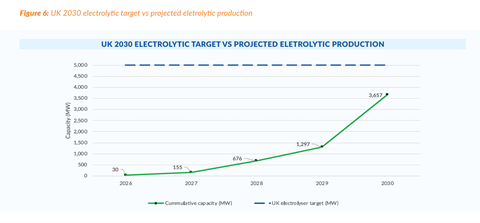
Regarding the UK, the report said that a target of 10GW of low-carbon hydrogen production by 2030, set in 2022, under the previous Conservative government, “will not be met”.
The specific target for 5GW of electrolyser capacity would be more than 1GW short.
EIC added that, “A revised [UK] hydrogen strategy was to be released in Autumn 2025 but there have been no updates from the government as to when this will be released”.