

As the world’s data center capital, Virginia faces a surge in energy demand that could spike power costs and lead to more polluting fossil fuel plants. At the same time, the state is seeing its farmland disappear at one of the fastest rates in the United States.
The two problems may seem unrelated, but Old Dominion leaders believe they could be mitigated by a common solution: Use the same plot of land for both farming and solar panels. That’s the idea behind a new state law that officially defines “agrivoltaics,” the dual use of land for agriculture and solar photovoltaics.
Proponents say the measure will spur more affordable, clean power to meet rising electricity needs while also helping farmers earn a living. Virginia is just the fourth state in the country to pass an agrivoltaics law.
“For years, the conventional wisdom has forced us into a zero-sum game, viewing solar panels as a replacement for crops rather than a partner to them,” said Josephus Allmond, the chief energy officer for Gov. Abigail Spanberger, a Democrat, at a June bill-signing event in Loudoun County. “Today, we are rejecting that false choice. Agrivoltaics moves us from an either-or mindset to a both-and function.”
“Bring this abandoned farmland back”
The new law, which passed the Democratic-led General Assembly early this year with bipartisan support, is taking effect as power-hungry data centers and large-scale solar fields have become flashpoints in Virginia and across the country.
Hundreds of data centers have already set up shop in the state, lured in part by generous tax credits. The giant computer warehouses have polluted the air and threatened to overwhelm the grid. Dominion Energy, the state’s largest utility, estimates that the facilities could make up over half its sales by 2035. Legislators this year debated but failed to adopt incentives or mandates for tech companies to build their own clean energy.
Experts say solar is the cheapest, quickest way to meet the colossal needs of large electric customers like data centers. Plus, a 2020 law requires the state’s two largest utilities to build more than 16 gigawatts of land-based renewable energy, mostly solar, on their way to zero-carbon emissions by midcentury.
But early solar developers who failed to control their sediment pollution, combined with rampant disinformation, have helped tarnish the reputation of large projects. Though studies show that housing developments are bigger culprits, solar has emerged as a popular scapegoat for Virginia’s rapid loss of farmland. As of early this year, nearly two-thirds of Virginia counties outlawed or severely restricted large-scale solar.
There’s no evidence to suggest that solar panels ruin soil, and even without agrivoltaics, many farmers happily lease a portion of their property to renewable developers for extra income to help their businesses pencil out. But there’s no denying that solar panels are changing the state’s landscape: The vast bulk of large-scale solar energy is now on converted forest or farmland, and its footprint could triple to over 3% of former cropland alone by 2035, according to research from Virginia Commonwealth University.
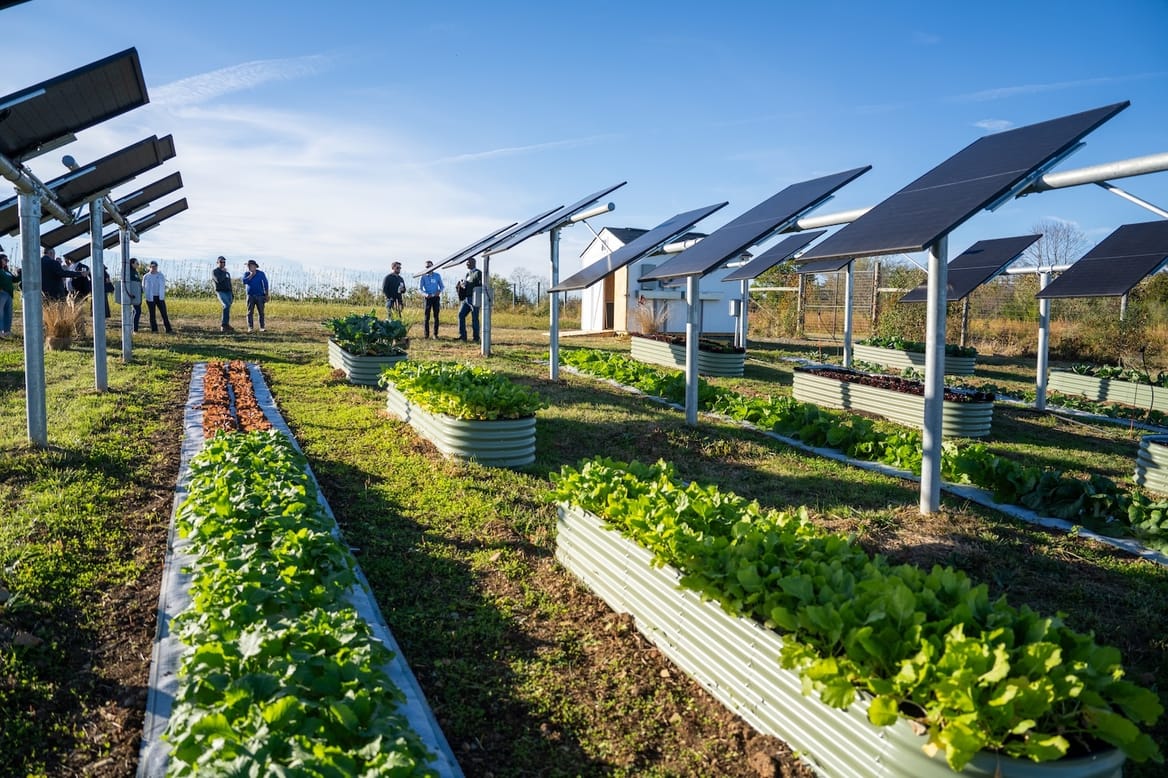
Agrivoltaics, proponents say, can mitigate that expanding footprint. Sheep and other livestock can graze beneath solar panels — helping enrich the soil and stopping it from running off into waterways. Eggplant, kale, and other crops can also grow well under panels — something the Piedmont Environmental Council is demonstrating at its test farm in Loudon County. Some 13 agrivoltaics projects operate in the state today, according to the National Laboratory of the Rockies.
The dual use of agricultural land isn’t just about alleviating the impact — perceived or real — of solar panels. Jess Gray, CEO of Gray’s Lambscaping, says it’s also about creating new opportunities for small-business owners like herself. She and her husband sold their house and started a family farm five years ago in Pittsylvania County, in south-central Virginia. They began raising a variety of animals — sheep, chickens, cattle — hoping the venture would be self-sufficient. “The truth is, it’s hard to be a farmer,” Gray said. “Nobody likes to talk about that.”
They initially used their sheep for meat and for “cleaning up” the ground cover on their farm. But they soon realized they could boost their income by offering grazing to manage vegetation on solar fields. Today, their 1,500-some ewes service about 4,000 acres of solar panels, from their home farm all the way to Chesapeake. “We’ve grazed to the beach and back,” she said. The result is revenue they can reinvest in their farming operation. “We use our sheep to buy our cows,” she said. Very quickly, they went from two cows to 50. “We were on this 10-year plan that happened in two years.”


